Immunoglobulin heavy constant epsilon (Ig epsilon chain C region) (Ig epsilon chain C region ND)
1_ASTQS 6_ PSVFP 11_ LTRCC 16_ KNIPS 21_ NATSV 26_ TLGCL 31_ ATGYF 36_ PEPVM 41_ VTWDT 46_ GSLNG 51_ TTMTL 56_ PATTL 61_ TLSGH 66_ YATIS 71_ LLTVS 76_ GAWAK 81_ QMFTC 86_ RVAHT 91_ PSSTD 96_ WVDNK 101_ TFSVC 106_ SRDFT 111_ PPTVK 116_ ILQSS 121_ CDGGG 126_ HFPPT 131_ IQLLC 136_ LVSGY 141_ TPGTI 146_ NITWL 151_ EDGQV 156_ MDVDL 161_ STAST 166_ TQEGE 171_ LASTQ 176_ SELTL 181_ SQKHW 186_ LSDRT 191_ YTCQV 196_ TYQGH 201_ TFEDS 206_ TKKCA 211_ DSNPR 216_ GVSAY 221_ LSRPS 226_ PFDLF 231_ IRKSP 236_ TITCL 241_ VVDLA 246_ PSKGT 251_ VNLTW 256_ SRASG 261_ KPVNH 266_ STRKE 271_ EKQRN 276_ GTLTV 281_ TSTLP 286_ VGTRD 291_ WIEGE 296_ TYQCR 301_ VTHPH 306_ LPRAL 311_ MRSTT 316_ KTSGP 321_ RAAPE 326_ VYAFA 331_ TPEWP 336_ GSRDK 341_ RTLAC 346_ LIQNF 351_ MPEDI 356_ SVQWL 361_ HNEVQ 366_ LPDAR 371_ HSTTQ 376_ PRKTK 381_ GSGFF 386_ VFSRL 391_ EVTRA 396_ EWEQK 401_ DEFIC 406_ RAVHE 411_ AASPS 416_ QTVQR 421_AVSVN
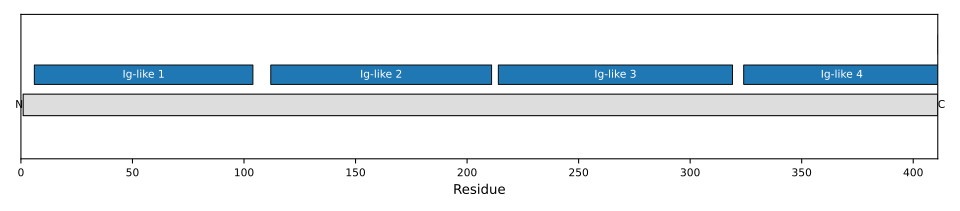
1: Constant region of immunoglobulin heavy chains. Immunoglobulins, also known as antibodies, are membrane-bound or secreted glycoproteins produced by B lymphocytes. In the recognition phase of humoral immunity, the membrane-bound immunoglobulins serve as receptors which, upon binding of a specific antigen, trigger the clonal expansion and differentiation of B lymphocytes into immunoglobulins-secreting plasma cells. Secreted immunoglobulins mediate the effector phase of humoral immunity, which results in the elimination of bound antigens (PubMed:20176268, PubMed:22158414). The antigen binding site is formed by the variable domain of one heavy chain, together with that of its associated light chain. Thus, each immunoglobulin has two antigen binding sites with remarkable affinity for a particular antigen. The variable domains are assembled by a process called V-(D)-J rearrangement and can then be subjected to somatic hypermutations which, after exposure to antigen and selection, allow affinity maturation for a particular antigen (PubMed:17576170, PubMed:20176268)
2: Constant region of secreted IgE, also known as the Fc region of IgE antibody. Mediates IgE effector functions on myeloid and lymphoid cells primarily via two Fc receptors, the high-affinity IgE Fc receptor complex/FCER1A:MS4A2:FCGR1A and the low-affinity FCER2 receptor, which upon antigen/allergen cross-linking initiate signaling pathways that lead to immune cell activation and differentiation (PubMed:2167225, PubMed:25629393, PubMed:33840121, PubMed:7544003, PubMed:8114916, PubMed:8551243). Triggers the immediate hypersensitivity response to allergens as a host defense mechanism against helminth parasites, pathogenic bacteria and venom toxicity. When dysregulated, it can elicit harmful life-threatening allergic and anaphylactic reactions (PubMed:25629393, PubMed:33840121, PubMed:7544003, PubMed:8114916, PubMed:8551243). Stimulates the high-affinity IgE Fc receptor complex/FCER1A:MS4A2:FCGR1A on mast cells, basophils and eosinophils leading to secretion of vasoactive amines, lipid mediators and cytokines that contribute to inflammatory response, tissue remodeling and cytotoxicity against microbes (PubMed:25629393, PubMed:8114916, PubMed:8551243). On macrophages, cross-linking of FCER2 by IgE immune complexes induces intracellular killing of parasites through activation of L-Arginine-nitric oxide pathway (PubMed:7544003). Activates macrophages to kill tumor cells via antigen-specific antibody-dependent cytotoxicity (ADCC). Triggers differentiation of quiescent M0 macrophages toward M1 state and reprograms M2 macrophages toward a proinflammatory state with antitumor functions (PubMed:30956175). Stimulates FCER2 on B cells and initiates IgE-dependent antigen uptake and presentation to T cells (PubMed:2167225)
3: Constant region of membrane-bound IgE (long mIgE), part of the B cell receptor complex (BCR). Upon antigen cross-linking triggers quick BCR signaling, ensuring survival of IgE-switched B cells and differentiation into plasma cells, thus regulating both primary and memory IgE responses
4: Constant region of membrane-bound IgE (short mIgE), part of the B cell receptor complex (BCR). Upon antigen cross-linking initiates slower but sustained BCR signaling that negatively regulates mature B cell proliferation