Immunoglobulin heavy constant gamma 1 (Ig gamma-1 chain C region) (Ig gamma-1 chain C region EU) (Ig gamma-1 chain C region KOL) (Ig gamma-1 chain C region NIE)
1_ASTKG 6_ PSVFP 11_ LAPSS 16_ KSTSG 21_ GTAAL 26_ GCLVK 31_ DYFPE 36_ PVTVS 41_ WNSGA 46_ LTSGV 51_ HTFPA 56_ VLQSS 61_ GLYSL 66_ SSVVT 71_ VPSSS 76_ LGTQT 81_ YICNV 86_ NHKPS 91_ NTKVD 96_ KKVEP 101_ KSCDK 106_ THTCP 111_ PCPAP 116_ ELLGG 121_ PSVFL 126_ FPPKP 131_ KDTLM 136_ ISRTP 141_ EVTCV 146_ VVDVS 151_ HEDPE 156_ VKFNW 161_ YVDGV 166_ EVHNA 171_ KTKPR 176_ EEQYN 181_ STYRV 186_ VSVLT 191_ VLHQD 196_ WLNGK 201_ EYKCK 206_ VSNKA 211_ LPAPI 216_ EKTIS 221_ KAKGQ 226_ PREPQ 231_ VYTLP 236_ PSRDE 241_ LTKNQ 246_ VSLTC 251_ LVKGF 256_ YPSDI 261_ AVEWE 266_ SNGQP 271_ ENNYK 276_ TTPPV 281_ LDSDG 286_ SFFLY 291_ SKLTV 296_ DKSRW 301_ QQGNV 306_ FSCSV 311_ MHEAL 316_ HNHYT 321_QKSLS
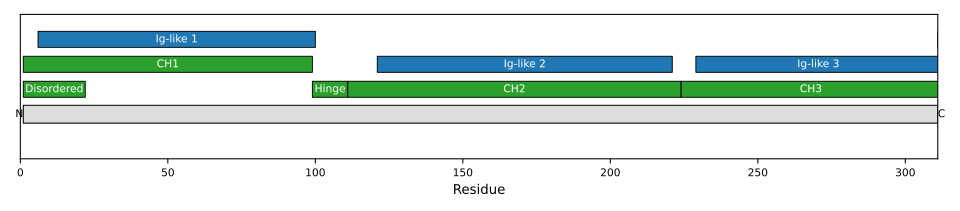
1: Constant region of immunoglobulin heavy chains. Immunoglobulins, also known as antibodies, are membrane-bound or secreted glycoproteins produced by B lymphocytes. In the recognition phase of humoral immunity, the membrane-bound immunoglobulins serve as receptors which, upon binding of a specific antigen, trigger the clonal expansion and differentiation of B lymphocytes into immunoglobulins-secreting plasma cells. Secreted immunoglobulins mediate the effector phase of humoral immunity, which results in the elimination of bound antigens (PubMed:20176268, PubMed:22158414). The antigen binding site is formed by the variable domain of one heavy chain, together with that of its associated light chain. Thus, each immunoglobulin has two antigen binding sites with remarkable affinity for a particular antigen. The variable domains are assembled by a process called V-(D)-J rearrangement and can then be subjected to somatic hypermutations which, after exposure to antigen and selection, allow affinity maturation for a particular antigen (PubMed:17576170, PubMed:20176268). Mediates IgG effector functions on monocytes triggering ADCC of virus-infected cells