Immunoglobulin heavy constant mu (Ig mu chain C region) (Ig mu chain C region BOT) (Ig mu chain C region GAL) (Ig mu chain C region OU)
1_GSASA 6_ PTLFP 11_ LVSCE 16_ NSPSD 21_ TSSVA 26_ VGCLA 31_ QDFLP 36_ DSITF 41_ SWKYK 46_ NNSDI 51_ SSTRG 56_ FPSVL 61_ RGGKY 66_ AATSQ 71_ VLLPS 76_ KDVMQ 81_ GTDEH 86_ VVCKV 91_ QHPNG 96_ NKEKN 101_ VPLPV 106_ IAELP 111_ PKVSV 116_ FVPPR 121_ DGFFG 126_ NPRKS 131_ KLICQ 136_ ATGFS 141_ PRQIQ 146_ VSWLR 151_ EGKQV 156_ GSGVT 161_ TDQVQ 166_ AEAKE 171_ SGPTT 176_ YKVTS 181_ TLTIK 186_ ESDWL 191_ GQSMF 196_ TCRVD 201_ HRGLT 206_ FQQNA 211_ SSMCV 216_ PDQDT 221_ AIRVF 226_ AIPPS 231_ FASIF 236_ LTKST 241_ KLTCL 246_ VTDLT 251_ TYDSV 256_ TISWT 261_ RQNGE 266_ AVKTH 271_ TNISE 276_ SHPNA 281_ TFSAV 286_ GEASI 291_ CEDDW 296_ NSGER 301_ FTCTV 306_ THTDL 311_ PSPLK 316_ QTISR 321_ PKGVA 326_ LHRPD 331_ VYLLP 336_ PAREQ 341_ LNLRE 346_ SATIT 351_ CLVTG 356_ FSPAD 361_ VFVQW 366_ MQRGQ 371_ PLSPE 376_ KYVTS 381_ APMPE 386_ PQAPG 391_ RYFAH 396_ SILTV 401_ SEEEW 406_ NTGET 411_ YTCVV 416_ AHEAL 421_ PNRVT 426_ ERTVD 431_ KSTGK 436_ PTLYN 441_ VSLVM 446_SDTAG
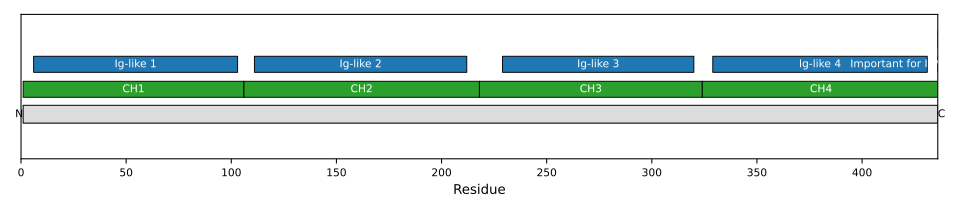
1: Constant region of immunoglobulin heavy chains. Immunoglobulins, also known as antibodies, are membrane-bound or secreted glycoproteins produced by B lymphocytes. In the recognition phase of humoral immunity, the membrane-bound immunoglobulins serve as receptors which, upon binding of a specific antigen, trigger the clonal expansion and differentiation of B lymphocytes into immunoglobulins-secreting plasma cells. Secreted immunoglobulins mediate the effector phase of humoral immunity, which results in the elimination of bound antigens (PubMed:20176268, PubMed:22158414). The antigen binding site is formed by the variable domain of one heavy chain, together with that of its associated light chain. Thus, each immunoglobulin has two antigen binding sites with remarkable affinity for a particular antigen. The variable domains are assembled by a process called V-(D)-J rearrangement and can then be subjected to somatic hypermutations which, after exposure to antigen and selection, allow affinity maturation for a particular antigen (PubMed:17576170, PubMed:20176268)
2: Constant region of secreted IgM (sIgM), also known as the Fc region of IgM antibody. Able to multimerize, forms high order polymers, mainly pentamers and occasionally hexamers, providing for multivalency and high avidity recognition of antigens (PubMed:32029689, PubMed:37095205). Natural sIgM are polyreactive and recognize conserved self- and pathogen-derived structures, whereas immune sIgM are secreted only upon exposure to pathogens and are antigen-specific. Both natural and immune sIgM are required for an efficient humoral immune response to infection (By similarity). Mediates sIgM effector functions mostly via Fc receptors and the complement system. On lymphoid cells binds high-affinity Fc receptor FCMR and promotes induction of an efficient neutralizing IgG response while maintaining tolerance to self-antigens. Recruits C1q complement component to initiate the classical complement pathway, facilitating the recognition and neutralization of pathogens by the host. Together with C1q and mannose-binding lectin promotes the phagocytosis of apoptotic cells by macrophages, ensuring the clearance of potential autoimmune epitopes from tissues (By similarity) (PubMed:12847249, PubMed:19006321, PubMed:28230186, PubMed:32029689). Involved in mucosal immunity. It is transported by transcytosis across mucosal epithelium by PIGR and secreted on the apical side in complex with PIGR secretory component to scan mucosal lining for pathogens. IgM-antigen complexes undergo FCMR-mediated retrotranscytosis across mucosal M cells toward antigen-presenting cells in mucosal lymphoid tissues (By similarity) (PubMed:32029689)
3: Constant region of membrane-bound IgM, part of the B cell receptor complex (BCR). IgM BCR provides constitutive tonic signaling for B cell survival. Mediates pre-BCR signaling that regulates B cell selection and rearrangement of Ig genes via allelic exclusion