HLA class I histocompatibility antigen, B alpha chain (Human leukocyte antigen B) (HLA-B)
1_MLVMA 6_ PRTVL 11_ LLLSA 16_ ALALT 21_ ETWAG 26_ SHSMR 31_ YFYTS 36_ VSRPG 41_ RGEPR 46_ FISVG 51_ YVDDT 56_ QFVRF 61_ DSDAA 66_ SPREE 71_ PRAPW 76_ IEQEG 81_ PEYWD 86_ RNTQI 91_ YKAQA 96_ QTDRE 101_ SLRNL 106_ RGYYN 111_ QSEAG 116_ SHTLQ 121_ SMYGC 126_ DVGPD 131_ GRLLR 136_ GHDQY 141_ AYDGK 146_ DYIAL 151_ NEDLR 156_ SWTAA 161_ DTAAQ 166_ ITQRK 171_ WEAAR 176_ EAEQR 181_ RAYLE 186_ GECVE 191_ WLRRY 196_ LENGK 201_ DKLER 206_ ADPPK 211_ THVTH 216_ HPISD 221_ HEATL 226_ RCWAL 231_ GFYPA 236_ EITLT 241_ WQRDG 246_ EDQTQ 251_ DTELV 256_ ETRPA 261_ GDRTF 266_ QKWAA 271_ VVVPS 276_ GEEQR 281_ YTCHV 286_ QHEGL 291_ PKPLT 296_ LRWEP 301_ SSQST 306_ VPIVG 311_ IVAGL 316_ AVLAV 321_ VVIGA 326_ VVAAV 331_ MCRRK 336_ SSGGK 341_ GGSYS 346_ QAACS 351_ DSAQG 356_SDVSL
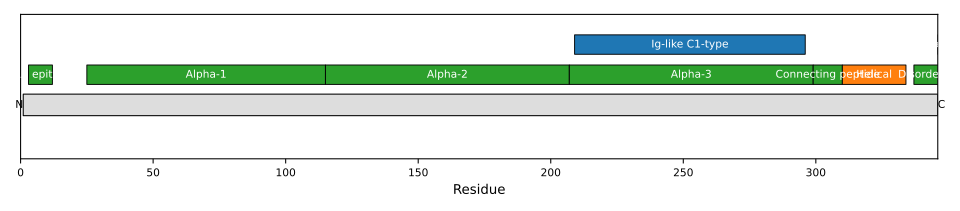
1: Antigen-presenting major histocompatibility complex class I (MHCI) molecule. In complex with B2M/beta 2 microglobulin displays primarily viral and tumor-derived peptides on antigen-presenting cells for recognition by alpha-beta T cell receptor (TCR) on HLA-B-restricted CD8-positive T cells, guiding antigen-specific T cell immune response to eliminate infected or transformed cells (PubMed:23209413, PubMed:25808313, PubMed:29531227, PubMed:9620674). May also present self-peptides derived from the signal sequence of secreted or membrane proteins, although T cells specific for these peptides are usually inactivated to prevent autoreactivity (PubMed:18991276, PubMed:7743181). Both the peptide and the MHC molecule are recognized by TCR, the peptide is responsible for the fine specificity of antigen recognition and MHC residues account for the MHC restriction of T cells (PubMed:24600035, PubMed:29531227, PubMed:9620674). Typically presents intracellular peptide antigens of 8 to 13 amino acids that arise from cytosolic proteolysis via constitutive proteasome and IFNG-induced immunoproteasome (PubMed:23209413). Can bind different peptides containing allele-specific binding motifs, which are mainly defined by anchor residues at position 2 and 9 (PubMed:25808313, PubMed:29531227)
2: Allele B*07:02: Displays peptides sharing a common signature motif, namely a Pro residue at position 2 and mainly a Leu anchor residue at the C-terminus (PubMed:7743181). Presents a long peptide (APRGPHGGAASGL) derived from the cancer-testis antigen CTAG1A/NY-ESO-1, eliciting a polyclonal CD8-positive T cell response against tumor cells (PubMed:29531227). Presents viral epitopes derived from HIV-1 gag-pol (TPQDLNTML) and Nef (RPQVPLRPM) (PubMed:25808313). Presents an immunodominant epitope derived from SARS-CoV-2 N/nucleoprotein (SPRWYFYYL) (PubMed:32887977). Displays self-peptides including a peptide derived from the signal sequence of HLA-DPB1 (APRTVALTA) (PubMed:7743181)
3: Allele B*08:01: Presents to CD8-positive T cells viral epitopes derived from EBV/HHV-4 EBNA3 (QAKWRLQTL), eliciting cytotoxic T cell response
4: Allele B*13:02: Presents multiple HIV-1 epitopes derived from gag (RQANFLGKI, GQMREPRGSDI), nef (RQDILDLWI), gag-pol (RQYDQILIE, GQGQWTYQI) and rev (LQLPPLERL), all having in common a Gln residue at position 2 and mainly hydrophobic amino acids Leu, Ile or Val at the C-terminus. Associated with successful control of HIV-1 infection
5: Allele B*18:01: Preferentially presents octomeric and nonameric peptides sharing a common motif, namely a Glu at position 2 and Phe or Tyr anchor residues at the C-terminus (PubMed:14978097, PubMed:18991276, PubMed:23749632). Presents an EBV/HHV-4 epitope derived from BZLF1 (SELEIKRY) (PubMed:23749632). May present to CD8-positive T cells an antigenic peptide derived from MAGEA3 (MEVDPIGHLY), triggering an anti-tumor immune response (PubMed:12366779). May display a broad repertoire of self-peptides with a preference for peptides derived from RNA-binding proteins (PubMed:14978097)
6: Allele B*27:05: Presents to CD8-positive T cells immunodominant viral epitopes derived from HCV POLG (ARMILMTHF), HIV-1 gag (KRWIILGLNK), IAV NP (SRYWAIRTR), SARS-CoV-2 N/nucleoprotein (QRNAPRITF), EBV/HHV-4 EBNA4 (HRCQAIRKK) and EBV/HHV-4 EBNA6 (RRIYDLIEL), conferring longterm protection against viral infection (PubMed:15113903, PubMed:18385228, PubMed:19139562, PubMed:32887977, PubMed:9620674). Can present self-peptides derived from cytosolic and nuclear proteins. All peptides carry an Arg at position 2 (PubMed:1922338). The peptide-bound form interacts with NK cell inhibitory receptor KIR3DL1 and inhibits NK cell activation in a peptide-specific way, being particularly sensitive to the nature of the amino acid side chain at position 8 of the antigenic peptide (PubMed:15657948, PubMed:8879234). KIR3DL1 fails to recognize HLA-B*27:05 in complex with B2M and EBV/HHV-4 EBNA6 (RRIYDLIEL) peptide, which can lead to increased activation of NK cells during infection (PubMed:15657948). May present an altered repertoire of peptides in the absence of TAP1-TAP2 and TAPBPL (PubMed:9620674)
7: Allele B*40:01: Presents immunodominant viral epitopes derived from EBV/HHV-4 LMP2 (IEDPPFNSL) and SARS-CoV-2 N/nucleoprotein (MEVTPSGTWL), triggering memory CD8-positive T cell response (PubMed:18991276, PubMed:32887977). Displays self-peptides sharing a signature motif, namely a Glu at position 2 and a Leu anchor residue at the C-terminus (PubMed:18991276)
8: Allele B*41:01: Displays self-peptides sharing a signature motif, namely a Glu at position 2 and Ala or Pro anchor residues at the C-terminus
9: Allele B*44:02: Presents immunodominant viral epitopes derived from EBV/HHV-4 EBNA4 (VEITPYKPTW) and EBNA6 (AEGGVGWRHW, EENLLDFVRF), triggering memory CD8-positive T cell response (PubMed:18991276, PubMed:9620674). Displays self-peptides sharing a signature motif, namely a Glu at position 2 and Phe, Tyr or Trp anchor residues at the C-terminus (PubMed:18991276)
10: Allele B*45:01: Displays self-peptides sharing a signature motif, namely a Glu at position 2 and Ala or Pro anchor residues at the C-terminus
11: Allele B*46:01: Preferentially presents nonameric peptides sharing a signature motif, namely Ala and Leu at position 2 and Tyr, Phe, Leu, or Met anchor residues at the C-terminus. The peptide-bound form interacts with KIR2DL3 and inhibits NK cell cytotoxic response in a peptide-specific way
12: Allele B*47:01: Displays self-peptides sharing a signature motif, namely an Asp at position 2 and Leu or Met anchor residues at the C-terminus
13: Allele B*49:01: Displays self-peptides sharing a signature motif, namely a Glu at position 2 and Ile or Val anchor residues at the C-terminus
14: Allele B*50:01: Displays self-peptides sharing a signature motif, namely a Glu at position 2 and Ala or Pro anchor residues at the C-terminus
15: Allele B*51:01: Presents an octomeric HIV-1 epitope derived from gag-pol (TAFTIPSI) to the public TRAV17/TRBV7-3 TCR clonotype, strongly suppressing HIV-1 replication
16: Allele B*54:01: Displays peptides sharing a common signature motif, namely a Pro residue at position 2 and Ala anchor residue at the C-terminus
17: Allele B*55:01: Displays peptides sharing a common signature motif, namely a Pro residue at position 2 and Ala anchor residue at the C-terminus
18: Allele B*56:01: Displays peptides sharing a common signature motif, namely a Pro residue at position 2 and Ala anchor residue at the C-terminus
19: Allele B*57:01: The peptide-bound form recognizes KIR3DL1 and inhibits NK cell cytotoxic response. Presents HIV gag peptides (immunodominant KAFSPEVIPMF and subdominant KALGPAATL epitopes) predominantly to CD8-positive T cell clones expressing a TRAV41-containing TCR, triggering HLA-B-restricted T cell responses
20: Allele B*67:01: Displays peptides sharing a common signature motif, namely a Pro residue at position 2 and Leu anchor residue at the C-terminus