HLA class II histocompatibility antigen, DQ alpha 1 chain (DC-1 alpha chain) (DC-alpha) (HLA-DCA) (MHC class II DQA1)
1_MILNK 6_ ALMLG 11_ ALALT 16_ TVMSP 21_ CGGED 26_ IVADH 31_ VASYG 36_ VNLYQ 41_ SYGPS 46_ GQYTH 51_ EFDGD 56_ EQFYV 61_ DLGRK 66_ ETVWC 71_ LPVLR 76_ QFRFD 81_ PQFAL 86_ TNIAV 91_ LKHNL 96_ NSLIK 101_ RSNST 106_ AATNE 111_ VPEVT 116_ VFSKS 121_ PVTLG 126_ QPNIL 131_ ICLVD 136_ NIFPP 141_ VVNIT 146_ WLSNG 151_ HSVTE 156_ GVSET 161_ SFLSK 166_ SDHSF 171_ FKISY 176_ LTLLP 181_ SAEES 186_ YDCKV 191_ EHWGL 196_ DKPLL 201_ KHWEP 206_ EIPAP 211_ MSELT 216_ ETVVC 221_ ALGLS 226_ VGLVG 231_ IVVGT 236_ VFIIR 241_ GLRSV 246_GASRH
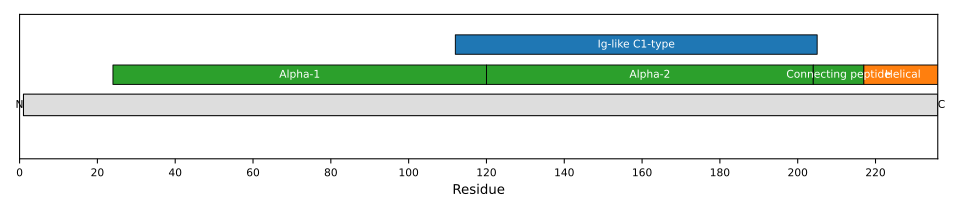
1: Binds peptides derived from antigens that access the endocytic route of antigen presenting cells (APC) and presents them on the cell surface for recognition by the CD4 T-cells. The peptide binding cleft accommodates peptides of 10-30 residues. The peptides presented by MHC class II molecules are generated mostly by degradation of proteins that access the endocytic route, where they are processed by lysosomal proteases and other hydrolases. Exogenous antigens that have been endocytosed by the APC are thus readily available for presentation via MHC II molecules, and for this reason this antigen presentation pathway is usually referred to as exogenous. As membrane proteins on their way to degradation in lysosomes as part of their normal turn-over are also contained in the endosomal/lysosomal compartments, exogenous antigens must compete with those derived from endogenous components. Autophagy is also a source of endogenous peptides, autophagosomes constitutively fuse with MHC class II loading compartments. In addition to APCs, other cells of the gastrointestinal tract, such as epithelial cells, express MHC class II molecules and CD74 and act as APCs, which is an unusual trait of the GI tract. To produce a MHC class II molecule that presents an antigen, three MHC class II molecules (heterodimers of an alpha and a beta chain) associate with a CD74 trimer in the ER to form a heterononamer. Soon after the entry of this complex into the endosomal/lysosomal system where antigen processing occurs, CD74 undergoes a sequential degradation by various proteases, including CTSS and CTSL, leaving a small fragment termed CLIP (class-II-associated invariant chain peptide). The removal of CLIP is facilitated by HLA-DM via direct binding to the alpha-beta-CLIP complex so that CLIP is released. HLA-DM stabilizes MHC class II molecules until primary high affinity antigenic peptides are bound. The MHC II molecule bound to a peptide is then transported to the cell membrane surface. In B-cells, the interaction between HLA-DM and MHC class II molecules is regulated by HLA-DO. Primary dendritic cells (DCs) also to express HLA-DO. Lysosomal microenvironment has been implicated in the regulation of antigen loading into MHC II molecules, increased acidification produces increased proteolysis and efficient peptide loading