Transferrin receptor protein 1 (TR) (TfR) (TfR1) (Trfr) (T9) (p90) (CD antigen CD71) [Cleaved into: Transferrin receptor protein 1, serum form (sTfR)]
1_MMDQA 6_ RSAFS 11_ NLFGG 16_ EPLSY 21_ TRFSL 26_ ARQVD 31_ GDNSH 36_ VEMKL 41_ AVDEE 46_ ENADN 51_ NTKAN 56_ VTKPK 61_ RCSGS 66_ ICYGT 71_ IAVIV 76_ FFLIG 81_ FMIGY 86_ LGYCK 91_ GVEPK 96_ TECER 101_ LAGTE 106_ SPVRE 111_ EPGED 116_ FPAAR 121_ RLYWD 126_ DLKRK 131_ LSEKL 136_ DSTDF 141_ TGTIK 146_ LLNEN 151_ SYVPR 156_ EAGSQ 161_ KDENL 166_ ALYVE 171_ NQFRE 176_ FKLSK 181_ VWRDQ 186_ HFVKI 191_ QVKDS 196_ AQNSV 201_ IIVDK 206_ NGRLV 211_ YLVEN 216_ PGGYV 221_ AYSKA 226_ ATVTG 231_ KLVHA 236_ NFGTK 241_ KDFED 246_ LYTPV 251_ NGSIV 256_ IVRAG 261_ KITFA 266_ EKVAN 271_ AESLN 276_ AIGVL 281_ IYMDQ 286_ TKFPI 291_ VNAEL 296_ SFFGH 301_ AHLGT 306_ GDPYT 311_ PGFPS 316_ FNHTQ 321_ FPPSR 326_ SSGLP 331_ NIPVQ 336_ TISRA 341_ AAEKL 346_ FGNME 351_ GDCPS 356_ DWKTD 361_ STCRM 366_ VTSES 371_ KNVKL 376_ TVSNV 381_ LKEIK 386_ ILNIF 391_ GVIKG 396_ FVEPD 401_ HYVVV 406_ GAQRD 411_ AWGPG 416_ AAKSG 421_ VGTAL 426_ LLKLA 431_ QMFSD 436_ MVLKD 441_ GFQPS 446_ RSIIF 451_ ASWSA 456_ GDFGS 461_ VGATE 466_ WLEGY 471_ LSSLH 476_ LKAFT 481_ YINLD 486_ KAVLG 491_ TSNFK 496_ VSASP 501_ LLYTL 506_ IEKTM 511_ QNVKH 516_ PVTGQ 521_ FLYQD 526_ SNWAS 531_ KVEKL 536_ TLDNA 541_ AFPFL 546_ AYSGI 551_ PAVSF 556_ CFCED 561_ TDYPY 566_ LGTTM 571_ DTYKE 576_ LIERI 581_ PELNK 586_ VARAA 591_ AEVAG 596_ QFVIK 601_ LTHDV 606_ ELNLD 611_ YERYN 616_ SQLLS 621_ FVRDL 626_ NQYRA 631_ DIKEM 636_ GLSLQ 641_ WLYSA 646_ RGDFF 651_ RATSR 656_ LTTDF 661_ GNAEK 666_ TDRFV 671_ MKKLN 676_ DRVMR 681_ VEYHF 686_ LSPYV 691_ SPKES 696_ PFRHV 701_ FWGSG 706_ SHTLP 711_ ALLEN 716_ LKLRK 721_ QNNGA 726_ FNETL 731_ FRNQL 736_ ALATW 741_ TIQGA 746_ ANALS 751_GDVWD
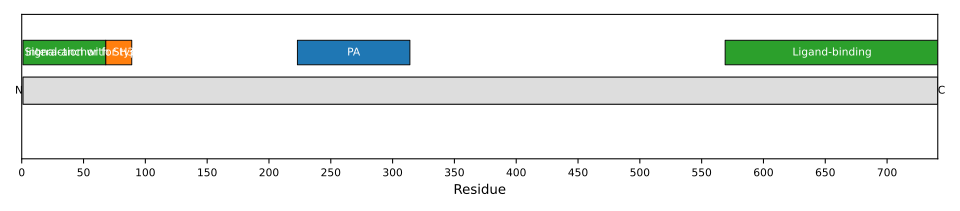
1: Cellular uptake of iron occurs via receptor-mediated endocytosis of ligand-occupied transferrin receptor into specialized endosomes (PubMed:26214738). Endosomal acidification leads to iron release. The apotransferrin-receptor complex is then recycled to the cell surface with a return to neutral pH and the concomitant loss of affinity of apotransferrin for its receptor. Transferrin receptor is necessary for development of erythrocytes and the nervous system (By similarity). A second ligand, the hereditary hemochromatosis protein HFE, competes for binding with transferrin for an overlapping C-terminal binding site. Positively regulates T and B cell proliferation through iron uptake (PubMed:26642240). Acts as a lipid sensor that regulates mitochondrial fusion by regulating activation of the JNK pathway (PubMed:26214738). When dietary levels of stearate (C18:0) are low, promotes activation of the JNK pathway, resulting in HUWE1-mediated ubiquitination and subsequent degradation of the mitofusin MFN2 and inhibition of mitochondrial fusion (PubMed:26214738). When dietary levels of stearate (C18:0) are high, TFRC stearoylation inhibits activation of the JNK pathway and thus degradation of the mitofusin MFN2 (PubMed:26214738). Mediates uptake of NICOL1 into fibroblasts where it may regulate extracellular matrix production (By similarity)
2: (Microbial infection) Acts as a receptor for new-world arenaviruses: Guanarito, Junin and Machupo virus
3: (Microbial infection) Acts as a host entry factor for rabies virus that hijacks the endocytosis of TFRC to enter cells
4: (Microbial infection) Acts as a host entry factor for SARS-CoV, MERS-CoV and SARS-CoV-2 viruses that hijack the endocytosis of TFRC to enter cells