Lactotransferrin (Lactoferrin) (EC 3.4.21.-) (Growth-inhibiting protein 12) (Talalactoferrin) [Cleaved into: Lactoferricin-H (Lfcin-H); Kaliocin-1; Lactoferroxin-A; Lactoferroxin-B; Lactoferroxin-C]
1_MKLVF 6_ LVLLF 11_ LGALG 16_ LCLAG 21_ RRRSV 26_ QWCAV 31_ SQPEA 36_ TKCFQ 41_ WQRNM 46_ RKVRG 51_ PPVSC 56_ IKRDS 61_ PIQCI 66_ QAIAE 71_ NRADA 76_ VTLDG 81_ GFIYE 86_ AGLAP 91_ YKLRP 96_ VAAEV 101_ YGTER 106_ QPRTH 111_ YYAVA 116_ VVKKG 121_ GSFQL 126_ NELQG 131_ LKSCH 136_ TGLRR 141_ TAGWN 146_ VPIGT 151_ LRPFL 156_ NWTGP 161_ PEPIE 166_ AAVAR 171_ FFSAS 176_ CVPGA 181_ DKGQF 186_ PNLCR 191_ LCAGT 196_ GENKC 201_ AFSSQ 206_ EPYFS 211_ YSGAF 216_ KCLRD 221_ GAGDV 226_ AFIRE 231_ STVFE 236_ DLSDE 241_ AERDE 246_ YELLC 251_ PDNTR 256_ KPVDK 261_ FKDCH 266_ LARVP 271_ SHAVV 276_ ARSVN 281_ GKEDA 286_ IWNLL 291_ RQAQE 296_ KFGKD 301_ KSPKF 306_ QLFGS 311_ PSGQK 316_ DLLFK 321_ DSAIG 326_ FSRVP 331_ PRIDS 336_ GLYLG 341_ SGYFT 346_ AIQNL 351_ RKSEE 356_ EVAAR 361_ RARVV 366_ WCAVG 371_ EQELR 376_ KCNQW 381_ SGLSE 386_ GSVTC 391_ SSAST 396_ TEDCI 401_ ALVLK 406_ GEADA 411_ MSLDG 416_ GYVYT 421_ AGKCG 426_ LVPVL 431_ AENYK 436_ SQQSS 441_ DPDPN 446_ CVDRP 451_ VEGYL 456_ AVAVV 461_ RRSDT 466_ SLTWN 471_ SVKGK 476_ KSCHT 481_ AVDRT 486_ AGWNI 491_ PMGLL 496_ FNQTG 501_ SCKFD 506_ EYFSQ 511_ SCAPG 516_ SDPRS 521_ NLCAL 526_ CIGDE 531_ QGENK 536_ CVPNS 541_ NERYY 546_ GYTGA 551_ FRCLA 556_ ENAGD 561_ VAFVK 566_ DVTVL 571_ QNTDG 576_ NNNEA 581_ WAKDL 586_ KLADF 591_ ALLCL 596_ DGKRK 601_ PVTEA 606_ RSCHL 611_ AMAPN 616_ HAVVS 621_ RMDKV 626_ ERLKQ 631_ VLLHQ 636_ QAKFG 641_ RNGSD 646_ CPDKF 651_ CLFQS 656_ ETKNL 661_ LFNDN 666_ TECLA 671_ RLHGK 676_ TTYEK 681_ YLGPQ 686_ YVAGI 691_ TNLKK 696_ CSTSP 701_LLEAC
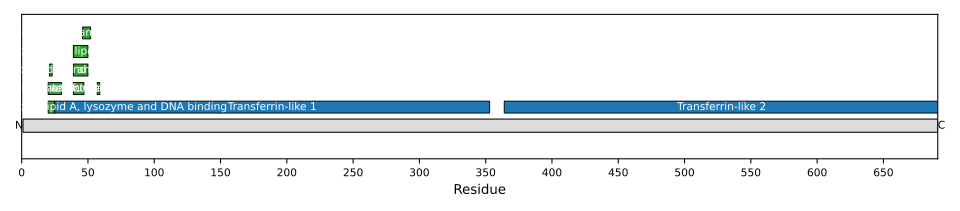
1: Transferrins are iron binding transport proteins which can bind two Fe(3+) ions in association with the binding of an anion, usually bicarbonate
2: Major iron-binding and multifunctional protein found in exocrine fluids such as breast milk and mucosal secretions (PubMed:11179314, PubMed:12693969, PubMed:14573629, PubMed:1599934, PubMed:3169987, PubMed:6802759). Has antimicrobial activity, which depends on the extracellular cation concentration (PubMed:6802759). Antimicrobial properties include bacteriostasis, which is related to its ability to sequester free iron and thus inhibit microbial growth, as well as direct bactericidal properties leading to the release of lipopolysaccharides from the bacterial outer membrane (PubMed:11179314, PubMed:12693969, PubMed:14573629, PubMed:1599934, PubMed:3169987, PubMed:6802759). Can also prevent bacterial biofilm development in P.aeruginosa infection (PubMed:12037568). Has weak antifungal activity against C.albicans (PubMed:11083624). Has anabolic, differentiating and anti-apoptotic effects on osteoblasts and can also inhibit osteoclastogenesis, possibly playing a role in the regulation of bone growth (PubMed:15166119). Promotes binding of species C adenoviruses to epithelial cells, promoting adenovirus infection (PubMed:17079302). Can inhibit papillomavirus infections (PubMed:17481742). Stimulates the TLR4 signaling pathway leading to NF-kappa-B activation and subsequent pro-inflammatory cytokine production while also interfering with the lipopolysaccharide (LPS)-stimulated TLR4 signaling (PubMed:20345905). Inhibits neutrophil granulocyte migration to sites of apoptosis, when secreted by apoptotic cells (PubMed:19033648). Stimulates VEGFA-mediated endothelial cell migration and proliferation (PubMed:16842782). Binds heparin, chondroitin sulfate and possibly other glycosaminoglycans (GAGs) (PubMed:9359845). Also binds specifically to pneumococcal surface protein A (PspA), the lipid A portion of bacterial lipopolysaccharide (LPS), lysozyme and DNA (PubMed:9359845)
3: Lactoferricin binds to the bacterial surface and is crucial for the bactericidal functions. Has some antiviral activity against papillomavirus infection (PubMed:17481742). N-terminal region shows strong antifungal activity against C.albicans (PubMed:11083624). Contains two BBXB heparin-binding consensus sequences that appear to form the predominate functional GAG-binding site
4: Has antimicrobial activity and is able to permeabilize different ions through liposomal membranes
5: Has opioid antagonist activity (PubMed:1369293). Shows preference for mu-receptor (PubMed:1369293)
6: Has opioid antagonist activity (PubMed:1369293). Shows higher degrees of preference for kappa-receptors than for mu-receptors (PubMed:1369293)
7: Has opioid antagonist activity (PubMed:1369293). Shows higher degrees of preference for kappa-receptors than for mu-receptors (PubMed:1369293)
8: The lactotransferrin transferrin-like domain 1 functions as a serine protease of the peptidase S60 family that cuts arginine rich regions (PubMed:12535064). This function contributes to the antimicrobial activity (PubMed:12535064). Shows a preferential cleavage at -Arg-Ser-Arg-Arg-|- and -Arg-Arg-Ser-Arg-|-, and of Z-Phe-Arg-|-aminomethylcoumarin sites (PubMed:12535064)
9: Transcription factor with antiproliferative properties and ability to induce cell cycle arrest (PubMed:15222485). Binds to the DeltaLf response element found in the SKP1, BAX, DCPS, and SELENOH promoters (PubMed:22320386)