Estrogen receptor (ER) (ER-alpha) (Estradiol receptor) (Nuclear receptor subfamily 3 group A member 1)
1_MTMTL 6_ HTKAS 11_ GMALL 16_ HQIQG 21_ NELEP 26_ LNRPQ 31_ LKIPL 36_ ERPLG 41_ EVYLD 46_ SSKPA 51_ VYNYP 56_ EGAAY 61_ EFNAA 66_ AAANA 71_ QVYGQ 76_ TGLPY 81_ GPGSE 86_ AAAFG 91_ SNGLG 96_ GFPPL 101_ NSVSP 106_ SPLML 111_ LHPPP 116_ QLSPF 121_ LQPHG 126_ QQVPY 131_ YLENE 136_ PSGYT 141_ VREAG 146_ PPAFY 151_ RPNSD 156_ NRRQG 161_ GRERL 166_ ASTND 171_ KGSMA 176_ MESAK 181_ ETRYC 186_ AVCND 191_ YASGY 196_ HYGVW 201_ SCEGC 206_ KAFFK 211_ RSIQG 216_ HNDYM 221_ CPATN 226_ QCTID 231_ KNRRK 236_ SCQAC 241_ RLRKC 246_ YEVGM 251_ MKGGI 256_ RKDRR 261_ GGRML 266_ KHKRQ 271_ RDDGE 276_ GRGEV 281_ GSAGD 286_ MRAAN 291_ LWPSP 296_ LMIKR 301_ SKKNS 306_ LALSL 311_ TADQM 316_ VSALL 321_ DAEPP 326_ ILYSE 331_ YDPTR 336_ PFSEA 341_ SMMGL 346_ LTNLA 351_ DRELV 356_ HMINW 361_ AKRVP 366_ GFVDL 371_ TLHDQ 376_ VHLLE 381_ CAWLE 386_ ILMIG 391_ LVWRS 396_ MEHPG 401_ KLLFA 406_ PNLLL 411_ DRNQG 416_ KCVEG 421_ MVEIF 426_ DMLLA 431_ TSSRF 436_ RMMNL 441_ QGEEF 446_ VCLKS 451_ IILLN 456_ SGVYT 461_ FLSST 466_ LKSLE 471_ EKDHI 476_ HRVLD 481_ KITDT 486_ LIHLM 491_ AKAGL 496_ TLQQQ 501_ HQRLA 506_ QLLLI 511_ LSHIR 516_ HMSNK 521_ GMEHL 526_ YSMKC 531_ KNVVP 536_ LYDLL 541_ LEMLD 546_ AHRLH 551_ APTSR 556_ GGASV 561_ EETDQ 566_ SHLAT 571_ AGSTS 576_ SHSLQ 581_ KYYIT 586_GEAEG
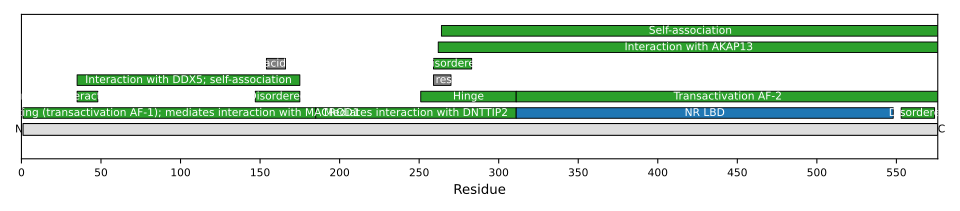
1: Nuclear hormone receptor. The steroid hormones and their receptors are involved in the regulation of eukaryotic gene expression and affect cellular proliferation and differentiation in target tissues. Ligand-dependent nuclear transactivation involves either direct homodimer binding to a palindromic estrogen response element (ERE) sequence or association with other DNA-binding transcription factors, such as AP-1/c-Jun, c-Fos, ATF-2, Sp1 and Sp3, to mediate ERE-independent signaling. Ligand binding induces a conformational change allowing subsequent or combinatorial association with multiprotein coactivator complexes through LXXLL motifs of their respective components. Mutual transrepression occurs between the estrogen receptor (ER) and NF-kappa-B in a cell-type specific manner. Decreases NF-kappa-B DNA-binding activity and inhibits NF-kappa-B-mediated transcription from the IL6 promoter and displace RELA/p65 and associated coregulators from the promoter. Recruited to the NF-kappa-B response element of the CCL2 and IL8 promoters and can displace CREBBP. Present with NF-kappa-B components RELA/p65 and NFKB1/p50 on ERE sequences. Can also act synergistically with NF-kappa-B to activate transcription involving respective recruitment adjacent response elements; the function involves CREBBP. Can activate the transcriptional activity of TFF1. Also mediates membrane-initiated estrogen signaling involving various kinase cascades. Essential for MTA1-mediated transcriptional regulation of BRCA1 and BCAS3 (PubMed:17922032). Maintains neuronal survival in response to ischemic reperfusion injury when in the presence of circulating estradiol (17-beta-estradiol/E2) (By similarity)
2: Involved in activation of NOS3 and endothelial nitric oxide production (PubMed:21937726). Isoforms lacking one or several functional domains are thought to modulate transcriptional activity by competitive ligand or DNA binding and/or heterodimerization with the full-length receptor (PubMed:10970861). Binds to ERE and inhibits isoform 1 (PubMed:10970861)