RAF proto-oncogene serine/threonine-protein kinase (EC 2.7.11.1) (Proto-oncogene c-RAF) (cRaf) (Raf-1)
1_MEHIQ 6_ GAWKT 11_ ISNGF 16_ GFKDA 21_ VFDGS 26_ SCISP 31_ TIVQQ 36_ FGYQR 41_ RASDD 46_ GKLTD 51_ PSKTS 56_ NTIRV 61_ FLPNK 66_ QRTVV 71_ NVRNG 76_ MSLHD 81_ CLMKA 86_ LKVRG 91_ LQPEC 96_ CAVFR 101_ LLHEH 106_ KGKKA 111_ RLDWN 116_ TDAAS 121_ LIGEE 126_ LQVDF 131_ LDHVP 136_ LTTHN 141_ FARKT 146_ FLKLA 151_ FCDIC 156_ QKFLL 161_ NGFRC 166_ QTCGY 171_ KFHEH 176_ CSTKV 181_ PTMCV 186_ DWSNI 191_ RQLLL 196_ FPNST 201_ IGDSG 206_ VPALP 211_ SLTMR 216_ RMRES 221_ VSRMP 226_ VSSQH 231_ RYSTP 236_ HAFTF 241_ NTSSP 246_ SSEGS 251_ LSQRQ 256_ RSTST 261_ PNVHM 266_ VSTTL 271_ PVDSR 276_ MIEDA 281_ IRSHS 286_ ESASP 291_ SALSS 296_ SPNNL 301_ SPTGW 306_ SQPKT 311_ PVPAQ 316_ RERAP 321_ VSGTQ 326_ EKNKI 331_ RPRGQ 336_ RDSSY 341_ YWEIE 346_ ASEVM 351_ LSTRI 356_ GSGSF 361_ GTVYK 366_ GKWHG 371_ DVAVK 376_ ILKVV 381_ DPTPE 386_ QFQAF 391_ RNEVA 396_ VLRKT 401_ RHVNI 406_ LLFMG 411_ YMTKD 416_ NLAIV 421_ TQWCE 426_ GSSLY 431_ KHLHV 436_ QETKF 441_ QMFQL 446_ IDIAR 451_ QTAQG 456_ MDYLH 461_ AKNII 466_ HRDMK 471_ SNNIF 476_ LHEGL 481_ TVKIG 486_ DFGLA 491_ TVKSR 496_ WSGSQ 501_ QVEQP 506_ TGSVL 511_ WMAPE 516_ VIRMQ 521_ DNNPF 526_ SFQSD 531_ VYSYG 536_ IVLYE 541_ LMTGE 546_ LPYSH 551_ INNRD 556_ QIIFM 561_ VGRGY 566_ ASPDL 571_ SKLYK 576_ NCPKA 581_ MKRLV 586_ ADCVK 591_ KVKEE 596_ RPLFP 601_ QILSS 606_ IELLQ 611_ HSLPK 616_ INRSA 621_ SEPSL 626_ HRAAH 631_ TEDIN 636_ ACTLT 641_TSPRL
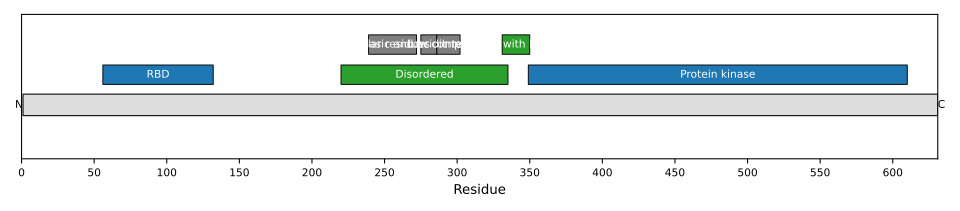
1: Serine/threonine-protein kinase that acts as a regulatory link between the membrane-associated Ras GTPases and the MAPK/ERK cascade, and this critical regulatory link functions as a switch determining cell fate decisions including proliferation, differentiation, apoptosis, survival and oncogenic transformation. RAF1 activation initiates a mitogen-activated protein kinase (MAPK) cascade that comprises a sequential phosphorylation of the dual-specific MAPK kinases (MAP2K1/MEK1 and MAP2K2/MEK2) and the extracellular signal-regulated kinases (MAPK3/ERK1 and MAPK1/ERK2). The phosphorylated form of RAF1 (on residues Ser-338 and Ser-339, by PAK1) phosphorylates BAD/Bcl2-antagonist of cell death at 'Ser-75'. Phosphorylates adenylyl cyclases: ADCY2, ADCY5 and ADCY6, resulting in their activation. Phosphorylates PPP1R12A resulting in inhibition of the phosphatase activity. Phosphorylates TNNT2/cardiac muscle troponin T. Can promote NF-kB activation and inhibit signal transducers involved in motility (ROCK2), apoptosis (MAP3K5/ASK1 and STK3/MST2), proliferation and angiogenesis (RB1). Can protect cells from apoptosis also by translocating to the mitochondria where it binds BCL2 and displaces BAD/Bcl2-antagonist of cell death. Regulates Rho signaling and migration, and is required for normal wound healing. Plays a role in the oncogenic transformation of epithelial cells via repression of the TJ protein, occludin (OCLN) by inducing the up-regulation of a transcriptional repressor SNAI2/SLUG, which induces down-regulation of OCLN. Restricts caspase activation in response to selected stimuli, notably Fas stimulation, pathogen-mediated macrophage apoptosis, and erythroid differentiation