Glucocorticoid receptor (GR) (Nuclear receptor subfamily 3 group C member 1)
1_MDSKE 6_ SLTPG 11_ REENP 16_ SSVLA 21_ QERGD 26_ VMDFY 31_ KTLRG 36_ GATVK 41_ VSASS 46_ PSLAV 51_ ASQSD 56_ SKQRR 61_ LLVDF 66_ PKGSV 71_ SNAQQ 76_ PDLSK 81_ AVSLS 86_ MGLYM 91_ GETET 96_ KVMGN 101_ DLGFP 106_ QQGQI 111_ SLSSG 116_ ETDLK 121_ LLEES 126_ IANLN 131_ RSTSV 136_ PENPK 141_ SSAST 146_ AVSAA 151_ PTEKE 156_ FPKTH 161_ SDVSS 166_ EQQHL 171_ KGQTG 176_ TNGGN 181_ VKLYT 186_ TDQST 191_ FDILQ 196_ DLEFS 201_ SGSPG 206_ KETNE 211_ SPWRS 216_ DLLID 221_ ENCLL 226_ SPLAG 231_ EDDSF 236_ LLEGN 241_ SNEDC 246_ KPLIL 251_ PDTKP 256_ KIKDN 261_ GDLVL 266_ SSPSN 271_ VTLPQ 276_ VKTEK 281_ EDFIE 286_ LCTPG 291_ VIKQE 296_ KLGTV 301_ YCQAS 306_ FPGAN 311_ IIGNK 316_ MSAIS 321_ VHGVS 326_ TSGGQ 331_ MYHYD 336_ MNTAS 341_ LSQQQ 346_ DQKPI 351_ FNVIP 356_ PIPVG 361_ SENWN 366_ RCQGS 371_ GDDNL 376_ TSLGT 381_ LNFPG 386_ RTVFS 391_ NGYSS 396_ PSMRP 401_ DVSSP 406_ PSSSS 411_ TATTG 416_ PPPKL 421_ CLVCS 426_ DEASG 431_ CHYGV 436_ LTCGS 441_ CKVFF 446_ KRAVE 451_ GQHNY 456_ LCAGR 461_ NDCII 466_ DKIRR 471_ KNCPA 476_ CRYRK 481_ CLQAG 486_ MNLEA 491_ RKTKK 496_ KIKGI 501_ QQATT 506_ GVSQE 511_ TSENP 516_ GNKTI 521_ VPATL 526_ PQLTP 531_ TLVSL 536_ LEVIE 541_ PEVLY 546_ AGYDS 551_ SVPDS 556_ TWRIM 561_ TTLNM 566_ LGGRQ 571_ VIAAV 576_ KWAKA 581_ IPGFR 586_ NLHLD 591_ DQMTL 596_ LQYSW 601_ MFLMA 606_ FALGW 611_ RSYRQ 616_ SSANL 621_ LCFAP 626_ DLIIN 631_ EQRMT 636_ LPCMY 641_ DQCKH 646_ MLYVS 651_ SELHR 656_ LQVSY 661_ EEYLC 666_ MKTLL 671_ LLSSV 676_ PKDGL 681_ KSQEL 686_ FDEIR 691_ MTYIK 696_ ELGKA 701_ IVKRE 706_ GNSSQ 711_ NWQRF 716_ YQLTK 721_ LLDSM 726_ HEVVE 731_ NLLNY 736_ CFQTF 741_ LDKTM 746_ SIEFP 751_ EMLAE 756_ IITNQ 761_ IPKYS 766_ NGNIK 771_KLLFH
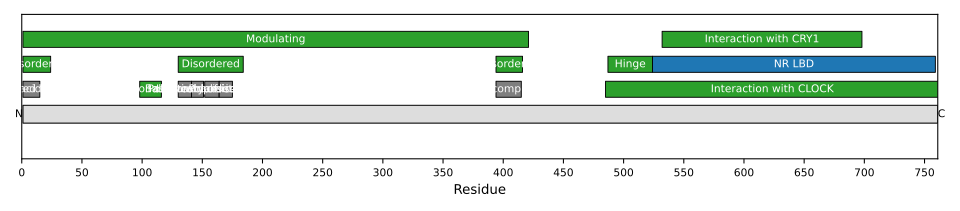
1: Receptor for glucocorticoids (GC) (PubMed:27120390, PubMed:37478846). Has a dual mode of action: as a transcription factor that binds to glucocorticoid response elements (GRE), both for nuclear and mitochondrial DNA, and as a modulator of other transcription factors (PubMed:28139699). Affects inflammatory responses, cellular proliferation and differentiation in target tissues. Involved in chromatin remodeling (PubMed:9590696). Plays a role in rapid mRNA degradation by binding to the 5' UTR of target mRNAs and interacting with PNRC2 in a ligand-dependent manner which recruits the RNA helicase UPF1 and the mRNA-decapping enzyme DCP1A, leading to RNA decay (PubMed:25775514). Could act as a coactivator for STAT5-dependent transcription upon growth hormone (GH) stimulation and could reveal an essential role of hepatic GR in the control of body growth (By similarity)
2: Has transcriptional activation and repression activity (PubMed:11435610, PubMed:15769988, PubMed:15866175, PubMed:17635946, PubMed:19141540, PubMed:19248771, PubMed:20484466, PubMed:21664385, PubMed:23820903). Mediates glucocorticoid-induced apoptosis (PubMed:23303127). Promotes accurate chromosome segregation during mitosis (PubMed:25847991). May act as a tumor suppressor (PubMed:25847991). May play a negative role in adipogenesis through the regulation of lipolytic and antilipogenic gene expression (By similarity)
3: Acts as a dominant negative inhibitor of isoform Alpha (PubMed:20484466, PubMed:7769088, PubMed:8621628). Has intrinsic transcriptional activity independent of isoform Alpha when both isoforms are coexpressed (PubMed:19248771, PubMed:26711253). Loses this transcription modulator function on its own (PubMed:20484466). Has no hormone-binding activity (PubMed:8621628). May play a role in controlling glucose metabolism by maintaining insulin sensitivity (By similarity). Reduces hepatic gluconeogenesis through down-regulation of PEPCK in an isoform Alpha-dependent manner (PubMed:26711253). Directly regulates STAT1 expression in isoform Alpha-independent manner (PubMed:26711253)
4: Has lower transcriptional activation activity than isoform Alpha. Exerts a dominant negative effect on isoform Alpha trans-repression mechanism (PubMed:20484466)
5: Increases activity of isoform Alpha
6: More effective than isoform Alpha in transcriptional activation, but not repression activity
7: Has transcriptional activation activity
8: Has transcriptional activation activity
9: Has transcriptional activation activity
10: Has highest transcriptional activation activity of all isoforms created by alternative initiation (PubMed:15866175, PubMed:23820903). Has transcriptional repression activity (PubMed:23303127). Mediates glucocorticoid-induced apoptosis (PubMed:23303127, PubMed:23820903)
11: Has transcriptional activation activity
12: Has transcriptional activation activity
13: Has lowest transcriptional activation activity of all isoforms created by alternative initiation (PubMed:15866175, PubMed:23820903). Has transcriptional repression activity (PubMed:23303127)