T-cell surface glycoprotein CD3 delta chain (T-cell receptor T3 delta chain) (CD antigen CD3d)
1_MEHST 6_ FLSGL 11_ VLATL 16_ LSQVS 21_ PFKIP 26_ IEELE 31_ DRVFV 36_ NCNTS 41_ ITWVE 46_ GTVGT 51_ LLSDI 56_ TRLDL 61_ GKRIL 66_ DPRGI 71_ YRCNG 76_ TDIYK 81_ DKEST 86_ VQVHY 91_ RMCQS 96_ CVELD 101_ PATVA 106_ GIIVT 111_ DVIAT 116_ LLLAL 121_ GVFCF 126_ AGHET 131_ GRLSG 136_ AADTQ 141_ ALLRN 146_ DQVYQ 151_ PLRDR 156_ DDAQY 161_ SHLGG 166_NWARN
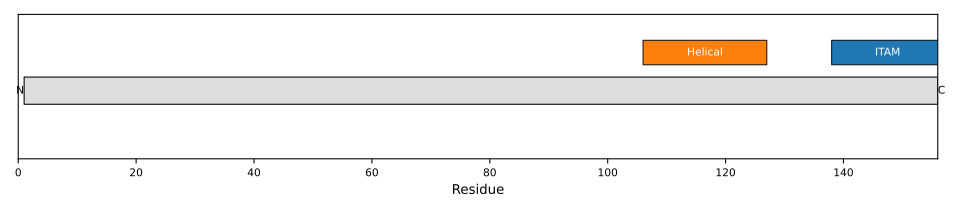
1: Part of the TCR-CD3 complex present on T-lymphocyte cell surface that plays an essential role in adaptive immune response. When antigen presenting cells (APCs) activate T-cell receptor (TCR), TCR-mediated signals are transmitted across the cell membrane by the CD3 chains CD3D, CD3E, CD3G and CD3Z. All CD3 chains contain immunoreceptor tyrosine-based activation motifs (ITAMs) in their cytoplasmic domain. Upon TCR engagement, these motifs become phosphorylated by Src family protein tyrosine kinases LCK and FYN, resulting in the activation of downstream signaling pathways (PubMed:2470098). In addition of this role of signal transduction in T-cell activation, CD3D plays an essential role in thymocyte differentiation. Indeed, participates in correct intracellular TCR-CD3 complex assembly and surface expression. In absence of a functional TCR-CD3 complex, thymocytes are unable to differentiate properly. Interacts with CD4 and CD8 and thus serves to establish a functional link between the TCR and coreceptors CD4 and CD8, which is needed for activation and positive selection of CD4 or CD8 T-cells (PubMed:12215456)