Amyloid-beta precursor protein (APP) (ABPP) (APPI) (Alzheimer disease amyloid A4 protein homolog) (Alzheimer disease amyloid protein) (Amyloid precursor protein) (Amyloid-beta (A4) precursor protein) (Amyloid-beta A4 protein) (Cerebral vascular amyloid peptide) (CVAP) (PreA4) (Protease nexin-II) (PN-II) [Cleaved into: N-APP; Soluble APP-alpha (S-APP-alpha); Soluble APP-beta (S-APP-beta); C99 (Beta-secretase C-terminal fragment) (Beta-CTF); Amyloid-beta protein 42 (Abeta42) (Beta-APP42); Amyloid-beta protein 40 (Abeta40) (Beta-APP40); C83 (Alpha-secretase C-terminal fragment) (Alpha-CTF); P3(42); P3(40); C80; Gamma-secretase C-terminal fragment 59 (Amyloid intracellular domain 59) (AICD-59) (AID(59)) (Gamma-CTF(59)); Gamma-secretase C-terminal fragment 57 (Amyloid intracellular domain 57) (AICD-57) (AID(57)) (Gamma-CTF(57)); Gamma-secretase C-terminal fragment 50 (Amyloid intracellular domain 50) (AICD-50) (AID(50)) (Gamma-CTF(50)); C31]
1_MLPGL 6_ ALLLL 11_ AAWTA 16_ RALEV 21_ PTDGN 26_ AGLLA 31_ EPQIA 36_ MFCGR 41_ LNMHM 46_ NVQNG 51_ KWDSD 56_ PSGTK 61_ TCIDT 66_ KEGIL 71_ QYCQE 76_ VYPEL 81_ QITNV 86_ VEANQ 91_ PVTIQ 96_ NWCKR 101_ GRKQC 106_ KTHPH 111_ FVIPY 116_ RCLVG 121_ EFVSD 126_ ALLVP 131_ DKCKF 136_ LHQER 141_ MDVCE 146_ THLHW 151_ HTVAK 156_ ETCSE 161_ KSTNL 166_ HDYGM 171_ LLPCG 176_ IDKFR 181_ GVEFV 186_ CCPLA 191_ EESDN 196_ VDSAD 201_ AEEDD 206_ SDVWW 211_ GGADT 216_ DYADG 221_ SEDKV 226_ VEVAE 231_ EEEVA 236_ EVEEE 241_ EADDD 246_ EDDED 251_ GDEVE 256_ EEAEE 261_ PYEEA 266_ TERTT 271_ SIATT 276_ TTTTT 281_ ESVEE 286_ VVREV 291_ CSEQA 296_ ETGPC 301_ RAMIS 306_ RWYFD 311_ VTEGK 316_ CAPFF 321_ YGGCG 326_ GNRNN 331_ FDTEE 336_ YCMAV 341_ CGSAM 346_ SQSLL 351_ KTTQE 356_ PLARD 361_ PVKLP 366_ TTAAS 371_ TPDAV 376_ DKYLE 381_ TPGDE 386_ NEHAH 391_ FQKAK 396_ ERLEA 401_ KHRER 406_ MSQVM 411_ REWEE 416_ AERQA 421_ KNLPK 426_ ADKKA 431_ VIQHF 436_ QEKVE 441_ SLEQE 446_ AANER 451_ QQLVE 456_ THMAR 461_ VEAML 466_ NDRRR 471_ LALEN 476_ YITAL 481_ QAVPP 486_ RPRHV 491_ FNMLK 496_ KYVRA 501_ EQKDR 506_ QHTLK 511_ HFEHV 516_ RMVDP 521_ KKAAQ 526_ IRSQV 531_ MTHLR 536_ VIYER 541_ MNQSL 546_ SLLYN 551_ VPAVA 556_ EEIQD 561_ EVDEL 566_ LQKEQ 571_ NYSDD 576_ VLANM 581_ ISEPR 586_ ISYGN 591_ DALMP 596_ SLTET 601_ KTTVE 606_ LLPVN 611_ GEFSL 616_ DDLQP 621_ WHSFG 626_ ADSVP 631_ ANTEN 636_ EVEPV 641_ DARPA 646_ ADRGL 651_ TTRPG 656_ SGLTN 661_ IKTEE 666_ ISEVK 671_ MDAEF 676_ RHDSG 681_ YEVHH 686_ QKLVF 691_ FAEDV 696_ GSNKG 701_ AIIGL 706_ MVGGV 711_ VIATV 716_ IVITL 721_ VMLKK 726_ KQYTS 731_ IHHGV 736_ VEVDA 741_ AVTPE 746_ ERHLS 751_ KMQQN 756_ GYENP 761_TYKFF
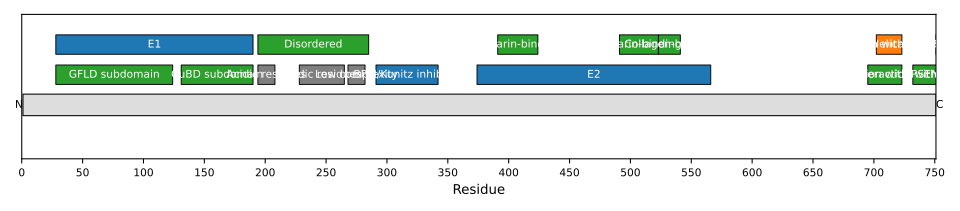
1: Functions as a cell surface receptor and performs physiological functions on the surface of neurons relevant to neurite growth, neuronal adhesion and axonogenesis. Interaction between APP molecules on neighboring cells promotes synaptogenesis (PubMed:25122912). Involved in cell mobility and transcription regulation through protein-protein interactions. Can promote transcription activation through binding to APBB1-KAT5 and inhibits Notch signaling through interaction with Numb. Couples to apoptosis-inducing pathways such as those mediated by G(o) and JIP. Inhibits G(o) alpha ATPase activity (By similarity). Acts as a kinesin I membrane receptor, mediating the axonal transport of beta-secretase and presenilin 1 (By similarity). By acting as a kinesin I membrane receptor, plays a role in axonal anterograde transport of cargo towards synapses in axons (PubMed:17062754, PubMed:23011729). Involved in copper homeostasis/oxidative stress through copper ion reduction. In vitro, copper-metallated APP induces neuronal death directly or is potentiated through Cu(2+)-mediated low-density lipoprotein oxidation. Can regulate neurite outgrowth through binding to components of the extracellular matrix such as heparin and collagen I and IV. The splice isoforms that contain the BPTI domain possess protease inhibitor activity. Induces a AGER-dependent pathway that involves activation of p38 MAPK, resulting in internalization of amyloid-beta peptide and leading to mitochondrial dysfunction in cultured cortical neurons. Provides Cu(2+) ions for GPC1 which are required for release of nitric oxide (NO) and subsequent degradation of the heparan sulfate chains on GPC1
2: Amyloid-beta peptides are lipophilic metal chelators with metal-reducing activity. Bind transient metals such as copper, zinc and iron. In vitro, can reduce Cu(2+) and Fe(3+) to Cu(+) and Fe(2+), respectively. Amyloid-beta peptides bind to lipoproteins and apolipoproteins E and J in the CSF and to HDL particles in plasma, inhibiting metal-catalyzed oxidation of lipoproteins. Promotes both tau aggregation and TPK II-mediated phosphorylation. Interaction with overexpressed HADH2 leads to oxidative stress and neurotoxicity. Also binds GPC1 in lipid rafts
3: More effective reductant than amyloid-beta protein 40. May activate mononuclear phagocytes in the brain and elicit inflammatory responses
4: Appicans elicit adhesion of neural cells to the extracellular matrix and may regulate neurite outgrowth in the brain
5: The gamma-CTF peptides as well as the caspase-cleaved peptides, including C31, are potent enhancers of neuronal apoptosis