Plasma serine protease inhibitor (Acrosomal serine protease inhibitor) (Plasminogen activator inhibitor 3) (PAI-3) (PAI3) (Protein C inhibitor) (PCI) (Serpin A5)
1_MQLFL 6_ LLCLV 11_ LLSPQ 16_ GASLH 21_ RHHPR 26_ EMKKR 31_ VEDLH 36_ VGATV 41_ APSSR 46_ RDFTF 51_ DLYRA 56_ LASAA 61_ PSQSI 66_ FFSPV 71_ SISMS 76_ LAMLS 81_ LGAGS 86_ STKMQ 91_ ILEGL 96_ GLNLQ 101_ KSSEK 106_ ELHRG 111_ FQQLL 116_ QELNQ 121_ PRDGF 126_ QLSLG 131_ NALFT 136_ DLVVD 141_ LQDTF 146_ VSAMK 151_ TLYLA 156_ DTFPT 161_ NFRDS 166_ AGAMK 171_ QINDY 176_ VAKQT 181_ KGKIV 186_ DLLKN 191_ LDSNA 196_ VVIMV 201_ NYIFF 206_ KAKWE 211_ TSFNH 216_ KGTQE 221_ QDFYV 226_ TSETV 231_ VRVPM 236_ MSRED 241_ QYHYL 246_ LDRNL 251_ SCRVV 256_ GVPYQ 261_ GNATA 266_ LFILP 271_ SEGKM 276_ QQVEN 281_ GLSEK 286_ TLRKW 291_ LKMFK 296_ KRQLE 301_ LYLPK 306_ FSIEG 311_ SYQLE 316_ KVLPS 321_ LGISN 326_ VFTSH 331_ ADLSG 336_ ISNHS 341_ NIQVS 346_ EMVHK 351_ AVVEV 356_ DESGT 361_ RAAAA 366_ TGTIF 371_ TFRSA 376_ RLNSQ 381_ RLVFN 386_ RPFLM 391_ FIVDN 396_ NILFL 401_GKVNR
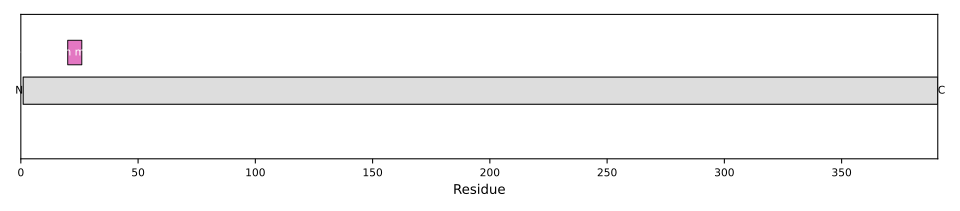
1: Heparin-dependent serine protease inhibitor acting in body fluids and secretions. Inactivates serine proteases by binding irreversibly to their serine activation site. Involved in the regulation of intravascular and extravascular proteolytic activities. Plays hemostatic roles in the blood plasma. Acts as a procoagulant and pro-inflammatory factor by inhibiting the anticoagulant activated protein C factor as well as the generation of activated protein C factor by the thrombin/thrombomodulin complex. Acts as an anticoagulant factor by inhibiting blood coagulation factors like prothrombin, factor XI, factor Xa, plasma kallikrein and fibrinolytic enzymes such as tissue- and urinary-type plasminogen activators. In seminal plasma, inactivates several serine proteases implicated in the reproductive system. Inhibits the serpin acrosin; indirectly protects component of the male genital tract from being degraded by excessive released acrosin. Inhibits tissue- and urinary-type plasminogen activator, prostate-specific antigen and kallikrein activities; has a control on the sperm motility and fertilization. Inhibits the activated protein C-catalyzed degradation of SEMG1 and SEMG2; regulates the degradation of semenogelin during the process of transfer of spermatozoa from the male reproductive tract into the female tract. In urine, inhibits urinary-type plasminogen activator and kallikrein activities. Inactivates membrane-anchored serine proteases activities such as MPRSS7 and TMPRSS11E. Inhibits urinary-type plasminogen activator-dependent tumor cell invasion and metastasis. May also play a non-inhibitory role in seminal plasma and urine as a hydrophobic hormone carrier by its binding to retinoic acid