Complement factor I (EC 3.4.21.45) (C3B/C4B inactivator) [Cleaved into: Complement factor I heavy chain; Complement factor I light chain]
1_MKLLH 6_ VFLLF 11_ LCFHL 16_ RFCKV 21_ TYTSQ 26_ EDLVE 31_ KKCLA 36_ KKYTH 41_ LSCDK 46_ VFCQP 51_ WQRCI 56_ EGTCV 61_ CKLPY 66_ QCPKN 71_ GTAVC 76_ ATNRR 81_ SFPTY 86_ CQQKS 91_ LECLH 96_ PGTKF 101_ LNNGT 106_ CTAEG 111_ KFSVS 116_ LKHGN 121_ TDSEG 126_ IVEVK 131_ LVDQD 136_ KTMFI 141_ CKSSW 146_ SMREA 151_ NVACL 156_ DLGFQ 161_ QGADT 166_ QRRFK 171_ LSDLS 176_ INSTE 181_ CLHVH 186_ CRGLE 191_ TSLAE 196_ CTFTK 201_ RRTMG 206_ YQDFA 211_ DVVCY 216_ TQKAD 221_ SPMDD 226_ FFQCV 231_ NGKYI 236_ SQMKA 241_ CDGIN 246_ DCGDQ 251_ SDELC 256_ CKACQ 261_ GKGFH 266_ CKSGV 271_ CIPSQ 276_ YQCNG 281_ EVDCI 286_ TGEDE 291_ VGCAG 296_ FASVT 301_ QEETE 306_ ILTAD 311_ MDAER 316_ RRIKS 321_ LLPKL 326_ SCGVK 331_ NRMHI 336_ RRKRI 341_ VGGKR 346_ AQLGD 351_ LPWQV 356_ AIKDA 361_ SGITC 366_ GGIYI 371_ GGCWI 376_ LTAAH 381_ CLRAS 386_ KTHRY 391_ QIWTT 396_ VVDWI 401_ HPDLK 406_ RIVIE 411_ YVDRI 416_ IFHEN 421_ YNAGT 426_ YQNDI 431_ ALIEM 436_ KKDGN 441_ KKDCE 446_ LPRSI 451_ PACVP 456_ WSPYL 461_ FQPND 466_ TCIVS 471_ GWGRE 476_ KDNER 481_ VFSLQ 486_ WGEVK 491_ LISNC 496_ SKFYG 501_ NRFYE 506_ KEMEC 511_ AGTYD 516_ GSIDA 521_ CKGDS 526_ GGPLV 531_ CMDAN 536_ NVTYV 541_ WGVVS 546_ WGENC 551_ GKPEF 556_ PGVYT 561_ KVANY 566_ FDWIS 571_ YHVGR 576_PFISQ
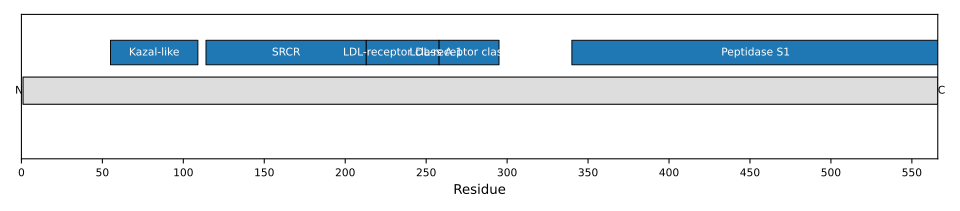
1: Trypsin-like serine protease that plays an essential role in regulating the immune response by controlling all complement pathways. Inhibits these pathways by cleaving three peptide bonds in the alpha-chain of C3b and two bonds in the alpha-chain of C4b thereby inactivating these proteins (PubMed:17320177, PubMed:7360115). Essential cofactors for these reactions include factor H and C4BP in the fluid phase and membrane cofactor protein/CD46 and CR1 on cell surfaces (PubMed:12055245, PubMed:2141838, PubMed:9605165). The presence of these cofactors on healthy cells allows degradation of deposited C3b by CFI in order to prevent undesired complement activation, while in apoptotic cells or microbes, the absence of such cofactors leads to C3b-mediated complement activation and subsequent opsonization (PubMed:28671664)