Alkaline phosphatase, tissue-nonspecific isozyme (AP-TNAP) (TNS-ALP) (TNSALP) (EC 3.1.3.1) (Alkaline phosphatase liver/bone/kidney isozyme) (Phosphoamidase) (Phosphocreatine phosphatase) (EC 3.9.1.1)
1_MISPF 6_ LVLAI 11_ GTCLT 16_ NSLVP 21_ EKEKD 26_ PKYWR 31_ DQAQE 36_ TLKYA 41_ LELQK 46_ LNTNV 51_ AKNVI 56_ MFLGD 61_ GMGVS 66_ TVTAA 71_ RILKG 76_ QLHHN 81_ PGEET 86_ RLEMD 91_ KFPFV 96_ ALSKT 101_ YNTNA 106_ QVPDS 111_ AGTAT 116_ AYLCG 121_ VKANE 126_ GTVGV 131_ SAATE 136_ RSRCN 141_ TTQGN 146_ EVTSI 151_ LRWAK 156_ DAGKS 161_ VGIVT 166_ TTRVN 171_ HATPS 176_ AAYAH 181_ SADRD 186_ WYSDN 191_ EMPPE 196_ ALSQG 201_ CKDIA 206_ YQLMH 211_ NIRDI 216_ DVIMG 221_ GGRKY 226_ MYPKN 231_ KTDVE 236_ YESDE 241_ KARGT 246_ RLDGL 251_ DLVDT 256_ WKSFK 261_ PRYKH 266_ SHFIW 271_ NRTEL 276_ LTLDP 281_ HNVDY 286_ LLGLF 291_ EPGDM 296_ QYELN 301_ RNNVT 306_ DPSLS 311_ EMVVV 316_ AIQIL 321_ RKNPK 326_ GFFLL 331_ VEGGR 336_ IDHGH 341_ HEGKA 346_ KQALH 351_ EAVEM 356_ DRAIG 361_ QAGSL 366_ TSSED 371_ TLTVV 376_ TADHS 381_ HVFTF 386_ GGYTP 391_ RGNSI 396_ FGLAP 401_ MLSDT 406_ DKKPF 411_ TAILY 416_ GNGPG 421_ YKVVG 426_ GEREN 431_ VSMVD 436_ YAHNN 441_ YQAQS 446_ AVPLR 451_ HETHG 456_ GEDVA 461_ VFSKG 466_ PMAHL 471_ LHGVH 476_ EQNYV 481_ PHVMA 486_ YAACI 491_ GANLG 496_ HCAPA 501_ SSAGS 506_ LAAGP 511_ LLLAL 516_ALYPL
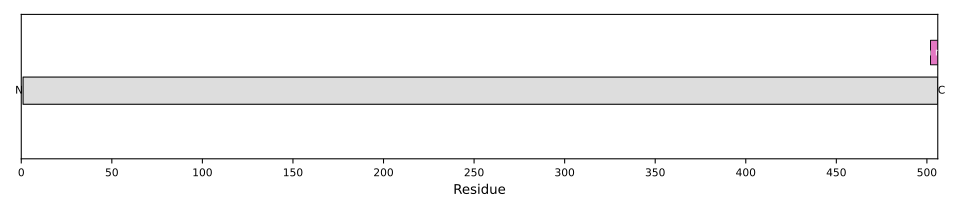
1: Alkaline phosphatase that metabolizes various phosphate compounds and plays a key role in skeletal mineralization and adaptive thermogenesis (PubMed:12162492, PubMed:23688511, PubMed:25982064). Has broad substrate specificity and can hydrolyze a considerable variety of compounds: however, only a few substrates, such as diphosphate (inorganic pyrophosphate; PPi), pyridoxal 5'-phosphate (PLP) and N-phosphocreatine are natural substrates (PubMed:12162492, PubMed:2220817). Plays an essential role in skeletal and dental mineralization via its ability to hydrolyze extracellular diphosphate, a potent mineralization inhibitor, to phosphate: it thereby promotes hydroxyapatite crystal formation and increases inorganic phosphate concentration (PubMed:23688511, PubMed:25982064). Acts in a non-redundant manner with PHOSPHO1 in skeletal mineralization: while PHOSPHO1 mediates the initiation of hydroxyapatite crystallization in the matrix vesicles (MVs), ALPL/TNAP catalyzes the spread of hydroxyapatite crystallization in the extracellular matrix (By similarity). Also promotes dephosphorylation of osteopontin (SSP1), an inhibitor of hydroxyapatite crystallization in its phosphorylated state; it is however unclear whether ALPL/TNAP mediates SSP1 dephosphorylation via a direct or indirect manner (By similarity). Catalyzes dephosphorylation of PLP to pyridoxal (PL), the transportable form of vitamin B6, in order to provide a sufficient amount of PLP in the brain, an essential cofactor for enzymes catalyzing the synthesis of diverse neurotransmitters (PubMed:20049532, PubMed:2220817). Additionally, also able to mediate ATP degradation in a stepwise manner to adenosine, thereby regulating the availability of ligands for purinergic receptors (By similarity). Also capable of dephosphorylating microbial products, such as lipopolysaccharides (LPS) as well as other phosphorylated small-molecules, such as poly-inosine:cytosine (poly I:C) (PubMed:28448526). Acts as a key regulator of adaptive thermogenesis as part of the futile creatine cycle: localizes to the mitochondria of thermogenic fat cells and acts by mediating hydrolysis of N-phosphocreatine to initiate a futile cycle of creatine dephosphorylation and phosphorylation (By similarity). During the futile creatine cycle, creatine and N-phosphocreatine are in a futile cycle, which dissipates the high energy charge of N-phosphocreatine as heat without performing any mechanical or chemical work (By similarity)