Integrin beta-1 (Fibronectin receptor subunit beta) (Glycoprotein IIa) (GPIIA) (VLA-4 subunit beta) (CD antigen CD29)
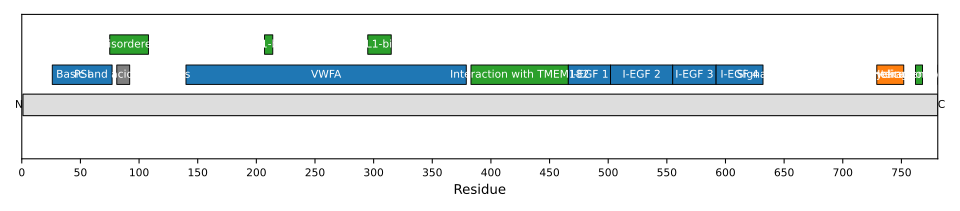
1_MNLQP 6_ IFWIG 11_ LISSV 16_ CCVFA 21_ QTDEN 26_ RCLKA 31_ NAKSC 36_ GECIQ 41_ AGPNC 46_ GWCTN 51_ STFLQ 56_ EGMPT 61_ SARCD 66_ DLEAL 71_ KKKGC 76_ PPDDI 81_ ENPRG 86_ SKDIK 91_ KNKNV 96_ TNRSK 101_ GTAEK 106_ LKPED 111_ ITQIQ 116_ PQQLV 121_ LRLRS 126_ GEPQT 131_ FTLKF 136_ KRAED 141_ YPIDL 146_ YYLMD 151_ LSYSM 156_ KDDLE 161_ NVKSL 166_ GTDLM 171_ NEMRR 176_ ITSDF 181_ RIGFG 186_ SFVEK 191_ TVMPY 196_ ISTTP 201_ AKLRN 206_ PCTSE 211_ QNCTS 216_ PFSYK 221_ NVLSL 226_ TNKGE 231_ VFNEL 236_ VGKQR 241_ ISGNL 246_ DSPEG 251_ GFDAI 256_ MQVAV 261_ CGSLI 266_ GWRNV 271_ TRLLV 276_ FSTDA 281_ GFHFA 286_ GDGKL 291_ GGIVL 296_ PNDGQ 301_ CHLEN 306_ NMYTM 311_ SHYYD 316_ YPSIA 321_ HLVQK 326_ LSENN 331_ IQTIF 336_ AVTEE 341_ FQPVY 346_ KELKN 351_ LIPKS 356_ AVGTL 361_ SANSS 366_ NVIQL 371_ IIDAY 376_ NSLSS 381_ EVILE 386_ NGKLS 391_ EGVTI 396_ SYKSY 401_ CKNGV 406_ NGTGE 411_ NGRKC 416_ SNISI 421_ GDEVQ 426_ FEISI 431_ TSNKC 436_ PKKDS 441_ DSFKI 446_ RPLGF 451_ TEEVE 456_ VILQY 461_ ICECE 466_ CQSEG 471_ IPESP 476_ KCHEG 481_ NGTFE 486_ CGACR 491_ CNEGR 496_ VGRHC 501_ ECSTD 506_ EVNSE 511_ DMDAY 516_ CRKEN 521_ SSEIC 526_ SNNGE 531_ CVCGQ 536_ CVCRK 541_ RDNTN 546_ EIYSG 551_ KFCEC 556_ DNFNC 561_ DRSNG 566_ LICGG 571_ NGVCK 576_ CRVCE 581_ CNPNY 586_ TGSAC 591_ DCSLD 596_ TSTCE 601_ ASNGQ 606_ ICNGR 611_ GICEC 616_ GVCKC 621_ TDPKF 626_ QGQTC 631_ EMCQT 636_ CLGVC 641_ AEHKE 646_ CVQCR 651_ AFNKG 656_ EKKDT 661_ CTQEC 666_ SYFNI 671_ TKVES 676_ RDKLP 681_ QPVQP 686_ DPVSH 691_ CKEKD 696_ VDDCW 701_ FYFTY 706_ SVNGN 711_ NEVMV 716_ HVVEN 721_ PECPT 726_ GPDII 731_ PIVAG 736_ VVAGI 741_ VLIGL 746_ ALLLI 751_ WKLLM 756_ IIHDR 761_ REFAK 766_ FEKEK 771_ MNAKW 776_ DTGEN 781_ PIYKS 786_ AVTTV 791_VNPKY
1: Integrins alpha-1/beta-1, alpha-2/beta-1, alpha-10/beta-1 and alpha-11/beta-1 are receptors for collagen. Integrins alpha-1/beta-1 and alpha-2/beta-2 recognize the proline-hydroxylated sequence G-F-P-G-E-R in collagen. Integrins alpha-2/beta-1, alpha-3/beta-1, alpha-4/beta-1, alpha-5/beta-1, alpha-8/beta-1, alpha-10/beta-1, alpha-11/beta-1 and alpha-V/beta-1 are receptors for fibronectin. Alpha-4/beta-1 recognizes one or more domains within the alternatively spliced CS-1 and CS-5 regions of fibronectin. Integrin alpha-5/beta-1 is a receptor for fibrinogen. Integrin alpha-1/beta-1, alpha-2/beta-1, alpha-6/beta-1 and alpha-7/beta-1 are receptors for lamimin. Integrin alpha-6/beta-1 (ITGA6:ITGB1) is present in oocytes and is involved in sperm-egg fusion (By similarity). Integrin alpha-4/beta-1 is a receptor for VCAM1. It recognizes the sequence Q-I-D-S in VCAM1. Integrin alpha-9/beta-1 is a receptor for VCAM1, cytotactin and osteopontin. It recognizes the sequence A-E-I-D-G-I-E-L in cytotactin. Integrin alpha-3/beta-1 is a receptor for epiligrin, thrombospondin and CSPG4. Alpha-3/beta-1 may mediate with LGALS3 the stimulation by CSPG4 of endothelial cells migration. Integrin alpha-V/beta-1 is a receptor for vitronectin. Beta-1 integrins recognize the sequence R-G-D in a wide array of ligands. When associated with alpha-7 integrin, regulates cell adhesion and laminin matrix deposition. Involved in promoting endothelial cell motility and angiogenesis. Involved in osteoblast compaction through the fibronectin fibrillogenesis cell-mediated matrix assembly process and the formation of mineralized bone nodules. May be involved in up-regulation of the activity of kinases such as PKC via binding to KRT1. Together with KRT1 and RACK1, serves as a platform for SRC activation or inactivation. Plays a mechanistic adhesive role during telophase, required for the successful completion of cytokinesis. Integrin alpha-3/beta-1 provides a docking site for FAP (seprase) at invadopodia plasma membranes in a collagen-dependent manner and hence may participate in the adhesion, formation of invadopodia and matrix degradation processes, promoting cell invasion. ITGA4:ITGB1 binds to fractalkine (CX3CL1) and may act as its coreceptor in CX3CR1-dependent fractalkine signaling (PubMed:23125415, PubMed:24789099). ITGA4:ITGB1 and ITGA5:ITGB1 bind to PLA2G2A via a site (site 2) which is distinct from the classical ligand-binding site (site 1) and this induces integrin conformational changes and enhanced ligand binding to site 1 (PubMed:18635536, PubMed:25398877). ITGA5:ITGB1 acts as a receptor for fibrillin-1 (FBN1) and mediates R-G-D-dependent cell adhesion to FBN1 (PubMed:12807887, PubMed:17158881). ITGA5:ITGB1 acts as a receptor for fibronectin FN1 and mediates R-G-D-dependent cell adhesion to FN1 (PubMed:33962943). ITGA5:ITGB1 is a receptor for IL1B and binding is essential for IL1B signaling (PubMed:29030430). ITGA5:ITGB3 is a receptor for soluble CD40LG and is required for CD40/CD40LG signaling (PubMed:31331973). Plays an important role in myoblast differentiation and fusion during skeletal myogenesis (By similarity). ITGA9:ITGB1 may play a crucial role in SVEP1/polydom-mediated myoblast cell adhesion (By similarity). Integrins ITGA9:ITGB1 and ITGA4:ITGB1 repress PRKCA-mediated L-type voltage-gated channel Ca(2+) influx and ROCK-mediated calcium sensitivity in vascular smooth muscle cells via their interaction with SVEP1, thereby inhibit vasocontraction (PubMed:35802072)
2: Interferes with isoform 1 resulting in a dominant negative effect on cell adhesion and migration (in vitro)
3: Isoform 5 displaces isoform 1 in striated muscles
4: (Microbial infection) Integrin ITGA2:ITGB1 acts as a receptor for Human echoviruses 1 and 8
5: (Microbial infection) Acts as a receptor for Cytomegalovirus/HHV-5
6: (Microbial infection) Acts as a receptor for Epstein-Barr virus/HHV-4
7: (Microbial infection) Integrin ITGA5:ITGB1 acts as a receptor for Human parvovirus B19
8: (Microbial infection) Integrin ITGA2:ITGB1 acts as a receptor for Human rotavirus
9: (Microbial infection) Acts as a receptor for Mammalian reovirus
10: (Microbial infection) In case of HIV-1 infection, integrin ITGA5:ITGB1 binding to extracellular viral Tat protein seems to enhance angiogenesis in Kaposi's sarcoma lesions
11: (Microbial infection) Interacts with CotH proteins expressed by fungi of the order mucorales, the causative agent of mucormycosis, which plays an important role in epithelial cell invasion by the fungi (PubMed:32487760). Integrin ITGA3:ITGB1 may act as a receptor for R.delemar CotH7 in alveolar epithelial cells, which may be an early step in pulmonary mucormycosis disease progression (PubMed:32487760)
12: (Microbial infection) May serve as a receptor for adhesin A (nadA) of N.meningitidis
13: (Microbial infection) Facilitates rabies infection in a fibronectin-dependent manner and participates in rabies virus traffic after internalization