Insulin receptor (IR) (EC 2.7.10.1) (CD antigen CD220) [Cleaved into: Insulin receptor subunit alpha; Insulin receptor subunit beta]
1_MATGG 6_ RRGAA 11_ AAPLL 16_ VAVAA 21_ LLLGA 26_ AGHLY 31_ PGEVC 36_ PGMDI 41_ RNNLT 46_ RLHEL 51_ ENCSV 56_ IEGHL 61_ QILLM 66_ FKTRP 71_ EDFRD 76_ LSFPK 81_ LIMIT 86_ DYLLL 91_ FRVYG 96_ LESLK 101_ DLFPN 106_ LTVIR 111_ GSRLF 116_ FNYAL 121_ VIFEM 126_ VHLKE 131_ LGLYN 136_ LMNIT 141_ RGSVR 146_ IEKNN 151_ ELCYL 156_ ATIDW 161_ SRILD 166_ SVEDN 171_ YIVLN 176_ KDDNE 181_ ECGDI 186_ CPGTA 191_ KGKTN 196_ CPATV 201_ INGQF 206_ VERCW 211_ THSHC 216_ QKVCP 221_ TICKS 226_ HGCTA 231_ EGLCC 236_ HSECL 241_ GNCSQ 246_ PDDPT 251_ KCVAC 256_ RNFYL 261_ DGRCV 266_ ETCPP 271_ PYYHF 276_ QDWRC 281_ VNFSF 286_ CQDLH 291_ HKCKN 296_ SRRQG 301_ CHQYV 306_ IHNNK 311_ CIPEC 316_ PSGYT 321_ MNSSN 326_ LLCTP 331_ CLGPC 336_ PKVCH 341_ LLEGE 346_ KTIDS 351_ VTSAQ 356_ ELRGC 361_ TVING 366_ SLIIN 371_ IRGGN 376_ NLAAE 381_ LEANL 386_ GLIEE 391_ ISGYL 396_ KIRRS 401_ YALVS 406_ LSFFR 411_ KLRLI 416_ RGETL 421_ EIGNY 426_ SFYAL 431_ DNQNL 436_ RQLWD 441_ WSKHN 446_ LTITQ 451_ GKLFF 456_ HYNPK 461_ LCLSE 466_ IHKME 471_ EVSGT 476_ KGRQE 481_ RNDIA 486_ LKTNG 491_ DQASC 496_ ENELL 501_ KFSYI 506_ RTSFD 511_ KILLR 516_ WEPYW 521_ PPDFR 526_ DLLGF 531_ MLFYK 536_ EAPYQ 541_ NVTEF 546_ DGQDA 551_ CGSNS 556_ WTVVD 561_ IDPPL 566_ RSNDP 571_ KSQNH 576_ PGWLM 581_ RGLKP 586_ WTQYA 591_ IFVKT 596_ LVTFS 601_ DERRT 606_ YGAKS 611_ DIIYV 616_ QTDAT 621_ NPSVP 626_ LDPIS 631_ VSNSS 636_ SQIIL 641_ KWKPP 646_ SDPNG 651_ NITHY 656_ LVFWE 661_ RQAED 666_ SELFE 671_ LDYCL 676_ KGLKL 681_ PSRTW 686_ SPPFE 691_ SEDSQ 696_ KHNQS 701_ EYEDS 706_ AGECC 711_ SCPKT 716_ DSQIL 721_ KELEE 726_ SSFRK 731_ TFEDY 736_ LHNVV 741_ FVPRK 746_ TSSGT 751_ GAEDP 756_ RPSRK 761_ RRSLG 766_ DVGNV 771_ TVAVP 776_ TVAAF 781_ PNTSS 786_ TSVPT 791_ SPEEH 796_ RPFEK 801_ VVNKE 806_ SLVIS 811_ GLRHF 816_ TGYRI 821_ ELQAC 826_ NQDTP 831_ EERCS 836_ VAAYV 841_ SARTM 846_ PEAKA 851_ DDIVG 856_ PVTHE 861_ IFENN 866_ VVHLM 871_ WQEPK 876_ EPNGL 881_ IVLYE 886_ VSYRR 891_ YGDEE 896_ LHLCV 901_ SRKHF 906_ ALERG 911_ CRLRG 916_ LSPGN 921_ YSVRI 926_ RATSL 931_ AGNGS 936_ WTEPT 941_ YFYVT 946_ DYLDV 951_ PSNIA 956_ KIIIG 961_ PLIFV 966_ FLFSV 971_ VIGSI 976_ YLFLR 981_ KRQPD 986_ GPLGP 991_ LYASS 996_ NPEYL 1001_ SASDV 1006_ FPCSV 1011_ YVPDE 1016_ WEVSR 1021_ EKITL 1026_ LRELG 1031_ QGSFG 1036_ MVYEG 1041_ NARDI 1046_ IKGEA 1051_ ETRVA 1056_ VKTVN 1061_ ESASL 1066_ RERIE 1071_ FLNEA 1076_ SVMKG 1081_ FTCHH 1086_ VVRLL 1091_ GVVSK 1096_ GQPTL 1101_ VVMEL 1106_ MAHGD 1111_ LKSYL 1116_ RSLRP 1121_ EAENN 1126_ PGRPP 1131_ PTLQE 1136_ MIQMA 1141_ AEIAD 1146_ GMAYL 1151_ NAKKF 1156_ VHRDL 1161_ AARNC 1166_ MVAHD 1171_ FTVKI 1176_ GDFGM 1181_ TRDIY 1186_ ETDYY 1191_ RKGGK 1196_ GLLPV 1201_ RWMAP 1206_ ESLKD 1211_ GVFTT 1216_ SSDMW 1221_ SFGVV 1226_ LWEIT 1231_ SLAEQ 1236_ PYQGL 1241_ SNEQV 1246_ LKFVM 1251_ DGGYL 1256_ DQPDN 1261_ CPERV 1266_ TDLMR 1271_ MCWQF 1276_ NPKMR 1281_ PTFLE 1286_ IVNLL 1291_ KDDLH 1296_ PSFPE 1301_ VSFFH 1306_ SEENK 1311_ APESE 1316_ ELEME 1321_ FEDME 1326_ NVPLD 1331_ RSSHC 1336_ QREEA 1341_ GGRDG 1346_ GSSLG 1351_ FKRSY 1356_ EEHIP 1361_ YTHMN 1366_ GGKKN 1371_ GRILT 1376_LPRSN
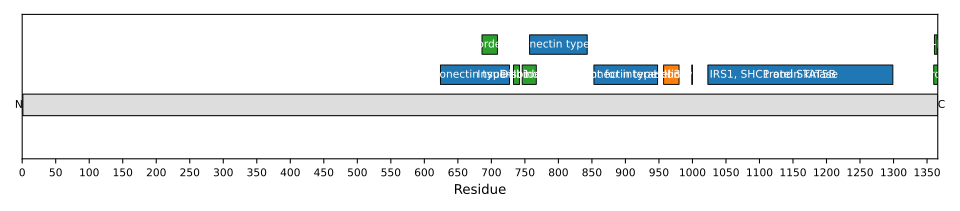
1: Receptor tyrosine kinase which mediates the pleiotropic actions of insulin. Binding of insulin leads to phosphorylation of several intracellular substrates, including, insulin receptor substrates (IRS1, 2, 3, 4), SHC, GAB1, CBL and other signaling intermediates. Each of these phosphorylated proteins serve as docking proteins for other signaling proteins that contain Src-homology-2 domains (SH2 domain) that specifically recognize different phosphotyrosine residues, including the p85 regulatory subunit of PI3K and SHP2. Phosphorylation of IRSs proteins lead to the activation of two main signaling pathways: the PI3K-AKT/PKB pathway, which is responsible for most of the metabolic actions of insulin, and the Ras-MAPK pathway, which regulates expression of some genes and cooperates with the PI3K pathway to control cell growth and differentiation. Binding of the SH2 domains of PI3K to phosphotyrosines on IRS1 leads to the activation of PI3K and the generation of phosphatidylinositol-(3, 4, 5)-triphosphate (PIP3), a lipid second messenger, which activates several PIP3-dependent serine/threonine kinases, such as PDPK1 and subsequently AKT/PKB. The net effect of this pathway is to produce a translocation of the glucose transporter SLC2A4/GLUT4 from cytoplasmic vesicles to the cell membrane to facilitate glucose transport. Moreover, upon insulin stimulation, activated AKT/PKB is responsible for: anti-apoptotic effect of insulin by inducing phosphorylation of BAD; regulates the expression of gluconeogenic and lipogenic enzymes by controlling the activity of the winged helix or forkhead (FOX) class of transcription factors. Another pathway regulated by PI3K-AKT/PKB activation is mTORC1 signaling pathway which regulates cell growth and metabolism and integrates signals from insulin. AKT mediates insulin-stimulated protein synthesis by phosphorylating TSC2 thereby activating mTORC1 pathway. The Ras/RAF/MAP2K/MAPK pathway is mainly involved in mediating cell growth, survival and cellular differentiation of insulin. Phosphorylated IRS1 recruits GRB2/SOS complex, which triggers the activation of the Ras/RAF/MAP2K/MAPK pathway. In addition to binding insulin, the insulin receptor can bind insulin-like growth factors (IGFI and IGFII). Isoform Short has a higher affinity for IGFII binding. When present in a hybrid receptor with IGF1R, binds IGF1. PubMed:12138094 shows that hybrid receptors composed of IGF1R and INSR isoform Long are activated with a high affinity by IGF1, with low affinity by IGF2 and not significantly activated by insulin, and that hybrid receptors composed of IGF1R and INSR isoform Short are activated by IGF1, IGF2 and insulin. In contrast, PubMed:16831875 shows that hybrid receptors composed of IGF1R and INSR isoform Long and hybrid receptors composed of IGF1R and INSR isoform Short have similar binding characteristics, both bind IGF1 and have a low affinity for insulin. In adipocytes, inhibits lipolysis (By similarity)