Tyrosine-protein kinase Lck (EC 2.7.10.2) (Leukocyte C-terminal Src kinase) (LSK) (Lymphocyte cell-specific protein-tyrosine kinase) (Protein YT16) (Proto-oncogene Lck) (T cell-specific protein-tyrosine kinase) (p56-LCK)
1_MGCGC 6_ SSHPE 11_ DDWME 16_ NIDVC 21_ ENCHY 26_ PIVPL 31_ DGKGT 36_ LLIRN 41_ GSEVR 46_ DPLVT 51_ YEGSN 56_ PPASP 61_ LQDNL 66_ VIALH 71_ SYEPS 76_ HDGDL 81_ GFEKG 86_ EQLRI 91_ LEQSG 96_ EWWKA 101_ QSLTT 106_ GQEGF 111_ IPFNF 116_ VAKAN 121_ SLEPE 126_ PWFFK 131_ NLSRK 136_ DAERQ 141_ LLAPG 146_ NTHGS 151_ FLIRE 156_ SESTA 161_ GSFSL 166_ SVRDF 171_ DQNQG 176_ EVVKH 181_ YKIRN 186_ LDNGG 191_ FYISP 196_ RITFP 201_ GLHEL 206_ VRHYT 211_ NASDG 216_ LCTRL 221_ SRPCQ 226_ TQKPQ 231_ KPWWE 236_ DEWEV 241_ PRETL 246_ KLVER 251_ LGAGQ 256_ FGEVW 261_ MGYYN 266_ GHTKV 271_ AVKSL 276_ KQGSM 281_ SPDAF 286_ LAEAN 291_ LMKQL 296_ QHQRL 301_ VRLYA 306_ VVTQE 311_ PIYII 316_ TEYME 321_ NGSLV 326_ DFLKT 331_ PSGIK 336_ LTINK 341_ LLDMA 346_ AQIAE 351_ GMAFI 356_ EERNY 361_ IHRDL 366_ RAANI 371_ LVSDT 376_ LSCKI 381_ ADFGL 386_ ARLIE 391_ DNEYT 396_ AREGA 401_ KFPIK 406_ WTAPE 411_ AINYG 416_ TFTIK 421_ SDVWS 426_ FGILL 431_ TEIVT 436_ HGRIP 441_ YPGMT 446_ NPEVI 451_ QNLER 456_ GYRMV 461_ RPDNC 466_ PEELY 471_ QLMRL 476_ CWKER 481_ PEDRP 486_ TFDYL 491_ RSVLE 496_ DFFTA 501_TEGQY
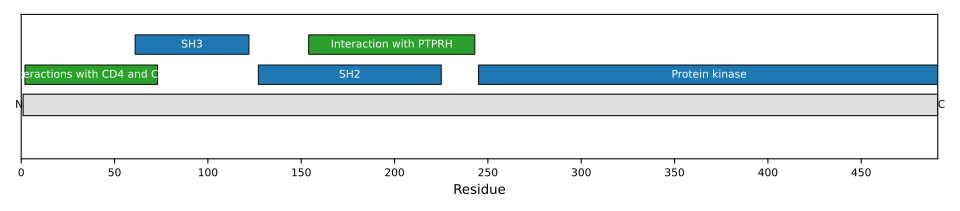
1: Non-receptor tyrosine-protein kinase that plays an essential role in the selection and maturation of developing T-cells in the thymus and in the function of mature T-cells. Plays a key role in T-cell antigen receptor (TCR)-linked signal transduction pathways. Constitutively associated with the cytoplasmic portions of the CD4 and CD8 surface receptors. Association of the TCR with a peptide antigen-bound MHC complex facilitates the interaction of CD4 and CD8 with MHC class II and class I molecules, respectively, thereby recruiting the associated LCK protein to the vicinity of the TCR/CD3 complex. LCK then phosphorylates tyrosine residues within the immunoreceptor tyrosine-based activation motifs (ITAM) of the cytoplasmic tails of the TCR-gamma chains and CD3 subunits, initiating the TCR/CD3 signaling pathway. Once stimulated, the TCR recruits the tyrosine kinase ZAP70, that becomes phosphorylated and activated by LCK. Following this, a large number of signaling molecules are recruited, ultimately leading to lymphokine production. LCK also contributes to signaling by other receptor molecules. Associates directly with the cytoplasmic tail of CD2, which leads to hyperphosphorylation and activation of LCK. Also plays a role in the IL2 receptor-linked signaling pathway that controls the T-cell proliferative response. Binding of IL2 to its receptor results in increased activity of LCK. Is expressed at all stages of thymocyte development and is required for the regulation of maturation events that are governed by both pre-TCR and mature alpha beta TCR. Phosphorylates other substrates including RUNX3, PTK2B/PYK2, the microtubule-associated protein MAPT, RHOH or TYROBP. Interacts with FYB2 (PubMed:27335501)