DNA polymerase beta (EC 2.7.7.7) (EC 4.2.99.-)
1_MSKRK 6_ APQET 11_ LNGGI 16_ TDMLT 21_ ELANF 26_ EKNVS 31_ QAIHK 36_ YNAYR 41_ KAASV 46_ IAKYP 51_ HKIKS 56_ GAEAK 61_ KLPGV 66_ GTKIA 71_ EKIDE 76_ FLATG 81_ KLRKL 86_ EKIRQ 91_ DDTSS 96_ SINFL 101_ TRVSG 106_ IGPSA 111_ ARKFV 116_ DEGIK 121_ TLEDL 126_ RKNED 131_ KLNHH 136_ QRIGL 141_ KYFGD 146_ FEKRI 151_ PREEM 156_ LQMQD 161_ IVLNE 166_ VKKVD 171_ SEYIA 176_ TVCGS 181_ FRRGA 186_ ESSGD 191_ MDVLL 196_ THPSF 201_ TSEST 206_ KQPKL 211_ LHQVV 216_ EQLQK 221_ VHFIT 226_ DTLSK 231_ GETKF 236_ MGVCQ 241_ LPSKN 246_ DEKEY 251_ PHRRI 256_ DIRLI 261_ PKDQY 266_ YCGVL 271_ YFTGS 276_ DIFNK 281_ NMRAH 286_ ALEKG 291_ FTINE 296_ YTIRP 301_ LGVTG 306_ VAGEP 311_ LPVDS 316_ EKDIF 321_ DYIQW 326_KYREP
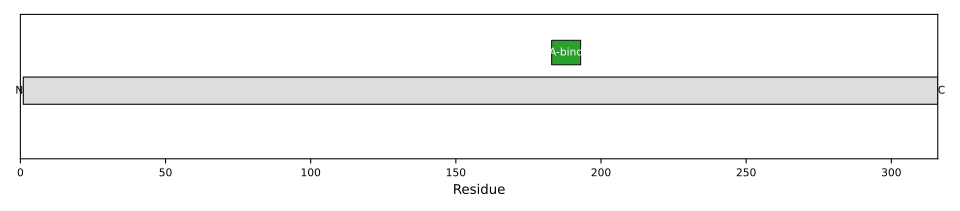
1: Repair polymerase that plays a key role in base-excision repair (PubMed:10556592, PubMed:9207062, PubMed:9572863). During this process, the damaged base is excised by specific DNA glycosylases, the DNA backbone is nicked at the abasic site by an apurinic/apyrimidic (AP) endonuclease, and POLB removes 5'-deoxyribose-phosphate from the preincised AP site acting as a 5'-deoxyribose-phosphate lyase (5'-dRP lyase); through its DNA polymerase activity, it adds one nucleotide to the 3' end of the arising single-nucleotide gap (PubMed:10556592, PubMed:17526740, PubMed:9556598, PubMed:9572863, PubMed:9614142). Conducts 'gap-filling' DNA synthesis in a stepwise distributive fashion rather than in a processive fashion as for other DNA polymerases. It is also able to cleave sugar-phosphate bonds 3' to an intact AP site, acting as an AP lyase (PubMed:9614142)