Macrophage colony-stimulating factor 1 receptor (CSF-1 receptor) (CSF-1-R) (CSF-1R) (M-CSF-R) (EC 2.7.10.1) (Proto-oncogene c-Fms) (CD antigen CD115)
1_MGPGV 6_ LLLLL 11_ VATAW 16_ HGQGI 21_ PVIEP 26_ SVPEL 31_ VVKPG 36_ ATVTL 41_ RCVGN 46_ GSVEW 51_ DGPPS 56_ PHWTL 61_ YSDGS 66_ SSILS 71_ TNNAT 76_ FQNTG 81_ TYRCT 86_ EPGDP 91_ LGGSA 96_ AIHLY 101_ VKDPA 106_ RPWNV 111_ LAQEV 116_ VVFED 121_ QDALL 126_ PCLLT 131_ DPVLE 136_ AGVSL 141_ VRVRG 146_ RPLMR 151_ HTNYS 156_ FSPWH 161_ GFTIH 166_ RAKFI 171_ QSQDY 176_ QCSAL 181_ MGGRK 186_ VMSIS 191_ IRLKV 196_ QKVIP 201_ GPPAL 206_ TLVPA 211_ ELVRI 216_ RGEAA 221_ QIVCS 226_ ASSVD 231_ VNFDV 236_ FLQHN 241_ NTKLA 246_ IPQQS 251_ DFHNN 256_ RYQKV 261_ LTLNL 266_ DQVDF 271_ QHAGN 276_ YSCVA 281_ SNVQG 286_ KHSTS 291_ MFFRV 296_ VESAY 301_ LNLSS 306_ EQNLI 311_ QEVTV 316_ GEGLN 321_ LKVMV 326_ EAYPG 331_ LQGFN 336_ WTYLG 341_ PFSDH 346_ QPEPK 351_ LANAT 356_ TKDTY 361_ RHTFT 366_ LSLPR 371_ LKPSE 376_ AGRYS 381_ FLARN 386_ PGGWR 391_ ALTFE 396_ LTLRY 401_ PPEVS 406_ VIWTF 411_ INGSG 416_ TLLCA 421_ ASGYP 426_ QPNVT 431_ WLQCS 436_ GHTDR 441_ CDEAQ 446_ VLQVW 451_ DDPYP 456_ EVLSQ 461_ EPFHK 466_ VTVQS 471_ LLTVE 476_ TLEHN 481_ QTYEC 486_ RAHNS 491_ VGSGS 496_ WAFIP 501_ ISAGA 506_ HTHPP 511_ DEFLF 516_ TPVVV 521_ ACMSI 526_ MALLL 531_ LLLLL 536_ LLYKY 541_ KQKPK 546_ YQVRW 551_ KIIES 556_ YEGNS 561_ YTFID 566_ PTQLP 571_ YNEKW 576_ EFPRN 581_ NLQFG 586_ KTLGA 591_ GAFGK 596_ VVEAT 601_ AFGLG 606_ KEDAV 611_ LKVAV 616_ KMLKS 621_ TAHAD 626_ EKEAL 631_ MSELK 636_ IMSHL 641_ GQHEN 646_ IVNLL 651_ GACTH 656_ GGPVL 661_ VITEY 666_ CCYGD 671_ LLNFL 676_ RRKAE 681_ AMLGP 686_ SLSPG 691_ QDPEG 696_ GVDYK 701_ NIHLE 706_ KKYVR 711_ RDSGF 716_ SSQGV 721_ DTYVE 726_ MRPVS 731_ TSSND 736_ SFSEQ 741_ DLDKE 746_ DGRPL 751_ ELRDL 756_ LHFSS 761_ QVAQG 766_ MAFLA 771_ SKNCI 776_ HRDVA 781_ ARNVL 786_ LTNGH 791_ VAKIG 796_ DFGLA 801_ RDIMN 806_ DSNYI 811_ VKGNA 816_ RLPVK 821_ WMAPE 826_ SIFDC 831_ VYTVQ 836_ SDVWS 841_ YGILL 846_ WEIFS 851_ LGLNP 856_ YPGIL 861_ VNSKF 866_ YKLVK 871_ DGYQM 876_ AQPAF 881_ APKNI 886_ YSIMQ 891_ ACWAL 896_ EPTHR 901_ PTFQQ 906_ ICSFL 911_ QEQAQ 916_ EDRRE 921_ RDYTN 926_ LPSSS 931_ RSGGS 936_ GSSSS 941_ ELEEE 946_ SSSEH 951_ LTCCE 956_ QGDIA 961_ QPLLQ 966_PNNYQ
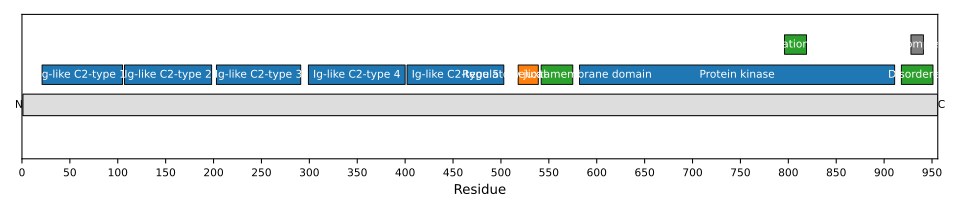
1: Tyrosine-protein kinase that acts as a cell-surface receptor for CSF1 and IL34 and plays an essential role in the regulation of survival, proliferation and differentiation of hematopoietic precursor cells, especially mononuclear phagocytes, such as macrophages and monocytes. Promotes the release of pro-inflammatory chemokines in response to IL34 and CSF1, and thereby plays an important role in innate immunity and in inflammatory processes. Plays an important role in the regulation of osteoclast proliferation and differentiation, the regulation of bone resorption, and is required for normal bone and tooth development. Required for normal male and female fertility, and for normal development of milk ducts and acinar structures in the mammary gland during pregnancy. Promotes reorganization of the actin cytoskeleton, regulates formation of membrane ruffles, cell adhesion and cell migration, and promotes cancer cell invasion. Activates several signaling pathways in response to ligand binding, including the ERK1/2 and the JNK pathway (PubMed:20504948, PubMed:30982609). Phosphorylates PIK3R1, PLCG2, GRB2, SLA2 and CBL. Activation of PLCG2 leads to the production of the cellular signaling molecules diacylglycerol and inositol 1,4,5-trisphosphate, that then lead to the activation of protein kinase C family members, especially PRKCD. Phosphorylation of PIK3R1, the regulatory subunit of phosphatidylinositol 3-kinase, leads to activation of the AKT1 signaling pathway. Activated CSF1R also mediates activation of the MAP kinases MAPK1/ERK2 and/or MAPK3/ERK1, and of the SRC family kinases SRC, FYN and YES1. Activated CSF1R transmits signals both via proteins that directly interact with phosphorylated tyrosine residues in its intracellular domain, or via adapter proteins, such as GRB2. Promotes activation of STAT family members STAT3, STAT5A and/or STAT5B. Promotes tyrosine phosphorylation of SHC1 and INPP5D/SHIP-1. Receptor signaling is down-regulated by protein phosphatases, such as INPP5D/SHIP-1, that dephosphorylate the receptor and its downstream effectors, and by rapid internalization of the activated receptor. In the central nervous system, may play a role in the development of microglia macrophages (PubMed:30982608)