Procathepsin L (EC 3.4.22.15) (Cathepsin L1) (Major excreted protein) (MEP) [Cleaved into: Cathepsin L; Cathepsin L heavy chain; Cathepsin L light chain]
1_MNPTL 6_ ILAAF 11_ CLGIA 16_ SATLT 21_ FDHSL 26_ EAQWT 31_ KWKAM 36_ HNRLY 41_ GMNEE 46_ GWRRA 51_ VWEKN 56_ MKMIE 61_ LHNQE 66_ YREGK 71_ HSFTM 76_ AMNAF 81_ GDMTS 86_ EEFRQ 91_ VMNGF 96_ QNRKP 101_ RKGKV 106_ FQEPL 111_ FYEAP 116_ RSVDW 121_ REKGY 126_ VTPVK 131_ NQGQC 136_ GSCWA 141_ FSATG 146_ ALEGQ 151_ MFRKT 156_ GRLIS 161_ LSEQN 166_ LVDCS 171_ GPQGN 176_ EGCNG 181_ GLMDY 186_ AFQYV 191_ QDNGG 196_ LDSEE 201_ SYPYE 206_ ATEES 211_ CKYNP 216_ KYSVA 221_ NDTGF 226_ VDIPK 231_ QEKAL 236_ MKAVA 241_ TVGPI 246_ SVAID 251_ AGHES 256_ FLFYK 261_ EGIYF 266_ EPDCS 271_ SEDMD 276_ HGVLV 281_ VGYGF 286_ ESTES 291_ DNNKY 296_ WLVKN 301_ SWGEE 306_ WGMGG 311_ YVKMA 316_ KDRRN 321_ HCGIA 326_SAASY
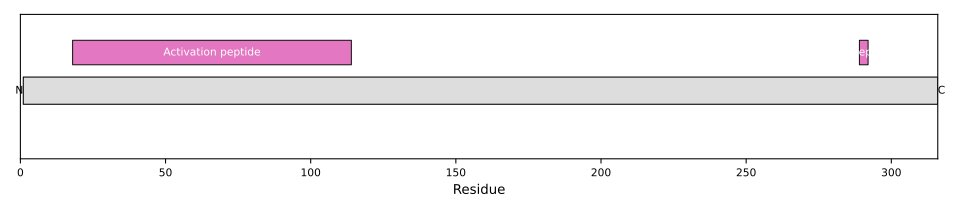
1: Thiol protease important for the overall degradation of proteins in lysosomes (Probable). Plays a critical for normal cellular functions such as general protein turnover, antigen processing and bone remodeling. Involved in the solubilization of cross-linked TG/thyroglobulin and in the subsequent release of thyroid hormone thyroxine (T4) by limited proteolysis of TG/thyroglobulin in the thyroid follicle lumen (By similarity). In neuroendocrine chromaffin cells secretory vesicles, catalyzes the prohormone proenkephalin processing to the active enkephalin peptide neurotransmitter (By similarity). In thymus, regulates CD4(+) T cell positive selection by generating the major histocompatibility complex class II (MHCII) bound peptide ligands presented by cortical thymic epithelial cells. Also mediates invariant chain processing in cortical thymic epithelial cells (By similarity). Major elastin-degrading enzyme at neutral pH. Accumulates as a mature and active enzyme in the extracellular space of antigen presenting cells (APCs) to regulate degradation of the extracellular matrix in the course of inflammation (By similarity). Secreted form generates endostatin from COL18A1 (PubMed:10716919). Critical for cardiac morphology and function. Plays an important role in hair follicle morphogenesis and cycling, as well as epidermal differentiation (By similarity). Required for maximal stimulation of steroidogenesis by TIMP1 (By similarity)
2: (Microbial infection) In cells lacking TMPRSS2 expression, facilitates human coronaviruses SARS-CoV and SARS-CoV-2 infections via a slow acid-activated route with the proteolysis of coronavirus spike (S) glycoproteins in lysosome for entry into host cell (PubMed:16339146, PubMed:18562523, PubMed:32142651, PubMed:32221306, PubMed:37990007). Proteolysis within lysosomes is sufficient to activate membrane fusion by coronaviruses SARS-CoV and EMC (HCoV-EMC) S as well as Zaire ebolavirus glycoproteins (PubMed:16081529, PubMed:18562523, PubMed:26953343)
3: Functions in the regulation of cell cycle progression through proteolytic processing of the CUX1 transcription factor (PubMed:15099520). Translation initiation at downstream start sites allows the synthesis of isoforms that are devoid of a signal peptide and localize to the nucleus where they cleave the CUX1 transcription factor and modify its DNA binding properties (PubMed:15099520)