T-cell surface glycoprotein CD3 epsilon chain (T-cell surface antigen T3/Leu-4 epsilon chain) (CD antigen CD3e)
1_MQSGT 6_ HWRVL 11_ GLCLL 16_ SVGVW 21_ GQDGN 26_ EEMGG 31_ ITQTP 36_ YKVSI 41_ SGTTV 46_ ILTCP 51_ QYPGS 56_ EILWQ 61_ HNDKN 66_ IGGDE 71_ DDKNI 76_ GSDED 81_ HLSLK 86_ EFSEL 91_ EQSGY 96_ YVCYP 101_ RGSKP 106_ EDANF 111_ YLYLR 116_ ARVCE 121_ NCMEM 126_ DVMSV 131_ ATIVI 136_ VDICI 141_ TGGLL 146_ LLVYY 151_ WSKNR 156_ KAKAK 161_ PVTRG 166_ AGAGG 171_ RQRGQ 176_ NKERP 181_ PPVPN 186_ PDYEP 191_ IRKGQ 196_ RDLYS 201_GLNQR
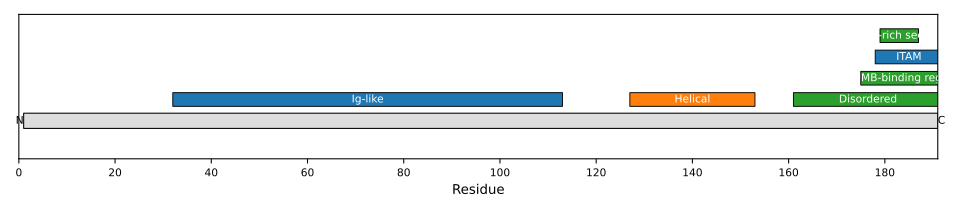
1: Part of the TCR-CD3 complex present on T-lymphocyte cell surface that plays an essential role in adaptive immune response. When antigen presenting cells (APCs) activate T-cell receptor (TCR), TCR-mediated signals are transmitted across the cell membrane by the CD3 chains CD3D, CD3E, CD3G and CD3Z. All CD3 chains contain immunoreceptor tyrosine-based activation motifs (ITAMs) in their cytoplasmic domain. Upon TCR engagement, these motifs become phosphorylated by Src family protein tyrosine kinases LCK and FYN, resulting in the activation of downstream signaling pathways (PubMed:2470098). In addition of this role of signal transduction in T-cell activation, CD3E plays an essential role in correct T-cell development. Initiates the TCR-CD3 complex assembly by forming the two heterodimers CD3D/CD3E and CD3G/CD3E. Also participates in internalization and cell surface down-regulation of TCR-CD3 complexes via endocytosis sequences present in CD3E cytosolic region (PubMed:10384095, PubMed:26507128). In addition to its role as a TCR coreceptor, it serves as a receptor for ITPRIPL1. Ligand recognition inhibits T-cell activation by promoting interaction with NCK1, which prevents CD3E-ZAP70 interaction and blocks the ERK-NFkB signaling cascade and calcium influx (PubMed:38614099)