Heat shock protein HSP 90-alpha (EC 3.6.4.10) (Heat shock 86 kDa) (HSP 86) (HSP86) (Lipopolysaccharide-associated protein 2) (LAP-2) (LPS-associated protein 2) (Renal carcinoma antigen NY-REN-38)
1_MPEET 6_ QTQDQ 11_ PMEEE 16_ EVETF 21_ AFQAE 26_ IAQLM 31_ SLIIN 36_ TFYSN 41_ KEIFL 46_ RELIS 51_ NSSDA 56_ LDKIR 61_ YESLT 66_ DPSKL 71_ DSGKE 76_ LHINL 81_ IPNKQ 86_ DRTLT 91_ IVDTG 96_ IGMTK 101_ ADLIN 106_ NLGTI 111_ AKSGT 116_ KAFME 121_ ALQAG 126_ ADISM 131_ IGQFG 136_ VGFYS 141_ AYLVA 146_ EKVTV 151_ ITKHN 156_ DDEQY 161_ AWESS 166_ AGGSF 171_ TVRTD 176_ TGEPM 181_ GRGTK 186_ VILHL 191_ KEDQT 196_ EYLEE 201_ RRIKE 206_ IVKKH 211_ SQFIG 216_ YPITL 221_ FVEKE 226_ RDKEV 231_ SDDEA 236_ EEKED 241_ KEEEK 246_ EKEEK 251_ ESEDK 256_ PEIED 261_ VGSDE 266_ EEEKK 271_ DGDKK 276_ KKKKI 281_ KEKYI 286_ DQEEL 291_ NKTKP 296_ IWTRN 301_ PDDIT 306_ NEEYG 311_ EFYKS 316_ LTNDW 321_ EDHLA 326_ VKHFS 331_ VEGQL 336_ EFRAL 341_ LFVPR 346_ RAPFD 351_ LFENR 356_ KKKNN 361_ IKLYV 366_ RRVFI 371_ MDNCE 376_ ELIPE 381_ YLNFI 386_ RGVVD 391_ SEDLP 396_ LNISR 401_ EMLQQ 406_ SKILK 411_ VIRKN 416_ LVKKC 421_ LELFT 426_ ELAED 431_ KENYK 436_ KFYEQ 441_ FSKNI 446_ KLGIH 451_ EDSQN 456_ RKKLS 461_ ELLRY 466_ YTSAS 471_ GDEMV 476_ SLKDY 481_ CTRMK 486_ ENQKH 491_ IYYIT 496_ GETKD 501_ QVANS 506_ AFVER 511_ LRKHG 516_ LEVIY 521_ MIEPI 526_ DEYCV 531_ QQLKE 536_ FEGKT 541_ LVSVT 546_ KEGLE 551_ LPEDE 556_ EEKKK 561_ QEEKK 566_ TKFEN 571_ LCKIM 576_ KDILE 581_ KKVEK 586_ VVVSN 591_ RLVTS 596_ PCCIV 601_ TSTYG 606_ WTANM 611_ ERIMK 616_ AQALR 621_ DNSTM 626_ GYMAA 631_ KKHLE 636_ INPDH 641_ SIIET 646_ LRQKA 651_ EADKN 656_ DKSVK 661_ DLVIL 666_ LYETA 671_ LLSSG 676_ FSLED 681_ PQTHA 686_ NRIYR 691_ MIKLG 696_ LGIDE 701_ DDPTA 706_ DDTSA 711_ AVTEE 716_ MPPLE 721_ GDDDT 726_SRMEE
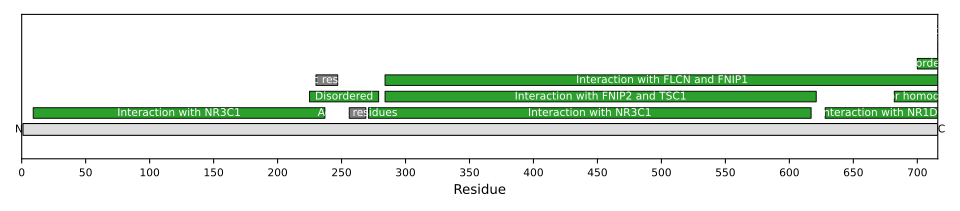
1: Molecular chaperone that promotes the maturation, structural maintenance and proper regulation of specific target proteins involved for instance in cell cycle control and signal transduction. Undergoes a functional cycle that is linked to its ATPase activity which is essential for its chaperone activity. This cycle probably induces conformational changes in the client proteins, thereby causing their activation. Interacts dynamically with various co-chaperones that modulate its substrate recognition, ATPase cycle and chaperone function (PubMed:11274138, PubMed:12526792, PubMed:15577939, PubMed:15937123, PubMed:27353360, PubMed:29127155). Engages with a range of client protein classes via its interaction with various co-chaperone proteins or complexes, that act as adapters, simultaneously able to interact with the specific client and the central chaperone itself (PubMed:29127155). Recruitment of ATP and co-chaperone followed by client protein forms a functional chaperone. After the completion of the chaperoning process, properly folded client protein and co-chaperone leave HSP90 in an ADP-bound partially open conformation and finally, ADP is released from HSP90 which acquires an open conformation for the next cycle (PubMed:26991466, PubMed:27295069). Plays a critical role in mitochondrial import, delivers preproteins to the mitochondrial import receptor TOMM70 (PubMed:12526792). Apart from its chaperone activity, it also plays a role in the regulation of the transcription machinery. HSP90 and its co-chaperones modulate transcription at least at three different levels (PubMed:25973397). In the first place, they alter the steady-state levels of certain transcription factors in response to various physiological cues (PubMed:25973397). Second, they modulate the activity of certain epigenetic modifiers, such as histone deacetylases or DNA methyl transferases, and thereby respond to the change in the environment (PubMed:25973397). Third, they participate in the eviction of histones from the promoter region of certain genes and thereby turn on gene expression (PubMed:25973397). Binds bacterial lipopolysaccharide (LPS) and mediates LPS-induced inflammatory response, including TNF secretion by monocytes (PubMed:11276205). Antagonizes STUB1-mediated inhibition of TGF-beta signaling via inhibition of STUB1-mediated SMAD3 ubiquitination and degradation (PubMed:24613385). Mediates the association of TOMM70 with IRF3 or TBK1 in mitochondrial outer membrane which promotes host antiviral response (PubMed:20628368, PubMed:25609812)
2: (Microbial infection) Seems to interfere with N.meningitidis NadA-mediated invasion of human cells. Decreasing HSP90 levels increases adhesion and entry of E.coli expressing NadA into human Chang cells; increasing its levels leads to decreased adhesion and invasion