Proto-oncogene tyrosine-protein kinase receptor Ret (EC 2.7.10.1) (Cadherin family member 12) (Proto-oncogene c-Ret) [Cleaved into: Soluble RET kinase fragment; Extracellular cell-membrane anchored RET cadherin 120 kDa fragment]
1_MAKAT 6_ SGAAG 11_ LRLLL 16_ LLLLP 21_ LLGKV 26_ ALGLY 31_ FSRDA 36_ YWEKL 41_ YVDQA 46_ AGTPL 51_ LYVHA 56_ LRDAP 61_ EEVPS 66_ FRLGQ 71_ HLYGT 76_ YRTRL 81_ HENNW 86_ ICIQE 91_ DTGLL 96_ YLNRS 101_ LDHSS 106_ WEKLS 111_ VRNRG 116_ FPLLT 121_ VYLKV 126_ FLSPT 131_ SLREG 136_ ECQWP 141_ GCARV 146_ YFSFF 151_ NTSFP 156_ ACSSL 161_ KPREL 166_ CFPET 171_ RPSFR 176_ IRENR 181_ PPGTF 186_ HQFRL 191_ LPVQF 196_ LCPNI 201_ SVAYR 206_ LLEGE 211_ GLPFR 216_ CAPDS 221_ LEVST 226_ RWALD 231_ REQRE 236_ KYELV 241_ AVCTV 246_ HAGAR 251_ EEVVM 256_ VPFPV 261_ TVYDE 266_ DDSAP 271_ TFPAG 276_ VDTAS 281_ AVVEF 286_ KRKED 291_ TVVAT 296_ LRVFD 301_ ADVVP 306_ ASGEL 311_ VRRYT 316_ STLLP 321_ GDTWA 326_ QQTFR 331_ VEHWP 336_ NETSV 341_ QANGS 346_ FVRAT 351_ VHDYR 356_ LVLNR 361_ NLSIS 366_ ENRTM 371_ QLAVL 376_ VNDSD 381_ FQGPG 386_ AGVLL 391_ LHFNV 396_ SVLPV 401_ SLHLP 406_ STYSL 411_ SVSRR 416_ ARRFA 421_ QIGKV 426_ CVENC 431_ QAFSG 436_ INVQY 441_ KLHSS 446_ GANCS 451_ TLGVV 456_ TSAED 461_ TSGIL 466_ FVNDT 471_ KALRR 476_ PKCAE 481_ LHYMV 486_ VATDQ 491_ QTSRQ 496_ AQAQL 501_ LVTVE 506_ GSYVA 511_ EEAGC 516_ PLSCA 521_ VSKRR 526_ LECEE 531_ CGGLG 536_ SPTGR 541_ CEWRQ 546_ GDGKG 551_ ITRNF 556_ STCSP 561_ STKTC 566_ PDGHC 571_ DVVET 576_ QDINI 581_ CPQDC 586_ LRGSI 591_ VGGHE 596_ PGEPR 601_ GIKAG 606_ YGTCN 611_ CFPEE 616_ EKCFC 621_ EPEDI 626_ QDPLC 631_ DELCR 636_ TVIAA 641_ AVLFS 646_ FIVSV 651_ LLSAF 656_ CIHCY 661_ HKFAH 666_ KPPIS 671_ SAEMT 676_ FRRPA 681_ QAFPV 686_ SYSSS 691_ GARRP 696_ SLDSM 701_ ENQVS 706_ VDAFK 711_ ILEDP 716_ KWEFP 721_ RKNLV 726_ LGKTL 731_ GEGEF 736_ GKVVK 741_ ATAFH 746_ LKGRA 751_ GYTTV 756_ AVKML 761_ KENAS 766_ PSELR 771_ DLLSE 776_ FNVLK 781_ QVNHP 786_ HVIKL 791_ YGACS 796_ QDGPL 801_ LLIVE 806_ YAKYG 811_ SLRGF 816_ LRESR 821_ KVGPG 826_ YLGSG 831_ GSRNS 836_ SSLDH 841_ PDERA 846_ LTMGD 851_ LISFA 856_ WQISQ 861_ GMQYL 866_ AEMKL 871_ VHRDL 876_ AARNI 881_ LVAEG 886_ RKMKI 891_ SDFGL 896_ SRDVY 901_ EEDSY 906_ VKRSQ 911_ GRIPV 916_ KWMAI 921_ ESLFD 926_ HIYTT 931_ QSDVW 936_ SFGVL 941_ LWEIV 946_ TLGGN 951_ PYPGI 956_ PPERL 961_ FNLLK 966_ TGHRM 971_ ERPDN 976_ CSEEM 981_ YRLML 986_ QCWKQ 991_ EPDKR 996_ PVFAD 1001_ ISKDL 1006_ EKMMV 1011_ KRRDY 1016_ LDLAA 1021_ STPSD 1026_ SLIYD 1031_ DGLSE 1036_ EETPL 1041_ VDCNN 1046_ APLPR 1051_ ALPST 1056_ WIENK 1061_ LYGMS 1066_ DPNWP 1071_ GESPV 1076_ PLTRA 1081_ DGTNT 1086_ GFPRY 1091_ PNDSV 1096_ YANWM 1101_ LSPSA 1106_AKLMD
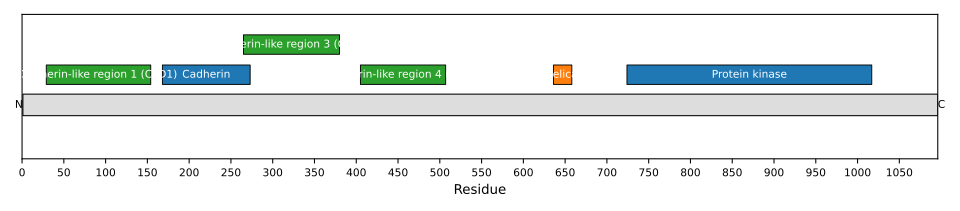
1: Receptor tyrosine-protein kinase involved in numerous cellular mechanisms including cell proliferation, neuronal navigation, cell migration, and cell differentiation in response to glia cell line-derived growth family factors (GDNF, NRTN, ARTN, PSPN and GDF15) (PubMed:20064382, PubMed:20616503, PubMed:20702524, PubMed:21357690, PubMed:21454698, PubMed:24560924, PubMed:28846097, PubMed:28846099, PubMed:28953886, PubMed:31118272). In contrast to most receptor tyrosine kinases, RET requires not only its cognate ligands but also coreceptors, for activation (PubMed:21994944, PubMed:23333276, PubMed:28846097, PubMed:28846099, PubMed:28953886). GDNF ligands (GDNF, NRTN, ARTN, PSPN and GDF15) first bind their corresponding GDNFR coreceptors (GFRA1, GFRA2, GFRA3, GFRA4 and GFRAL, respectively), triggering RET autophosphorylation and activation, leading to activation of downstream signaling pathways, including the MAPK- and AKT-signaling pathways (PubMed:21994944, PubMed:23333276, PubMed:24560924, PubMed:25242331, PubMed:28846097, PubMed:28846099, PubMed:28953886). Acts as a dependence receptor via the GDNF-GFRA1 signaling: in the presence of the ligand GDNF in somatotrophs within pituitary, promotes survival and down regulates growth hormone (GH) production, but triggers apoptosis in absence of GDNF (PubMed:20616503, PubMed:21994944). Required for the molecular mechanisms orchestration during intestine organogenesis via the ARTN-GFRA3 signaling: involved in the development of enteric nervous system and renal organogenesis during embryonic life, and promotes the formation of Peyer's patch-like structures, a major component of the gut-associated lymphoid tissue (By similarity). Mediates, through interaction with GDF15-receptor GFRAL, GDF15-induced cell-signaling in the brainstem which triggers an aversive response, characterized by nausea, vomiting, and/or loss of appetite in response to various stresses (PubMed:28846097, PubMed:28846099, PubMed:28953886). Modulates cell adhesion via its cleavage by caspase in sympathetic neurons and mediates cell migration in an integrin (e.g. ITGB1 and ITGB3)-dependent manner (PubMed:20702524, PubMed:21357690). Also active in the absence of ligand, triggering apoptosis through a mechanism that requires receptor intracellular caspase cleavage (PubMed:21357690). Triggers the differentiation of rapidly adapting (RA) mechanoreceptors (PubMed:20064382). Involved in the development of the neural crest (By similarity). Regulates nociceptor survival and size (By similarity). Phosphorylates PTK2/FAK1 (PubMed:21454698)
2: Isoform 1 in complex with GFRAL induces higher activation of MAPK-signaling pathway than isoform 2 in complex with GFRAL