Insulin-like growth factor 1 receptor (EC 2.7.10.1) (Insulin-like growth factor I receptor) (IGF-I receptor) (CD antigen CD221) [Cleaved into: Insulin-like growth factor 1 receptor alpha chain; Insulin-like growth factor 1 receptor beta chain]
1_MKSGS 6_ GGGSP 11_ TSLWG 16_ LLFLS 21_ AALSL 26_ WPTSG 31_ EICGP 36_ GIDIR 41_ NDYQQ 46_ LKRLE 51_ NCTVI 56_ EGYLH 61_ ILLIS 66_ KAEDY 71_ RSYRF 76_ PKLTV 81_ ITEYL 86_ LLFRV 91_ AGLES 96_ LGDLF 101_ PNLTV 106_ IRGWK 111_ LFYNY 116_ ALVIF 121_ EMTNL 126_ KDIGL 131_ YNLRN 136_ ITRGA 141_ IRIEK 146_ NADLC 151_ YLSTV 156_ DWSLI 161_ LDAVS 166_ NNYIV 171_ GNKPP 176_ KECGD 181_ LCPGT 186_ MEEKP 191_ MCEKT 196_ TINNE 201_ YNYRC 206_ WTTNR 211_ CQKMC 216_ PSTCG 221_ KRACT 226_ ENNEC 231_ CHPEC 236_ LGSCS 241_ APDND 246_ TACVA 251_ CRHYY 256_ YAGVC 261_ VPACP 266_ PNTYR 271_ FEGWR 276_ CVDRD 281_ FCANI 286_ LSAES 291_ SDSEG 296_ FVIHD 301_ GECMQ 306_ ECPSG 311_ FIRNG 316_ SQSMY 321_ CIPCE 326_ GPCPK 331_ VCEEE 336_ KKTKT 341_ IDSVT 346_ SAQML 351_ QGCTI 356_ FKGNL 361_ LINIR 366_ RGNNI 371_ ASELE 376_ NFMGL 381_ IEVVT 386_ GYVKI 391_ RHSHA 396_ LVSLS 401_ FLKNL 406_ RLILG 411_ EEQLE 416_ GNYSF 421_ YVLDN 426_ QNLQQ 431_ LWDWD 436_ HRNLT 441_ IKAGK 446_ MYFAF 451_ NPKLC 456_ VSEIY 461_ RMEEV 466_ TGTKG 471_ RQSKG 476_ DINTR 481_ NNGER 486_ ASCES 491_ DVLHF 496_ TSTTT 501_ SKNRI 506_ IITWH 511_ RYRPP 516_ DYRDL 521_ ISFTV 526_ YYKEA 531_ PFKNV 536_ TEYDG 541_ QDACG 546_ SNSWN 551_ MVDVD 556_ LPPNK 561_ DVEPG 566_ ILLHG 571_ LKPWT 576_ QYAVY 581_ VKAVT 586_ LTMVE 591_ NDHIR 596_ GAKSE 601_ ILYIR 606_ TNASV 611_ PSIPL 616_ DVLSA 621_ SNSSS 626_ QLIVK 631_ WNPPS 636_ LPNGN 641_ LSYYI 646_ VRWQR 651_ QPQDG 656_ YLYRH 661_ NYCSK 666_ DKIPI 671_ RKYAD 676_ GTIDI 681_ EEVTE 686_ NPKTE 691_ VCGGE 696_ KGPCC 701_ ACPKT 706_ EAEKQ 711_ AEKEE 716_ AEYRK 721_ VFENF 726_ LHNSI 731_ FVPRP 736_ ERKRR 741_ DVMQV 746_ ANTTM 751_ SSRSR 756_ NTTAA 761_ DTYNI 766_ TDPEE 771_ LETEY 776_ PFFES 781_ RVDNK 786_ ERTVI 791_ SNLRP 796_ FTLYR 801_ IDIHS 806_ CNHEA 811_ EKLGC 816_ SASNF 821_ VFART 826_ MPAEG 831_ ADDIP 836_ GPVTW 841_ EPRPE 846_ NSIFL 851_ KWPEP 856_ ENPNG 861_ LILMY 866_ EIKYG 871_ SQVED 876_ QRECV 881_ SRQEY 886_ RKYGG 891_ AKLNR 896_ LNPGN 901_ YTARI 906_ QATSL 911_ SGNGS 916_ WTDPV 921_ FFYVQ 926_ AKTGY 931_ ENFIH 936_ LIIAL 941_ PVAVL 946_ LIVGG 951_ LVIML 956_ YVFHR 961_ KRNNS 966_ RLGNG 971_ VLYAS 976_ VNPEY 981_ FSAAD 986_ VYVPD 991_ EWEVA 996_ REKIT 1001_ MSREL 1006_ GQGSF 1011_ GMVYE 1016_ GVAKG 1021_ VVKDE 1026_ PETRV 1031_ AIKTV 1036_ NEAAS 1041_ MRERI 1046_ EFLNE 1051_ ASVMK 1056_ EFNCH 1061_ HVVRL 1066_ LGVVS 1071_ QGQPT 1076_ LVIME 1081_ LMTRG 1086_ DLKSY 1091_ LRSLR 1096_ PEMEN 1101_ NPVLA 1106_ PPSLS 1111_ KMIQM 1116_ AGEIA 1121_ DGMAY 1126_ LNANK 1131_ FVHRD 1136_ LAARN 1141_ CMVAE 1146_ DFTVK 1151_ IGDFG 1156_ MTRDI 1161_ YETDY 1166_ YRKGG 1171_ KGLLP 1176_ VRWMS 1181_ PESLK 1186_ DGVFT 1191_ TYSDV 1196_ WSFGV 1201_ VLWEI 1206_ ATLAE 1211_ QPYQG 1216_ LSNEQ 1221_ VLRFV 1226_ MEGGL 1231_ LDKPD 1236_ NCPDM 1241_ LFELM 1246_ RMCWQ 1251_ YNPKM 1256_ RPSFL 1261_ EIISS 1266_ IKEEM 1271_ EPGFR 1276_ EVSFY 1281_ YSEEN 1286_ KLPEP 1291_ EELDL 1296_ EPENM 1301_ ESVPL 1306_ DPSAS 1311_ SSSLP 1316_ LPDRH 1321_ SGHKA 1326_ ENGPG 1331_ PGVLV 1336_ LRASF 1341_ DERQP 1346_ YAHMN 1351_ GGRKN 1356_ ERALP 1361_LPQSS
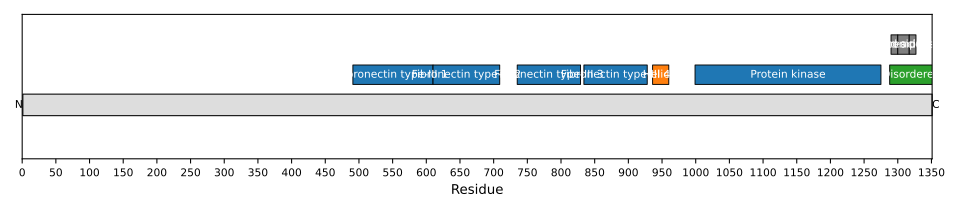
1: Receptor tyrosine kinase which mediates actions of insulin-like growth factor 1 (IGF1). Binds IGF1 with high affinity and IGF2 and insulin (INS) with a lower affinity. The activated IGF1R is involved in cell growth and survival control. IGF1R is crucial for tumor transformation and survival of malignant cell. Ligand binding activates the receptor kinase, leading to receptor autophosphorylation, and tyrosines phosphorylation of multiple substrates, that function as signaling adapter proteins including, the insulin-receptor substrates (IRS1/2), Shc and 14-3-3 proteins. Phosphorylation of IRSs proteins lead to the activation of two main signaling pathways: the PI3K-AKT/PKB pathway and the Ras-MAPK pathway. The result of activating the MAPK pathway is increased cellular proliferation, whereas activating the PI3K pathway inhibits apoptosis and stimulates protein synthesis. Phosphorylated IRS1 can activate the 85 kDa regulatory subunit of PI3K (PIK3R1), leading to activation of several downstream substrates, including protein AKT/PKB. AKT phosphorylation, in turn, enhances protein synthesis through mTOR activation and triggers the antiapoptotic effects of IGFIR through phosphorylation and inactivation of BAD. In parallel to PI3K-driven signaling, recruitment of Grb2/SOS by phosphorylated IRS1 or Shc leads to recruitment of Ras and activation of the ras-MAPK pathway. In addition to these two main signaling pathways IGF1R signals also through the Janus kinase/signal transducer and activator of transcription pathway (JAK/STAT). Phosphorylation of JAK proteins can lead to phosphorylation/activation of signal transducers and activators of transcription (STAT) proteins. In particular activation of STAT3, may be essential for the transforming activity of IGF1R. The JAK/STAT pathway activates gene transcription and may be responsible for the transforming activity. JNK kinases can also be activated by the IGF1R. IGF1 exerts inhibiting activities on JNK activation via phosphorylation and inhibition of MAP3K5/ASK1, which is able to directly associate with the IGF1R
2: When present in a hybrid receptor with INSR, binds IGF1. PubMed:12138094 shows that hybrid receptors composed of IGF1R and INSR isoform Long are activated with a high affinity by IGF1, with low affinity by IGF2 and not significantly activated by insulin, and that hybrid receptors composed of IGF1R and INSR isoform Short are activated by IGF1, IGF2 and insulin. In contrast, PubMed:16831875 shows that hybrid receptors composed of IGF1R and INSR isoform Long and hybrid receptors composed of IGF1R and INSR isoform Short have similar binding characteristics, both bind IGF1 and have a low affinity for insulin