Complement decay-accelerating factor (CD antigen CD55)
1_MTVAR 6_ PSVPA 11_ ALPLL 16_ GELPR 21_ LLLLV 26_ LLCLP 31_ AVWGD 36_ CGLPP 41_ DVPNA 46_ QPALE 51_ GRTSF 56_ PEDTV 61_ ITYKC 66_ EESFV 71_ KIPGE 76_ KDSVI 81_ CLKGS 86_ QWSDI 91_ EEFCN 96_ RSCEV 101_ PTRLN 106_ SASLK 111_ QPYIT 116_ QNYFP 121_ VGTVV 126_ EYECR 131_ PGYRR 136_ EPSLS 141_ PKLTC 146_ LQNLK 151_ WSTAV 156_ EFCKK 161_ KSCPN 166_ PGEIR 171_ NGQID 176_ VPGGI 181_ LFGAT 186_ ISFSC 191_ NTGYK 196_ LFGST 201_ SSFCL 206_ ISGSS 211_ VQWSD 216_ PLPEC 221_ REIYC 226_ PAPPQ 231_ IDNGI 236_ IQGER 241_ DHYGY 246_ RQSVT 251_ YACNK 256_ GFTMI 261_ GEHSI 266_ YCTVN 271_ NDEGE 276_ WSGPP 281_ PECRG 286_ KSLTS 291_ KVPPT 296_ VQKPT 301_ TVNVP 306_ TTEVS 311_ PTSQK 316_ TTTKT 321_ TTPNA 326_ QATRS 331_ TPVSR 336_ TTKHF 341_ HETTP 346_ NKGSG 351_ TTSGT 356_ TRLLS 361_ GHTCF 366_ TLTGL 371_ LGTLV 376_TMGLL
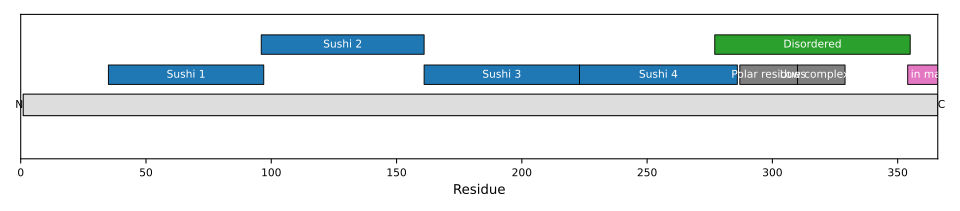
1: This protein recognizes C4b and C3b fragments that condense with cell-surface hydroxyl or amino groups when nascent C4b and C3b are locally generated during C4 and c3 activation. Interaction of daf with cell-associated C4b and C3b polypeptides interferes with their ability to catalyze the conversion of C2 and factor B to enzymatically active C2a and Bb and thereby prevents the formation of C4b2a and C3bBb, the amplification convertases of the complement cascade (PubMed:7525274). Inhibits complement activation by destabilizing and preventing the formation of C3 and C5 convertases, which prevents complement damage (PubMed:28657829)
2: (Microbial infection) Acts as a receptor for Coxsackievirus A21, coxsackieviruses B1, B3 and B5
3: (Microbial infection) Acts as a receptor for Human enterovirus 70 and D68 (Probable)
4: (Microbial infection) Acts as a receptor for Human echoviruses 6, 7, 11, 12, 20 and 21