Heat shock protein HSP 90-beta (HSP 90) (Heat shock 84 kDa) (HSP 84) (HSP84)
1_MPEEV 6_ HHGEE 11_ EVETF 16_ AFQAE 21_ IAQLM 26_ SLIIN 31_ TFYSN 36_ KEIFL 41_ RELIS 46_ NASDA 51_ LDKIR 56_ YESLT 61_ DPSKL 66_ DSGKE 71_ LKIDI 76_ IPNPQ 81_ ERTLT 86_ LVDTG 91_ IGMTK 96_ ADLIN 101_ NLGTI 106_ AKSGT 111_ KAFME 116_ ALQAG 121_ ADISM 126_ IGQFG 131_ VGFYS 136_ AYLVA 141_ EKVVV 146_ ITKHN 151_ DDEQY 156_ AWESS 161_ AGGSF 166_ TVRAD 171_ HGEPI 176_ GRGTK 181_ VILHL 186_ KEDQT 191_ EYLEE 196_ RRVKE 201_ VVKKH 206_ SQFIG 211_ YPITL 216_ YLEKE 221_ REKEI 226_ SDDEA 231_ EEEKG 236_ EKEEE 241_ DKDDE 246_ EKPKI 251_ EDVGS 256_ DEEDD 261_ SGKDK 266_ KKKTK 271_ KIKEK 276_ YIDQE 281_ ELNKT 286_ KPIWT 291_ RNPDD 296_ ITQEE 301_ YGEFY 306_ KSLTN 311_ DWEDH 316_ LAVKH 321_ FSVEG 326_ QLEFR 331_ ALLFI 336_ PRRAP 341_ FDLFE 346_ NKKKK 351_ NNIKL 356_ YVRRV 361_ FIMDS 366_ CDELI 371_ PEYLN 376_ FIRGV 381_ VDSED 386_ LPLNI 391_ SREML 396_ QQSKI 401_ LKVIR 406_ KNIVK 411_ KCLEL 416_ FSELA 421_ EDKEN 426_ YKKFY 431_ EAFSK 436_ NLKLG 441_ IHEDS 446_ TNRRR 451_ LSELL 456_ RYHTS 461_ QSGDE 466_ MTSLS 471_ EYVSR 476_ MKETQ 481_ KSIYY 486_ ITGES 491_ KEQVA 496_ NSAFV 501_ ERVRK 506_ RGFEV 511_ VYMTE 516_ PIDEY 521_ CVQQL 526_ KEFDG 531_ KSLVS 536_ VTKEG 541_ LELPE 546_ DEEEK 551_ KKMEE 556_ SKAKF 561_ ENLCK 566_ LMKEI 571_ LDKKV 576_ EKVTI 581_ SNRLV 586_ SSPCC 591_ IVTST 596_ YGWTA 601_ NMERI 606_ MKAQA 611_ LRDNS 616_ TMGYM 621_ MAKKH 626_ LEINP 631_ DHPIV 636_ ETLRQ 641_ KAEAD 646_ KNDKA 651_ VKDLV 656_ VLLFE 661_ TALLS 666_ SGFSL 671_ EDPQT 676_ HSNRI 681_ YRMIK 686_ LGLGI 691_ DEDEV 696_ AAEEP 701_ NAAVP 706_ DEIPP 711_ LEGDE 716_DASRM
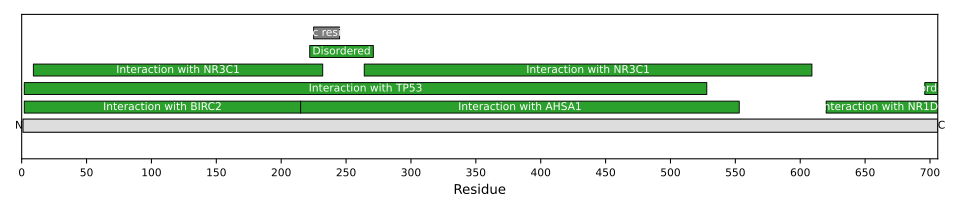
1: Molecular chaperone that promotes the maturation, structural maintenance and proper regulation of specific target proteins involved for instance in cell cycle control and signal transduction. Undergoes a functional cycle linked to its ATPase activity. This cycle probably induces conformational changes in the client proteins, thereby causing their activation. Interacts dynamically with various co-chaperones that modulate its substrate recognition, ATPase cycle and chaperone function (PubMed:16478993, PubMed:19696785). Engages with a range of client protein classes via its interaction with various co-chaperone proteins or complexes, that act as adapters, simultaneously able to interact with the specific client and the central chaperone itself. Recruitment of ATP and co-chaperone followed by client protein forms a functional chaperone. After the completion of the chaperoning process, properly folded client protein and co-chaperone leave HSP90 in an ADP-bound partially open conformation and finally, ADP is released from HSP90 which acquires an open conformation for the next cycle (PubMed:26991466, PubMed:27295069). Apart from its chaperone activity, it also plays a role in the regulation of the transcription machinery. HSP90 and its co-chaperones modulate transcription at least at three different levels. They first alter the steady-state levels of certain transcription factors in response to various physiological cues. Second, they modulate the activity of certain epigenetic modifiers, such as histone deacetylases or DNA methyl transferases, and thereby respond to the change in the environment. Third, they participate in the eviction of histones from the promoter region of certain genes and thereby turn on gene expression (PubMed:25973397). Antagonizes STUB1-mediated inhibition of TGF-beta signaling via inhibition of STUB1-mediated SMAD3 ubiquitination and degradation (PubMed:24613385). Promotes cell differentiation by chaperoning BIRC2 and thereby protecting from auto-ubiquitination and degradation by the proteasomal machinery (PubMed:18239673). Main chaperone involved in the phosphorylation/activation of the STAT1 by chaperoning both JAK2 and PRKCE under heat shock and in turn, activates its own transcription (PubMed:20353823). Involved in the translocation into ERGIC (endoplasmic reticulum-Golgi intermediate compartment) of leaderless cargos (lacking the secretion signal sequence) such as the interleukin 1/IL-1; the translocation process is mediated by the cargo receptor TMED10 (PubMed:32272059)
2: (Microbial infection) Binding to N.meningitidis NadA stimulates monocytes (PubMed:21949862). Seems to interfere with N.meningitidis NadA-mediated invasion of human cells (Probable)