Guanine nucleotide-binding protein G(i) subunit alpha-3 (G(i) alpha-3)
1_MGCTL 6_ SAEDK 11_ AAVER 16_ SKMID 21_ RNLRE 26_ DGEKA 31_ AKEVK 36_ LLLLG 41_ AGESG 46_ KSTIV 51_ KQMKI 56_ IHEDG 61_ YSEDE 66_ CKQYK 71_ VVVYS 76_ NTIQS 81_ IIAII 86_ RAMGR 91_ LKIDF 96_ GEAAR 101_ ADDAR 106_ QLFVL 111_ AGSAE 116_ EGVMT 121_ PELAG 126_ VIKRL 131_ WRDGG 136_ VQACF 141_ SRSRE 146_ YQLND 151_ SASYY 156_ LNDLD 161_ RISQS 166_ NYIPT 171_ QQDVL 176_ RTRVK 181_ TTGIV 186_ ETHFT 191_ FKDLY 196_ FKMFD 201_ VGGQR 206_ SERKK 211_ WIHCF 216_ EGVTA 221_ IIFCV 226_ ALSDY 231_ DLVLA 236_ EDEEM 241_ NRMHE 246_ SMKLF 251_ DSICN 256_ NKWFT 261_ ETSII 266_ LFLNK 271_ KDLFE 276_ EKIKR 281_ SPLTI 286_ CYPEY 291_ TGSNT 296_ YEEAA 301_ AYIQC 306_ QFEDL 311_ NRRKD 316_ TKEIY 321_ THFTC 326_ ATDTK 331_ NVQFV 336_ FDAVT 341_ DVIIK 346_NNLKE
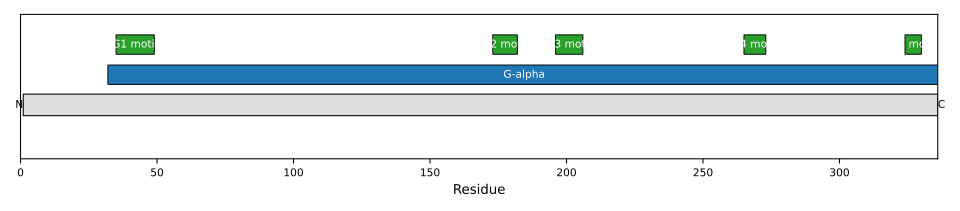
1: Heterotrimeric guanine nucleotide-binding proteins (G proteins) function as transducers downstream of G protein-coupled receptors (GPCRs) in numerous signaling cascades. The alpha chain contains the guanine nucleotide binding site and alternates between an active, GTP-bound state and an inactive, GDP-bound state. Signaling by an activated GPCR promotes GDP release and GTP binding. The alpha subunit has a low GTPase activity that converts bound GTP to GDP, thereby terminating the signal (By similarity). Both GDP release and GTP hydrolysis are modulated by numerous regulatory proteins (PubMed:18434541, PubMed:19478087, PubMed:8774883). Signaling is mediated via effector proteins, such as adenylate cyclase. Inhibits adenylate cyclase activity, leading to decreased intracellular cAMP levels (PubMed:19478087). Stimulates the activity of receptor-regulated K(+) channels (PubMed:2535845). The active GTP-bound form prevents the association of RGS14 with centrosomes and is required for the translocation of RGS14 from the cytoplasm to the plasma membrane. May play a role in cell division (PubMed:17635935). The active GTP-bound form activates the calcium permeant TRPC5 ion channels (PubMed:37137991)