Interleukin-6 receptor subunit alpha (IL-6 receptor subunit alpha) (IL-6R subunit alpha) (IL-6R-alpha) (IL-6RA) (IL-6R 1) (Membrane glycoprotein 80) (gp80) (CD antigen CD126) [Cleaved into: Soluble interleukin-6 receptor subunit alpha (sIL6R)]
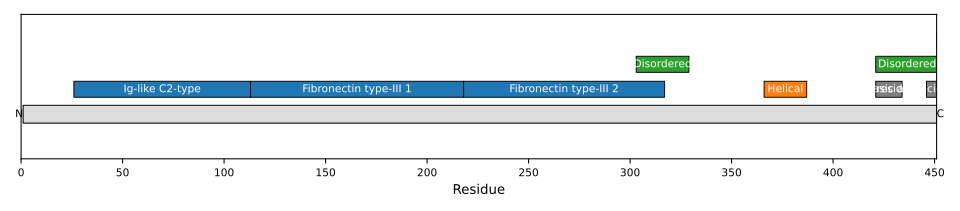
1_MLAVG 6_ CALLA 11_ ALLAA 16_ PGAAL 21_ APRRC 26_ PAQEV 31_ ARGVL 36_ TSLPG 41_ DSVTL 46_ TCPGV 51_ EPEDN 56_ ATVHW 61_ VLRKP 66_ AAGSH 71_ PSRWA 76_ GMGRR 81_ LLLRS 86_ VQLHD 91_ SGNYS 96_ CYRAG 101_ RPAGT 106_ VHLLV 111_ DVPPE 116_ EPQLS 121_ CFRKS 126_ PLSNV 131_ VCEWG 136_ PRSTP 141_ SLTTK 146_ AVLLV 151_ RKFQN 156_ SPAED 161_ FQEPC 166_ QYSQE 171_ SQKFS 176_ CQLAV 181_ PEGDS 186_ SFYIV 191_ SMCVA 196_ SSVGS 201_ KFSKT 206_ QTFQG 211_ CGILQ 216_ PDPPA 221_ NITVT 226_ AVARN 231_ PRWLS 236_ VTWQD 241_ PHSWN 246_ SSFYR 251_ LRFEL 256_ RYRAE 261_ RSKTF 266_ TTWMV 271_ KDLQH 276_ HCVIH 281_ DAWSG 286_ LRHVV 291_ QLRAQ 296_ EEFGQ 301_ GEWSE 306_ WSPEA 311_ MGTPW 316_ TESRS 321_ PPAEN 326_ EVSTP 331_ MQALT 336_ TNKDD 341_ DNILF 346_ RDSAN 351_ ATSLP 356_ VQDSS 361_ SVPLP 366_ TFLVA 371_ GGSLA 376_ FGTLL 381_ CIAIV 386_ LRFKK 391_ TWKLR 396_ ALKEG 401_ KTSMH 406_ PPYSL 411_ GQLVP 416_ ERPRP 421_ TPVLV 426_ PLISP 431_ PVSPS 436_ SLGSD 441_ NTSSH 446_ NRPDA 451_ RDPRS 456_ PYDIS 461_NTDYF
1: Part of the receptor for interleukin 6. Binds to IL6 with low affinity, but does not transduce a signal (PubMed:28265003). Signal activation necessitate an association with IL6ST. Activation leads to the regulation of the immune response, acute-phase reactions and hematopoiesis (PubMed:30995492, PubMed:31235509). The interaction with membrane-bound IL6R and IL6ST stimulates 'classic signaling', the restricted expression of the IL6R limits classic IL6 signaling to only a few tissues such as the liver and some cells of the immune system. Whereas the binding of IL6 and soluble IL6R to IL6ST stimulates 'trans-signaling'. Alternatively, 'cluster signaling' occurs when membrane-bound IL6:IL6R complexes on transmitter cells activate IL6ST receptors on neighboring receiver cells (Probable)
2: Signaling via the membrane-bound IL6R is mostly regenerative and anti-inflammatory (Probable). Drives naive CD4(+) T cells to the Th17 lineage, through 'cluster signaling' by dendritic cells (By similarity)
3: Soluble form of IL6 receptor (sIL6R) that acts as an agonist of IL6 activity (PubMed:21990364). The IL6:sIL6R complex (hyper-IL6) binds to IL6ST/gp130 on cell surfaces and induces signaling also on cells that do not express membrane-bound IL6R in a process called IL6 'trans-signaling'. sIL6R is causative for the pro-inflammatory properties of IL6 and an important player in the development of chronic inflammatory diseases (PubMed:21990364). In complex with IL6, is required for induction of VEGF production (PubMed:12794819). Plays a protective role during liver injury, being required for maintenance of tissue regeneration (By similarity). 'Trans-signaling' in central nervous system regulates energy and glucose homeostasis (By similarity)
4: Soluble form of IL6 receptor (sIL6R) that acts as an agonist of IL6 activity (PubMed:21990364). The IL6:sIL6R complex (hyper-IL6) binds to IL6ST/gp130 on cell surfaces and induces signaling also on cells that do not express membrane-bound IL6R in a process called IL6 'trans-signaling'. sIL6R is causative for the pro-inflammatory properties of IL6 and an important player in the development of chronic inflammatory diseases (PubMed:21990364). In complex with IL6, is required for induction of VEGF production (PubMed:12794819). Plays a protective role during liver injury, being required for maintenance of tissue regeneration (By similarity). 'Trans-signaling' in central nervous system regulates energy and glucose homeostasis (By similarity)