T-cell surface glycoprotein CD3 gamma chain (T-cell receptor T3 gamma chain) (CD antigen CD3g)
1_MEQGK 6_ GLAVL 11_ ILAII 16_ LLQGT 21_ LAQSI 26_ KGNHL 31_ VKVYD 36_ YQEDG 41_ SVLLT 46_ CDAEA 51_ KNITW 56_ FKDGK 61_ MIGFL 66_ TEDKK 71_ KWNLG 76_ SNAKD 81_ PRGMY 86_ QCKGS 91_ QNKSK 96_ PLQVY 101_ YRMCQ 106_ NCIEL 111_ NAATI 116_ SGFLF 121_ AEIVS 126_ IFVLA 131_ VGVYF 136_ IAGQD 141_ GVRQS 146_ RASDK 151_ QTLLP 156_ NDQLY 161_ QPLKD 166_ REDDQ 171_ YSHLQ 176_GNQLR
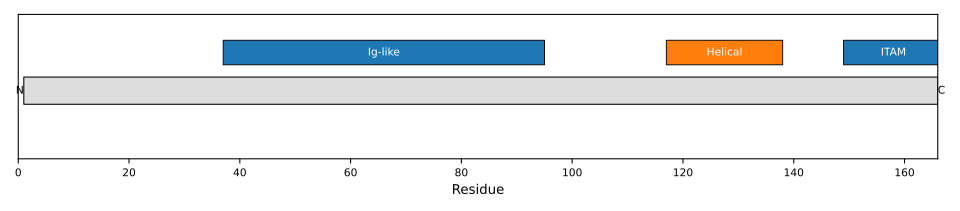
1: Part of the TCR-CD3 complex present on T-lymphocyte cell surface that plays an essential role in adaptive immune response. When antigen presenting cells (APCs) activate T-cell receptor (TCR), TCR-mediated signals are transmitted across the cell membrane by the CD3 chains CD3D, CD3E, CD3G and CD3Z. All CD3 chains contain immunoreceptor tyrosine-based activation motifs (ITAMs) in their cytoplasmic domain. Upon TCR engagement, these motifs become phosphorylated by Src family protein tyrosine kinases LCK and FYN, resulting in the activation of downstream signaling pathways (PubMed:2470098). In addition to this role of signal transduction in T-cell activation, CD3G plays an essential role in the dynamic regulation of TCR expression at the cell surface (PubMed:8187769). Indeed, constitutive TCR cycling is dependent on the di-leucine-based (diL) receptor-sorting motif present in CD3G