Poly [ADP-ribose] polymerase 1 (PARP-1) (EC 2.4.2.30) (ADP-ribosyltransferase diphtheria toxin-like 1) (ARTD1) (DNA ADP-ribosyltransferase PARP1) (EC 2.4.2.-) (NAD(+) ADP-ribosyltransferase 1) (ADPRT 1) (Poly[ADP-ribose] synthase 1) (Protein poly-ADP-ribosyltransferase PARP1) (EC 2.4.2.-)
1_MAESS 6_ DKLYR 11_ VEYAK 16_ SGRAS 21_ CKKCS 26_ ESIPK 31_ DSLRM 36_ AIMVQ 41_ SPMFD 46_ GKVPH 51_ WYHFS 56_ CFWKV 61_ GHSIR 66_ HPDVE 71_ VDGFS 76_ ELRWD 81_ DQQKV 86_ KKTAE 91_ AGGVT 96_ GKGQD 101_ GIGSK 106_ AEKTL 111_ GDFAA 116_ EYAKS 121_ NRSTC 126_ KGCME 131_ KIEKG 136_ QVRLS 141_ KKMVD 146_ PEKPQ 151_ LGMID 156_ RWYHP 161_ GCFVK 166_ NREEL 171_ GFRPE 176_ YSASQ 181_ LKGFS 186_ LLATE 191_ DKEAL 196_ KKQLP 201_ GVKSE 206_ GKRKG 211_ DEVDG 216_ VDEVA 221_ KKKSK 226_ KEKDK 231_ DSKLE 236_ KALKA 241_ QNDLI 246_ WNIKD 251_ ELKKV 256_ CSTND 261_ LKELL 266_ IFNKQ 271_ QVPSG 276_ ESAIL 281_ DRVAD 286_ GMVFG 291_ ALLPC 296_ EECSG 301_ QLVFK 306_ SDAYY 311_ CTGDV 316_ TAWTK 321_ CMVKT 326_ QTPNR 331_ KEWVT 336_ PKEFR 341_ EISYL 346_ KKLKV 351_ KKQDR 356_ IFPPE 361_ TSASV 366_ AATPP 371_ PSTAS 376_ APAAV 381_ NSSAS 386_ ADKPL 391_ SNMKI 396_ LTLGK 401_ LSRNK 406_ DEVKA 411_ MIEKL 416_ GGKLT 421_ GTANK 426_ ASLCI 431_ STKKE 436_ VEKMN 441_ KKMEE 446_ VKEAN 451_ IRVVS 456_ EDFLQ 461_ DVSAS 466_ TKSLQ 471_ ELFLA 476_ HILSP 481_ WGAEV 486_ KAEPV 491_ EVVAP 496_ RGKSG 501_ AALSK 506_ KSKGQ 511_ VKEEG 516_ INKSE 521_ KRMKL 526_ TLKGG 531_ AAVDP 536_ DSGLE 541_ HSAHV 546_ LEKGG 551_ KVFSA 556_ TLGLV 561_ DIVKG 566_ TNSYY 571_ KLQLL 576_ EDDKE 581_ NRYWI 586_ FRSWG 591_ RVGTV 596_ IGSNK 601_ LEQMP 606_ SKEDA 611_ IEHFM 616_ KLYEE 621_ KTGNA 626_ WHSKN 631_ FTKYP 636_ KKFYP 641_ LEIDY 646_ GQDEE 651_ AVKKL 656_ TVNPG 661_ TKSKL 666_ PKPVQ 671_ DLIKM 676_ IFDVE 681_ SMKKA 686_ MVEYE 691_ IDLQK 696_ MPLGK 701_ LSKRQ 706_ IQAAY 711_ SILSE 716_ VQQAV 721_ SQGSS 726_ DSQIL 731_ DLSNR 736_ FYTLI 741_ PHDFG 746_ MKKPP 751_ LLNNA 756_ DSVQA 761_ KVEML 766_ DNLLD 771_ IEVAY 776_ SLLRG 781_ GSDDS 786_ SKDPI 791_ DVNYE 796_ KLKTD 801_ IKVVD 806_ RDSEE 811_ AEIIR 816_ KYVKN 821_ THATT 826_ HNAYD 831_ LEVID 836_ IFKIE 841_ REGEC 846_ QRYKP 851_ FKQLH 856_ NRRLL 861_ WHGSR 866_ TTNFA 871_ GILSQ 876_ GLRIA 881_ PPEAP 886_ VTGYM 891_ FGKGI 896_ YFADM 901_ VSKSA 906_ NYCHT 911_ SQGDP 916_ IGLIL 921_ LGEVA 926_ LGNMY 931_ ELKHA 936_ SHISK 941_ LPKGK 946_ HSVKG 951_ LGKTT 956_ PDPSA 961_ NISLD 966_ GVDVP 971_ LGTGI 976_ SSGVN 981_ DTSLL 986_ YNEYI 991_ VYDIA 996_ QVNLK 1001_ YLLKL 1006_KFNFK
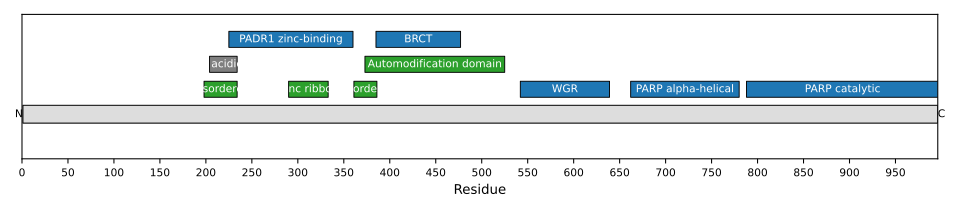
1: Poly-ADP-ribosyltransferase that mediates poly-ADP-ribosylation of proteins and plays a key role in DNA repair (PubMed:17177976, PubMed:18055453, PubMed:18172500, PubMed:19344625, PubMed:19661379, PubMed:20388712, PubMed:21680843, PubMed:22582261, PubMed:23230272, PubMed:25043379, PubMed:26344098, PubMed:26626479, PubMed:26626480, PubMed:30104678, PubMed:31796734, PubMed:32028527, PubMed:32241924, PubMed:32358582, PubMed:33186521, PubMed:34465625, PubMed:34737271). Mediates glutamate, aspartate, serine, histidine or tyrosine ADP-ribosylation of proteins: the ADP-D-ribosyl group of NAD(+) is transferred to the acceptor carboxyl group of target residues and further ADP-ribosyl groups are transferred to the 2'-position of the terminal adenosine moiety, building up a polymer with an average chain length of 20-30 units (PubMed:19764761, PubMed:25043379, PubMed:28190768, PubMed:29954836, PubMed:35393539, PubMed:7852410, PubMed:9315851). Serine ADP-ribosylation of proteins constitutes the primary form of ADP-ribosylation of proteins in response to DNA damage (PubMed:33186521, PubMed:34874266). Specificity for the different amino acids is conferred by interacting factors, such as HPF1 and NMNAT1 (PubMed:28190768, PubMed:29954836, PubMed:32028527, PubMed:33186521, PubMed:33589610, PubMed:34625544, PubMed:34874266). Following interaction with HPF1, catalyzes serine ADP-ribosylation of target proteins; HPF1 confers serine specificity by completing the PARP1 active site (PubMed:28190768, PubMed:29954836, PubMed:32028527, PubMed:33186521, PubMed:33589610, PubMed:34625544, PubMed:34874266). Also catalyzes tyrosine ADP-ribosylation of target proteins following interaction with HPF1 (PubMed:29954836, PubMed:30257210). Following interaction with NMNAT1, catalyzes glutamate and aspartate ADP-ribosylation of target proteins; NMNAT1 confers glutamate and aspartate specificity (By similarity). PARP1 initiates the repair of DNA breaks: recognizes and binds DNA breaks within chromatin and recruits HPF1, licensing serine ADP-ribosylation of target proteins, such as histones (H2BS6ADPr and H3S10ADPr), thereby promoting decompaction of chromatin and the recruitment of repair factors leading to the reparation of DNA strand breaks (PubMed:17177976, PubMed:18172500, PubMed:19344625, PubMed:19661379, PubMed:23230272, PubMed:27067600, PubMed:34465625, PubMed:34874266). HPF1 initiates serine ADP-ribosylation but restricts the polymerase activity of PARP1 in order to limit the length of poly-ADP-ribose chains (PubMed:33683197, PubMed:34732825, PubMed:34795260). In addition to base excision repair (BER) pathway, also involved in double-strand breaks (DSBs) repair: together with TIMELESS, accumulates at DNA damage sites and promotes homologous recombination repair by mediating poly-ADP-ribosylation (PubMed:26344098, PubMed:30356214). Mediates the poly-ADP-ribosylation of a number of proteins, including itself, APLF, CHFR, RPA1 and NFAT5 (PubMed:17396150, PubMed:19764761, PubMed:24906880, PubMed:34049076). In addition to proteins, also able to ADP-ribosylate DNA: catalyzes ADP-ribosylation of DNA strand break termini containing terminal phosphates and a 2'-OH group in single- and double-stranded DNA, respectively (PubMed:27471034). Required for PARP9 and DTX3L recruitment to DNA damage sites (PubMed:23230272). PARP1-dependent PARP9-DTX3L-mediated ubiquitination promotes the rapid and specific recruitment of 53BP1/TP53BP1, UIMC1/RAP80, and BRCA1 to DNA damage sites (PubMed:23230272). PARP1-mediated DNA repair in neurons plays a role in sleep: senses DNA damage in neurons and promotes sleep, facilitating efficient DNA repair (By similarity). In addition to DNA repair, also involved in other processes, such as transcription regulation, programmed cell death, membrane repair, adipogenesis and innate immunity (PubMed:15607977, PubMed:17177976, PubMed:19344625, PubMed:27256882, PubMed:32315358, PubMed:32844745, PubMed:35124853, PubMed:35393539, PubMed:35460603). Acts as a repressor of transcription: binds to nucleosomes and modulates chromatin structure in a manner similar to histone H1, thereby altering RNA polymerase II (PubMed:15607977, PubMed:22464733). Acts both as a positive and negative regulator of transcription elongation, depending on the context (PubMed:27256882, PubMed:35393539). Acts as a positive regulator of transcription elongation by mediating poly-ADP-ribosylation of NELFE, preventing RNA-binding activity of NELFE and relieving transcription pausing (PubMed:27256882). Acts as a negative regulator of transcription elongation in response to DNA damage by catalyzing poly-ADP-ribosylation of CCNT1, disrupting the phase separation activity of CCNT1 and subsequent activation of CDK9 (PubMed:35393539). Involved in replication fork progression following interaction with CARM1: mediates poly-ADP-ribosylation at replication forks, slowing fork progression (PubMed:33412112). Poly-ADP-ribose chains generated by PARP1 also play a role in poly-ADP-ribose-dependent cell death, a process named parthanatos (By similarity). Also acts as a negative regulator of the cGAS-STING pathway (PubMed:32315358, PubMed:32844745, PubMed:35460603). Acts by mediating poly-ADP-ribosylation of CGAS: PARP1 translocates into the cytosol following phosphorylation by PRKDC and catalyzes poly-ADP-ribosylation and inactivation of CGAS (PubMed:35460603). Acts as a negative regulator of adipogenesis: catalyzes poly-ADP-ribosylation of histone H2B on 'Glu-35' (H2BE35ADPr) following interaction with NMNAT1, inhibiting phosphorylation of H2B at 'Ser-36' (H2BS36ph), thereby blocking expression of pro-adipogenetic genes (By similarity). Involved in the synthesis of ATP in the nucleus, together with NMNAT1, PARG and NUDT5 (PubMed:27257257). Nuclear ATP generation is required for extensive chromatin remodeling events that are energy-consuming (PubMed:27257257)
2: Promotes AIFM1-mediated apoptosis (PubMed:33168626). This form, which translocates into the cytoplasm following cleavage by caspase-3 (CASP3) and caspase-7 (CASP7) in response to apoptosis, is auto-poly-ADP-ribosylated and serves as a poly-ADP-ribose carrier to induce AIFM1-mediated apoptosis (PubMed:33168626)
3: This cleavage form irreversibly binds to DNA breaks and interferes with DNA repair, promoting DNA damage-induced apoptosis