Heat shock 70 kDa protein 1B (Heat shock 70 kDa protein 2) (HSP70-2) (HSP70.2)
1_MAKAA 6_ AIGID 11_ LGTTY 16_ SCVGV 21_ FQHGK 26_ VEIIA 31_ NDQGN 36_ RTTPS 41_ YVAFT 46_ DTERL 51_ IGDAA 56_ KNQVA 61_ LNPQN 66_ TVFDA 71_ KRLIG 76_ RKFGD 81_ PVVQS 86_ DMKHW 91_ PFQVI 96_ NDGDK 101_ PKVQV 106_ SYKGE 111_ TKAFY 116_ PEEIS 121_ SMVLT 126_ KMKEI 131_ AEAYL 136_ GYPVT 141_ NAVIT 146_ VPAYF 151_ NDSQR 156_ QATKD 161_ AGVIA 166_ GLNVL 171_ RIINE 176_ PTAAA 181_ IAYGL 186_ DRTGK 191_ GERNV 196_ LIFDL 201_ GGGTF 206_ DVSIL 211_ TIDDG 216_ IFEVK 221_ ATAGD 226_ THLGG 231_ EDFDN 236_ RLVNH 241_ FVEEF 246_ KRKHK 251_ KDISQ 256_ NKRAV 261_ RRLRT 266_ ACERA 271_ KRTLS 276_ SSTQA 281_ SLEID 286_ SLFEG 291_ IDFYT 296_ SITRA 301_ RFEEL 306_ CSDLF 311_ RSTLE 316_ PVEKA 321_ LRDAK 326_ LDKAQ 331_ IHDLV 336_ LVGGS 341_ TRIPK 346_ VQKLL 351_ QDFFN 356_ GRDLN 361_ KSINP 366_ DEAVA 371_ YGAAV 376_ QAAIL 381_ MGDKS 386_ ENVQD 391_ LLLLD 396_ VAPLS 401_ LGLET 406_ AGGVM 411_ TALIK 416_ RNSTI 421_ PTKQT 426_ QIFTT 431_ YSDNQ 436_ PGVLI 441_ QVYEG 446_ ERAMT 451_ KDNNL 456_ LGRFE 461_ LSGIP 466_ PAPRG 471_ VPQIE 476_ VTFDI 481_ DANGI 486_ LNVTA 491_ TDKST 496_ GKANK 501_ ITITN 506_ DKGRL 511_ SKEEI 516_ ERMVQ 521_ EAEKY 526_ KAEDE 531_ VQRER 536_ VSAKN 541_ ALESY 546_ AFNMK 551_ SAVED 556_ EGLKG 561_ KISEA 566_ DKKKV 571_ LDKCQ 576_ EVISW 581_ LDANT 586_ LAEKD 591_ EFEHK 596_ RKELE 601_ QVCNP 606_ IISGL 611_ YQGAG 616_ GPGPG 621_ GFGAQ 626_ GPKGG 631_ SGSGP 636_TIEEV
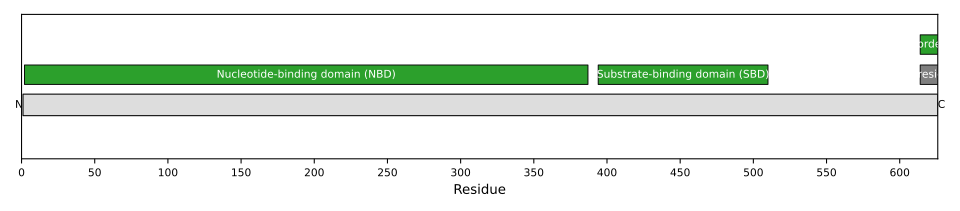
1: Molecular chaperone implicated in a wide variety of cellular processes, including protection of the proteome from stress, folding and transport of newly synthesized polypeptides, activation of proteolysis of misfolded proteins and the formation and dissociation of protein complexes. Plays a pivotal role in the protein quality control system, ensuring the correct folding of proteins, the re-folding of misfolded proteins and controlling the targeting of proteins for subsequent degradation. This is achieved through cycles of ATP binding, ATP hydrolysis and ADP release, mediated by co-chaperones. The co-chaperones have been shown to not only regulate different steps of the ATPase cycle, but they also have an individual specificity such that one co-chaperone may promote folding of a substrate while another may promote degradation. The affinity for polypeptides is regulated by its nucleotide bound state. In the ATP-bound form, it has a low affinity for substrate proteins. However, upon hydrolysis of the ATP to ADP, it undergoes a conformational change that increases its affinity for substrate proteins. It goes through repeated cycles of ATP hydrolysis and nucleotide exchange, which permits cycles of substrate binding and release. The co-chaperones are of three types: J-domain co-chaperones such as HSP40s (stimulate ATPase hydrolysis by HSP70), the nucleotide exchange factors (NEF) such as BAG1/2/3 (facilitate conversion of HSP70 from the ADP-bound to the ATP-bound state thereby promoting substrate release), and the TPR domain chaperones such as HOPX and STUB1 (PubMed:24012426, PubMed:24318877, PubMed:26865365). Maintains protein homeostasis during cellular stress through two opposing mechanisms: protein refolding and degradation. Its acetylation/deacetylation state determines whether it functions in protein refolding or protein degradation by controlling the competitive binding of co-chaperones HOPX and STUB1. During the early stress response, the acetylated form binds to HOPX which assists in chaperone-mediated protein refolding, thereafter, it is deacetylated and binds to ubiquitin ligase STUB1 that promotes ubiquitin-mediated protein degradation (PubMed:27708256). Regulates centrosome integrity during mitosis, and is required for the maintenance of a functional mitotic centrosome that supports the assembly of a bipolar mitotic spindle (PubMed:27137183). Enhances STUB1-mediated SMAD3 ubiquitination and degradation and facilitates STUB1-mediated inhibition of TGF-beta signaling (PubMed:24613385). Essential for STUB1-mediated ubiquitination and degradation of FOXP3 in regulatory T-cells (Treg) during inflammation (PubMed:23973223)
2: (Microbial infection) In case of rotavirus A infection, serves as a post-attachment receptor for the virus to facilitate entry into the cell