HLA class I histocompatibility antigen, C alpha chain (HLA-C) (HLA-Cw) (Human leukocyte antigen C)
1_MRVMA 6_ PRALL 11_ LLLSG 16_ GLALT 21_ ETWAC 26_ SHSMR 31_ YFDTA 36_ VSRPG 41_ RGEPR 46_ FISVG 51_ YVDDT 56_ QFVRF 61_ DSDAA 66_ SPRGE 71_ PRAPW 76_ VEQEG 81_ PEYWD 86_ RETQK 91_ YKRQA 96_ QADRV 101_ SLRNL 106_ RGYYN 111_ QSEDG 116_ SHTLQ 121_ RMSGC 126_ DLGPD 131_ GRLLR 136_ GYDQS 141_ AYDGK 146_ DYIAL 151_ NEDLR 156_ SWTAA 161_ DTAAQ 166_ ITQRK 171_ LEAAR 176_ AAEQL 181_ RAYLE 186_ GTCVE 191_ WLRRY 196_ LENGK 201_ ETLQR 206_ AEPPK 211_ THVTH 216_ HPLSD 221_ HEATL 226_ RCWAL 231_ GFYPA 236_ EITLT 241_ WQRDG 246_ EDQTQ 251_ DTELV 256_ ETRPA 261_ GDGTF 266_ QKWAA 271_ VVVPS 276_ GQEQR 281_ YTCHM 286_ QHEGL 291_ QEPLT 296_ LSWEP 301_ SSQPT 306_ IPIMG 311_ IVAGL 316_ AVLVV 321_ LAVLG 326_ AVVTA 331_ MMCRR 336_ KSSGG 341_ KGGSC 346_ SQAAC 351_ SNSAQ 356_ GSDES 361_LITCK
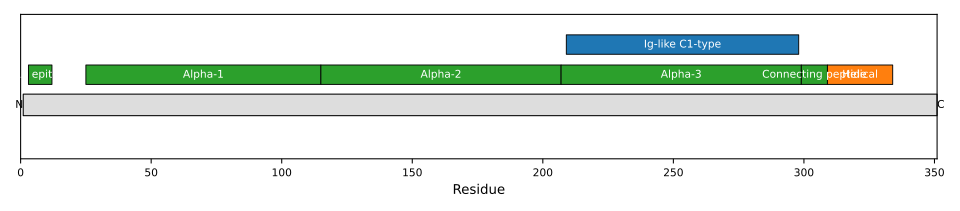
1: Antigen-presenting major histocompatibility complex class I (MHCI) molecule with an important role in reproduction and antiviral immunity (PubMed:11172028, PubMed:20104487, PubMed:20439706, PubMed:20972337, PubMed:24091323, PubMed:28649982, PubMed:29312307). In complex with B2M/beta 2 microglobulin displays a restricted repertoire of self and viral peptides and acts as a dominant ligand for inhibitory and activating killer immunoglobulin receptors (KIRs) expressed on NK cells (PubMed:16141329). In an allogeneic setting, such as during pregnancy, mediates interaction of extravillous trophoblasts with KIR on uterine NK cells and regulate trophoblast invasion necessary for placentation and overall fetal growth (PubMed:20972337, PubMed:24091323). During viral infection, may present viral peptides with low affinity for KIRs, impeding KIR-mediated inhibition through peptide antagonism and favoring lysis of infected cells (PubMed:20439706). Presents a restricted repertoire of viral peptides on antigen-presenting cells for recognition by alpha-beta T cell receptor (TCR) on HLA-C-restricted CD8-positive T cells, guiding antigen-specific T cell immune response to eliminate infected cells, particularly in chronic viral infection settings such as HIV-1 or CMV infection (PubMed:11172028, PubMed:20104487, PubMed:28649982). Both the peptide and the MHC molecule are recognized by TCR, the peptide is responsible for the fine specificity of antigen recognition and MHC residues account for the MHC restriction of T cells (By similarity). Typically presents intracellular peptide antigens of 9 amino acids that arise from cytosolic proteolysis via proteasome. Can bind different peptides containing allele-specific binding motifs, which are mainly defined by anchor residues at position 2 and 9. Preferentially displays peptides having a restricted repertoire of hydrophobic or aromatic amino acids (Phe, Ile, Leu, Met, Val and Tyr) at the C-terminal anchor (PubMed:25311805, PubMed:8265661)
2: ALLELE C*01:02: The peptide-bound form interacts with KIR2DL2 and KIR2DL3 inhibitory receptors on NK cells. The low affinity peptides compete with the high affinity peptides impeding KIR-mediated inhibition and favoring lysis of infected cells (PubMed:20439706). Presents to CD8-positive T cells a CMV epitope derived from UL83/pp65 (RCPEMISVL), an immediate-early antigen necessary for initiating viral replication (PubMed:12947002)
3: ALLELE C*04:01: Presents a conserved HIV-1 epitope derived from env (SFNCGGEFF) to memory CD8-positive T cells, eliciting very strong IFNG responses (PubMed:20104487). Presents CMV epitope derived from UL83/pp65 (QYDPVAALF) to CD8-positive T cells, triggering T cell cytotoxic response (PubMed:12947002)
4: ALLELE C*05:01: Presents HIV-1 epitope derived from rev (SAEPVPLQL) to CD8-positive T cells, triggering T cell cytotoxic response
5: ALLELE C*06:02: In trophoblasts, interacts with KIR2DS2 on uterine NK cells and triggers NK cell activation, including secretion of cytokines such as GMCSF that enhances trophoblast migration
6: ALLELE C*07:02: Plays an important role in the control of chronic CMV infection. Presents immunodominant CMV epitopes derived from IE1 (LSEFCRVL and CRVLCCYVL) and UL28 (FRCPRRFCF), both antigens synthesized during immediate-early period of viral replication. Elicits a strong anti-viral CD8-positive T cell immune response that increases markedly with age
7: ALLELE C*08:01: Presents viral epitopes derived from CMV UL83 (VVCAHELVC) and IAV M1 (GILGFVFTL), triggering CD8-positive T cell cytotoxic response
8: ALLELE C*12:02: Presents CMV epitope derived from UL83 (VAFTSHEHF) to CD8-positive T cells
9: ALLELE C*15:02: Presents CMV epitope derived from UL83 CC (VVCAHELVC) to CD8-positive T cells, triggering T cell cytotoxic response