Endoplasmic reticulum chaperone BiP (EC 3.6.4.10) (78 kDa glucose-regulated protein) (GRP-78) (Binding-immunoglobulin protein) (BiP) (Heat shock protein 70 family protein 5) (HSP70 family protein 5) (Heat shock protein family A member 5) (Immunoglobulin heavy chain-binding protein)
1_MKLSL 6_ VAAML 11_ LLLSA 16_ ARAEE 21_ EDKKE 26_ DVGTV 31_ VGIDL 36_ GTTYS 41_ CVGVF 46_ KNGRV 51_ EIIAN 56_ DQGNR 61_ ITPSY 66_ VAFTP 71_ EGERL 76_ IGDAA 81_ KNQLT 86_ SNPEN 91_ TVFDA 96_ KRLIG 101_ RTWND 106_ PSVQQ 111_ DIKFL 116_ PFKVV 121_ EKKTK 126_ PYIQV 131_ DIGGG 136_ QTKTF 141_ APEEI 146_ SAMVL 151_ TKMKE 156_ TAEAY 161_ LGKKV 166_ THAVV 171_ TVPAY 176_ FNDAQ 181_ RQATK 186_ DAGTI 191_ AGLNV 196_ MRIIN 201_ EPTAA 206_ AIAYG 211_ LDKRE 216_ GEKNI 221_ LVFDL 226_ GGGTF 231_ DVSLL 236_ TIDNG 241_ VFEVV 246_ ATNGD 251_ THLGG 256_ EDFDQ 261_ RVMEH 266_ FIKLY 271_ KKKTG 276_ KDVRK 281_ DNRAV 286_ QKLRR 291_ EVEKA 296_ KRALS 301_ SQHQA 306_ RIEIE 311_ SFYEG 316_ EDFSE 321_ TLTRA 326_ KFEEL 331_ NMDLF 336_ RSTMK 341_ PVQKV 346_ LEDSD 351_ LKKSD 356_ IDEIV 361_ LVGGS 366_ TRIPK 371_ IQQLV 376_ KEFFN 381_ GKEPS 386_ RGINP 391_ DEAVA 396_ YGAAV 401_ QAGVL 406_ SGDQD 411_ TGDLV 416_ LLDVC 421_ PLTLG 426_ IETVG 431_ GVMTK 436_ LIPRN 441_ TVVPT 446_ KKSQI 451_ FSTAS 456_ DNQPT 461_ VTIKV 466_ YEGER 471_ PLTKD 476_ NHLLG 481_ TFDLT 486_ GIPPA 491_ PRGVP 496_ QIEVT 501_ FEIDV 506_ NGILR 511_ VTAED 516_ KGTGN 521_ KNKIT 526_ ITNDQ 531_ NRLTP 536_ EEIER 541_ MVNDA 546_ EKFAE 551_ EDKKL 556_ KERID 561_ TRNEL 566_ ESYAY 571_ SLKNQ 576_ IGDKE 581_ KLGGK 586_ LSSED 591_ KETME 596_ KAVEE 601_ KIEWL 606_ ESHQD 611_ ADIED 616_ FKAKK 621_ KELEE 626_ IVQPI 631_ ISKLY 636_ GSAGP 641_ PPTGE 646_EDTAE
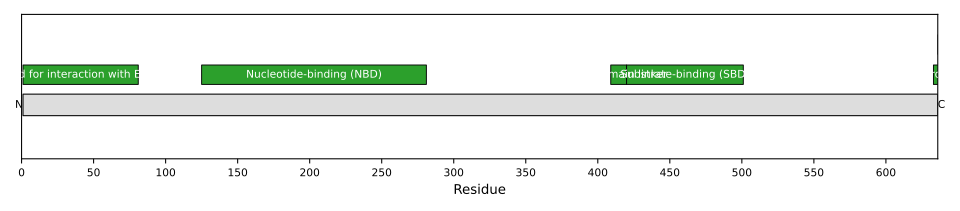
1: Endoplasmic reticulum chaperone that plays a key role in protein folding and quality control in the endoplasmic reticulum lumen (PubMed:2294010, PubMed:23769672, PubMed:23990668, PubMed:28332555). Involved in the correct folding of proteins and degradation of misfolded proteins via its interaction with DNAJC10/ERdj5, probably to facilitate the release of DNAJC10/ERdj5 from its substrate (By similarity). Acts as a key repressor of the EIF2AK3/PERK and ERN1/IRE1-mediated unfolded protein response (UPR) (PubMed:11907036, PubMed:1550958, PubMed:19538957, PubMed:36739529). In the unstressed endoplasmic reticulum, recruited by DNAJB9/ERdj4 to the luminal region of ERN1/IRE1, leading to disrupt the dimerization of ERN1/IRE1, thereby inactivating ERN1/IRE1 (By similarity). Also binds and inactivates EIF2AK3/PERK in unstressed cells (PubMed:11907036). Accumulation of misfolded protein in the endoplasmic reticulum causes release of HSPA5/BiP from ERN1/IRE1 and EIF2AK3/PERK, allowing their homodimerization and subsequent activation (PubMed:11907036). Plays an auxiliary role in post-translational transport of small presecretory proteins across endoplasmic reticulum (ER). May function as an allosteric modulator for SEC61 channel-forming translocon complex, likely cooperating with SEC62 to enable the productive insertion of these precursors into SEC61 channel. Appears to specifically regulate translocation of precursors having inhibitory residues in their mature region that weaken channel gating. May also play a role in apoptosis and cell proliferation (PubMed:26045166)
2: (Microbial infection) Plays an important role in viral binding to the host cell membrane and entry for several flaviruses such as Dengue virus, Zika virus and Japanese encephalitis virus (PubMed:15098107, PubMed:28053106, PubMed:33432092). Acts as a component of the cellular receptor for Dengue virus serotype 2/DENV-2 on human liver cells (PubMed:15098107)
3: (Microbial infection) Acts as a receptor for CotH proteins expressed by fungi of the order mucorales, the causative agent of mucormycosis, which plays an important role in epithelial cell invasion by the fungi (PubMed:20484814, PubMed:24355926, PubMed:32487760). Acts as a receptor for R.delemar CotH3 in nasal epithelial cells, which may be an early step in rhinoorbital/cerebral mucormycosis (RCM) disease progression (PubMed:32487760)