Serine/threonine-protein kinase pim-1 (EC 2.7.11.1)
1_MLLSK 6_ INSLA 11_ HLRAA 16_ PCNDL 21_ HATKL 26_ APGKE 31_ KEPLE 36_ SQYQV 41_ GPLLG 46_ SGGFG 51_ SVYSG 56_ IRVSD 61_ NLPVA 66_ IKHVE 71_ KDRIS 76_ DWGEL 81_ PNGTR 86_ VPMEV 91_ VLLKK 96_ VSSGF 101_ SGVIR 106_ LLDWF 111_ ERPDS 116_ FVLIL 121_ ERPEP 126_ VQDLF 131_ DFITE 136_ RGALQ 141_ EELAR 146_ SFFWQ 151_ VLEAV 156_ RHCHN 161_ CGVLH 166_ RDIKD 171_ ENILI 176_ DLNRG 181_ ELKLI 186_ DFGSG 191_ ALLKD 196_ TVYTD 201_ FDGTR 206_ VYSPP 211_ EWIRY 216_ HRYHG 221_ RSAAV 226_ WSLGI 231_ LLYDM 236_ VCGDI 241_ PFEHD 246_ EEIIR 251_ GQVFF 256_ RQRVS 261_ SECQH 266_ LIRWC 271_ LALRP 276_ SDRPT 281_ FEEIQ 286_ NHPWM 291_ QDVLL 296_ PQETA 301_ EIHLH 306_SLSPG
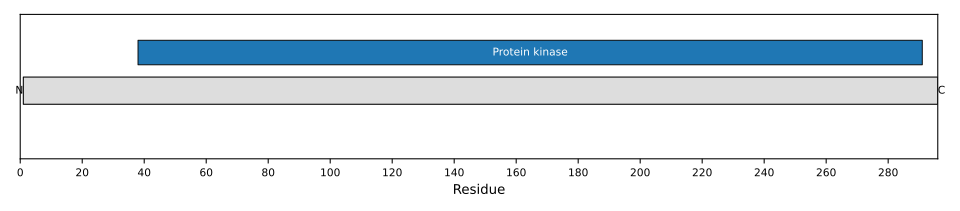
1: Proto-oncogene with serine/threonine kinase activity involved in cell survival and cell proliferation and thus providing a selective advantage in tumorigenesis (PubMed:15528381, PubMed:1825810, PubMed:31548394). Exerts its oncogenic activity through: the regulation of MYC transcriptional activity, the regulation of cell cycle progression and by phosphorylation and inhibition of proapoptotic proteins (BAD, MAP3K5, FOXO3) (PubMed:18593906). Phosphorylation of MYC leads to an increase of MYC protein stability and thereby an increase of transcriptional activity (By similarity). The stabilization of MYC exerted by PIM1 might explain partly the strong synergism between these two oncogenes in tumorigenesis (By similarity). Mediates survival signaling through phosphorylation of BAD, which induces release of the anti-apoptotic protein Bcl-X(L)/BCL2L1 (By similarity). Phosphorylation of MAP3K5, another proapoptotic protein, by PIM1, significantly decreases MAP3K5 kinase activity and inhibits MAP3K5-mediated phosphorylation of JNK and JNK/p38MAPK subsequently reducing caspase-3 activation and cell apoptosis (PubMed:19749799). Stimulates cell cycle progression at the G1-S and G2-M transitions by phosphorylation of CDC25A and CDC25C (PubMed:16356754). Phosphorylation of CDKN1A, a regulator of cell cycle progression at G1, results in the relocation of CDKN1A to the cytoplasm and enhanced CDKN1A protein stability (PubMed:12431783). Promotes cell cycle progression and tumorigenesis by down-regulating expression of a regulator of cell cycle progression, CDKN1B, at both transcriptional and post-translational levels (PubMed:18593906). Phosphorylation of CDKN1B, induces 14-3-3 proteins binding, nuclear export and proteasome-dependent degradation (PubMed:18593906). May affect the structure or silencing of chromatin by phosphorylating HP1 gamma/CBX3 (PubMed:10664448). Also acts as a regulator of homing and migration of bone marrow cells involving functional interaction with the CXCL12-CXCR4 signaling axis (By similarity). Acts as a positive regulator of mTORC1 signaling by mediating phosphorylation and inhibition of DEPDC5 component of the GATOR1 complex (PubMed:31548394). Acts as a negative regulator of innate immunity by mediating phosphorylation and inactivation of GBP1 in absence of infection: phosphorylation of GBP1 induces interaction with 14-3-3 protein sigma (SFN) and retention in the cytosol (PubMed:37797010). Also phosphorylates and activates the ATP-binding cassette transporter ABCG2, allowing resistance to drugs through their excretion from cells (PubMed:18056989). Promotes brown adipocyte differentiation (By similarity)