Proliferating cell nuclear antigen (PCNA) (Cyclin)
1_MFEAR 6_ LVQGS 11_ ILKKV 16_ LEALK 21_ DLINE 26_ ACWDI 31_ SSSGV 36_ NLQSM 41_ DSSHV 46_ SLVQL 51_ TLRSE 56_ GFDTY 61_ RCDRN 66_ LAMGV 71_ NLTSM 76_ SKILK 81_ CAGNE 86_ DIITL 91_ RAEDN 96_ ADTLA 101_ LVFEA 106_ PNQEK 111_ VSDYE 116_ MKLMD 121_ LDVEQ 126_ LGIPE 131_ QEYSC 136_ VVKMP 141_ SGEFA 146_ RICRD 151_ LSHIG 156_ DAVVI 161_ SCAKD 166_ GVKFS 171_ ASGEL 176_ GNGNI 181_ KLSQT 186_ SNVDK 191_ EEEAV 196_ TIEMN 201_ EPVQL 206_ TFALR 211_ YLNFF 216_ TKATP 221_ LSSTV 226_ TLSMS 231_ ADVPL 236_ VVEYK 241_ IADMG 246_ HLKYY 251_ LAPKI 256_EDEEG
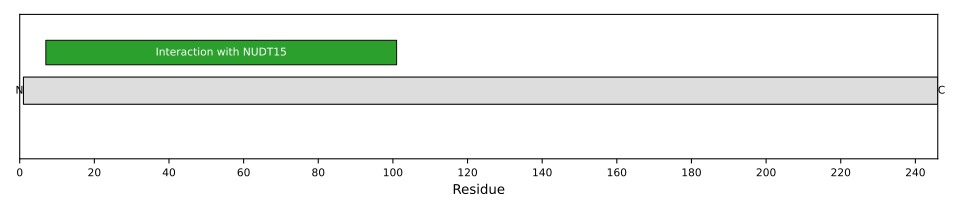
1: Auxiliary protein of DNA polymerase delta and epsilon, is involved in the control of eukaryotic DNA replication by increasing the polymerase's processibility during elongation of the leading strand (PubMed:35585232). Induces a robust stimulatory effect on the 3'-5' exonuclease and 3'-phosphodiesterase, but not apurinic-apyrimidinic (AP) endonuclease, APEX2 activities. Has to be loaded onto DNA in order to be able to stimulate APEX2. Plays a key role in DNA damage response (DDR) by being conveniently positioned at the replication fork to coordinate DNA replication with DNA repair and DNA damage tolerance pathways (PubMed:24939902). Acts as a loading platform to recruit DDR proteins that allow completion of DNA replication after DNA damage and promote postreplication repair: Monoubiquitinated PCNA leads to recruitment of translesion (TLS) polymerases, while 'Lys-63'-linked polyubiquitination of PCNA is involved in error-free pathway and employs recombination mechanisms to synthesize across the lesion (PubMed:24695737)