Proto-oncogene tyrosine-protein kinase Src (EC 2.7.10.2) (Proto-oncogene c-Src) (pp60c-src) (p60-Src)
1_MGSNK 6_ SKPKD 11_ ASQRR 16_ RSLEP 21_ AENVH 26_ GAGGG 31_ AFPAS 36_ QTPSK 41_ PASAD 46_ GHRGP 51_ SAAFA 56_ PAAAE 61_ PKLFG 66_ GFNSS 71_ DTVTS 76_ PQRAG 81_ PLAGG 86_ VTTFV 91_ ALYDY 96_ ESRTE 101_ TDLSF 106_ KKGER 111_ LQIVN 116_ NTEGD 121_ WWLAH 126_ SLSTG 131_ QTGYI 136_ PSNYV 141_ APSDS 146_ IQAEE 151_ WYFGK 156_ ITRRE 161_ SERLL 166_ LNAEN 171_ PRGTF 176_ LVRES 181_ ETTKG 186_ AYCLS 191_ VSDFD 196_ NAKGL 201_ NVKHY 206_ KIRKL 211_ DSGGF 216_ YITSR 221_ TQFNS 226_ LQQLV 231_ AYYSK 236_ HADGL 241_ CHRLT 246_ TVCPT 251_ SKPQT 256_ QGLAK 261_ DAWEI 266_ PRESL 271_ RLEVK 276_ LGQGC 281_ FGEVW 286_ MGTWN 291_ GTTRV 296_ AIKTL 301_ KPGTM 306_ SPEAF 311_ LQEAQ 316_ VMKKL 321_ RHEKL 326_ VQLYA 331_ VVSEE 336_ PIYIV 341_ TEYMS 346_ KGSLL 351_ DFLKG 356_ ETGKY 361_ LRLPQ 366_ LVDMA 371_ AQIAS 376_ GMAYV 381_ ERMNY 386_ VHRDL 391_ RAANI 396_ LVGEN 401_ LVCKV 406_ ADFGL 411_ ARLIE 416_ DNEYT 421_ ARQGA 426_ KFPIK 431_ WTAPE 436_ AALYG 441_ RFTIK 446_ SDVWS 451_ FGILL 456_ TELTT 461_ KGRVP 466_ YPGMV 471_ NREVL 476_ DQVER 481_ GYRMP 486_ CPPEC 491_ PESLH 496_ DLMCQ 501_ CWRKE 506_ PEERP 511_ TFEYL 516_ QAFLE 521_ DYFTS 526_ TEPQY 531_QPGEN
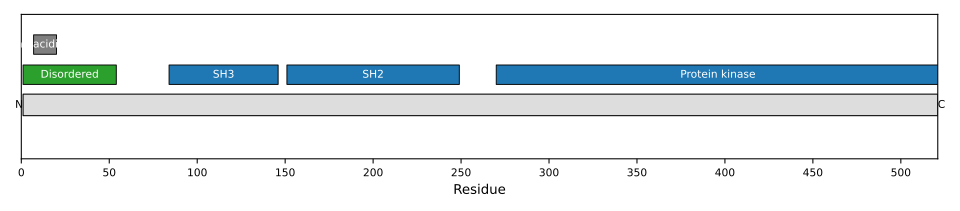
1: Non-receptor protein tyrosine kinase which is activated following engagement of many different classes of cellular receptors including immune response receptors, integrins and other adhesion receptors, receptor protein tyrosine kinases, G protein-coupled receptors as well as cytokine receptors (PubMed:34234773). Participates in signaling pathways that control a diverse spectrum of biological activities including gene transcription, immune response, cell adhesion, cell cycle progression, apoptosis, migration, and transformation. Due to functional redundancy between members of the SRC kinase family, identification of the specific role of each SRC kinase is very difficult. SRC appears to be one of the primary kinases activated following engagement of receptors and plays a role in the activation of other protein tyrosine kinase (PTK) families. Receptor clustering or dimerization leads to recruitment of SRC to the receptor complexes where it phosphorylates the tyrosine residues within the receptor cytoplasmic domains. Plays an important role in the regulation of cytoskeletal organization through phosphorylation of specific substrates such as AFAP1. Phosphorylation of AFAP1 allows the SRC SH2 domain to bind AFAP1 and to localize to actin filaments. Cytoskeletal reorganization is also controlled through the phosphorylation of cortactin (CTTN) (Probable). When cells adhere via focal adhesions to the extracellular matrix, signals are transmitted by integrins into the cell resulting in tyrosine phosphorylation of a number of focal adhesion proteins, including PTK2/FAK1 and paxillin (PXN) (PubMed:21411625). In addition to phosphorylating focal adhesion proteins, SRC is also active at the sites of cell-cell contact adherens junctions and phosphorylates substrates such as beta-catenin (CTNNB1), delta-catenin (CTNND1), and plakoglobin (JUP). Another type of cell-cell junction, the gap junction, is also a target for SRC, which phosphorylates connexin-43 (GJA1). SRC is implicated in regulation of pre-mRNA-processing and phosphorylates RNA-binding proteins such as KHDRBS1 (Probable). Phosphorylates PKP3 at 'Tyr-195' in response to reactive oxygen species, which may cause the release of PKP3 from desmosome cell junctions into the cytoplasm (PubMed:25501895). Also plays a role in PDGF-mediated tyrosine phosphorylation of both STAT1 and STAT3, leading to increased DNA binding activity of these transcription factors (By similarity). Involved in the RAS pathway through phosphorylation of RASA1 and RASGRF1 (PubMed:11389730). Plays a role in EGF-mediated calcium-activated chloride channel activation (PubMed:18586953). Required for epidermal growth factor receptor (EGFR) internalization through phosphorylation of clathrin heavy chain (CLTC and CLTCL1) at 'Tyr-1477'. Involved in beta-arrestin (ARRB1 and ARRB2) desensitization through phosphorylation and activation of GRK2, leading to beta-arrestin phosphorylation and internalization. Has a critical role in the stimulation of the CDK20/MAPK3 mitogen-activated protein kinase cascade by epidermal growth factor (Probable). Might be involved not only in mediating the transduction of mitogenic signals at the level of the plasma membrane but also in controlling progression through the cell cycle via interaction with regulatory proteins in the nucleus (PubMed:7853507). Plays an important role in osteoclastic bone resorption in conjunction with PTK2B/PYK2. Both the formation of a SRC-PTK2B/PYK2 complex and SRC kinase activity are necessary for this function. Recruited to activated integrins by PTK2B/PYK2, thereby phosphorylating CBL, which in turn induces the activation and recruitment of phosphatidylinositol 3-kinase to the cell membrane in a signaling pathway that is critical for osteoclast function (PubMed:14585963, PubMed:8755529). Promotes energy production in osteoclasts by activating mitochondrial cytochrome C oxidase (PubMed:12615910). Phosphorylates DDR2 on tyrosine residues, thereby promoting its subsequent autophosphorylation (PubMed:16186108). Phosphorylates RUNX3 and COX2 on tyrosine residues, TNK2 on 'Tyr-284' and CBL on 'Tyr-731' (PubMed:20100835, PubMed:21309750). Enhances RIGI-elicited antiviral signaling (PubMed:19419966). Phosphorylates PDPK1 at 'Tyr-9', 'Tyr-373' and 'Tyr-376' (PubMed:14585963). Phosphorylates BCAR1 at 'Tyr-128' (PubMed:22710723). Phosphorylates CBLC at multiple tyrosine residues, phosphorylation at 'Tyr-341' activates CBLC E3 activity (PubMed:20525694). Phosphorylates synaptic vesicle protein synaptophysin (SYP) (By similarity). Involved in anchorage-independent cell growth (PubMed:19307596). Required for podosome formation (By similarity). Mediates IL6 signaling by activating YAP1-NOTCH pathway to induce inflammation-induced epithelial regeneration (PubMed:25731159). Phosphorylates OTUB1, promoting deubiquitination of RPTOR (PubMed:35927303). Phosphorylates caspase CASP8 at 'Tyr-380' which negatively regulates CASP8 processing and activation, down-regulating CASP8 proapoptotic function (PubMed:16619028)
2: Non-receptor protein tyrosine kinase which phosphorylates synaptophysin with high affinity
3: Non-receptor protein tyrosine kinase which shows higher basal kinase activity than isoform 1, possibly due to weakened intramolecular interactions which enhance autophosphorylation of Tyr-419 and subsequent activation (By similarity). The SH3 domain shows reduced affinity with the linker sequence between the SH2 and kinase domains which may account for the increased basal activity (By similarity). Displays altered substrate specificity compared to isoform 1, showing weak affinity for synaptophysin and for peptide substrates containing class I or class II SH3 domain-binding motifs (By similarity). Plays a role in L1CAM-mediated neurite elongation, possibly by acting downstream of L1CAM to drive cytoskeletal rearrangements involved in neurite outgrowth (By similarity)
4: Non-receptor protein tyrosine kinase which shows higher basal kinase activity than isoform 1, possibly due to weakened intramolecular interactions which enhance autophosphorylation of Tyr-419 and subsequent activation (By similarity). The SH3 domain shows reduced affinity with the linker sequence between the SH2 and kinase domains which may account for the increased basal activity (By similarity). Displays altered substrate specificity compared to isoform 1, showing weak affinity for synaptophysin and for peptide substrates containing class I or class II SH3 domain-binding motifs (By similarity). Plays a role in neurite elongation (By similarity)