Uracil-DNA glycosylase (UDG) (EC 3.2.2.27)
1_MIGQK 6_ TLYSF 11_ FSPSP 16_ ARKRH 21_ APSPE 26_ PAVQG 31_ TGVAG 36_ VPEES 41_ GDAAA 46_ IPAKK 51_ APAGQ 56_ EEPGT 61_ PPSSP 66_ LSAEQ 71_ LDRIQ 76_ RNKAA 81_ ALLRL 86_ AARNV 91_ PVGFG 96_ ESWKK 101_ HLSGE 106_ FGKPY 111_ FIKLM 116_ GFVAE 121_ ERKHY 126_ TVYPP 131_ PHQVF 136_ TWTQM 141_ CDIKD 146_ VKVVI 151_ LGQDP 156_ YHGPN 161_ QAHGL 166_ CFSVQ 171_ RPVPP 176_ PPSLE 181_ NIYKE 186_ LSTDI 191_ EDFVH 196_ PGHGD 201_ LSGWA 206_ KQGVL 211_ LLNAV 216_ LTVRA 221_ HQANS 226_ HKERG 231_ WEQFT 236_ DAVVS 241_ WLNQN 246_ SNGLV 251_ FLLWG 256_ SYAQK 261_ KGSAI 266_ DRKRH 271_ HVLQT 276_ AHPSP 281_ LSVYR 286_ GFFGC 291_ RHFSK 296_ TNELL 301_ QKSGK 306_KPIDW
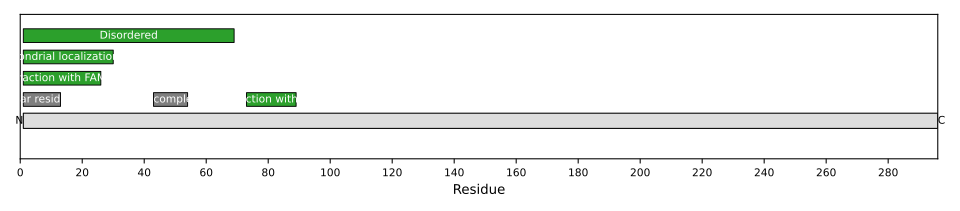
1: Uracil-DNA glycosylase that hydrolyzes the N-glycosidic bond between uracil and deoxyribose in single- and double-stranded DNA (ssDNA and dsDNA) to release a free uracil residue and form an abasic (apurinic/apyrimidinic; AP) site. Excises uracil residues arising as a result of misincorporation of dUMP residues by DNA polymerase during replication or due to spontaneous or enzymatic deamination of cytosine (PubMed:12958596, PubMed:15967827, PubMed:17101234, PubMed:22521144, PubMed:7671300, PubMed:8900285, PubMed:9016624, PubMed:9776759). Mediates error-free base excision repair (BER) of uracil at replication forks. According to the model, it is recruited by PCNA to S-phase replication forks to remove misincorporated uracil at U:A base mispairs in nascent DNA strands. Via trimeric RPA it is recruited to ssDNA stretches ahead of the polymerase to allow detection and excision of deaminated cytosines prior to replication. The resultant AP sites temporarily stall replication, allowing time to repair the lesion (PubMed:22521144). Mediates mutagenic uracil processing involved in antibody affinity maturation. Processes AICDA-induced U:G base mispairs at variable immunoglobulin (Ig) regions leading to the generation of transversion mutations (PubMed:12958596). Operates at switch sites of Ig constant regions where it mediates Ig isotype class switch recombination. Excises AICDA-induced uracil residues forming AP sites that are subsequently nicked by APEX1 endonuclease. The accumulation of staggered nicks in opposite strands results in double strand DNA breaks that are finally resolved via non-homologous end joining repair pathway (By similarity) (PubMed:12958596)