HLA class I histocompatibility antigen, alpha chain E (MHC class I antigen E) [Cleaved into: Soluble HLA class I histocompatibility antigen, alpha chain E (sHLA-E)]
1_MVDGT 6_ LLLLL 11_ SEALA 16_ LTQTW 21_ AGSHS 26_ LKYFH 31_ TSVSR 36_ PGRGE 41_ PRFIS 46_ VGYVD 51_ DTQFV 56_ RFDND 61_ AASPR 66_ MVPRA 71_ PWMEQ 76_ EGSEY 81_ WDRET 86_ RSARD 91_ TAQIF 96_ RVNLR 101_ TLRGY 106_ YNQSE 111_ AGSHT 116_ LQWMH 121_ GCELG 126_ PDGRF 131_ LRGYE 136_ QFAYD 141_ GKDYL 146_ TLNED 151_ LRSWT 156_ AVDTA 161_ AQISE 166_ QKSND 171_ ASEAE 176_ HQRAY 181_ LEDTC 186_ VEWLH 191_ KYLEK 196_ GKETL 201_ LHLEP 206_ PKTHV 211_ THHPI 216_ SDHEA 221_ TLRCW 226_ ALGFY 231_ PAEIT 236_ LTWQQ 241_ DGEGH 246_ TQDTE 251_ LVETR 256_ PAGDG 261_ TFQKW 266_ AAVVV 271_ PSGEE 276_ QRYTC 281_ HVQHE 286_ GLPEP 291_ VTLRW 296_ KPASQ 301_ PTIPI 306_ VGIIA 311_ GLVLL 316_ GSVVS 321_ GAVVA 326_ AVIWR 331_ KKSSG 336_ GKGGS 341_ YSKAE 346_ WSDSA 351_QGSES
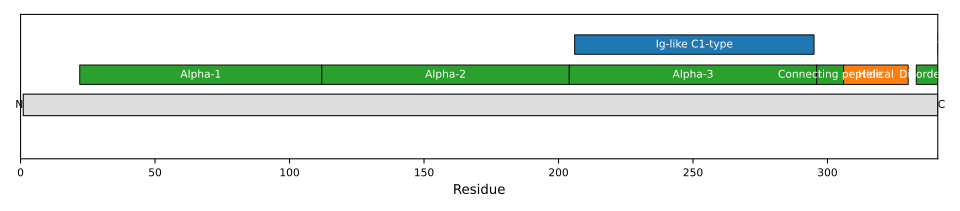
1: Non-classical major histocompatibility class Ib molecule involved in immune self-nonself discrimination. In complex with B2M/beta-2-microglobulin binds nonamer self-peptides derived from the signal sequence of classical MHC class Ia molecules (VL9 peptides - VMAPRT[V/L][L/V/I/F]L) (PubMed:18083576, PubMed:18339401, PubMed:35705051, PubMed:37264229, PubMed:9754572). Peptide-bound HLA-E-B2M heterotrimeric complex primarily functions as a ligand for natural killer (NK) cell inhibitory receptor KLRD1-KLRC1, enabling NK cells to monitor the expression of other MHC class I molecules in healthy cells and to tolerate self (PubMed:17179229, PubMed:18083576, PubMed:37264229, PubMed:9486650, PubMed:9754572). Upon cellular stress, preferentially binds signal sequence-derived peptides from stress-induced chaperones and is no longer recognized by NK cell inhibitory receptor KLRD1-KLRC1, resulting in impaired protection from NK cells (PubMed:12461076). Binds signal sequence-derived peptides from non-classical MHC class Ib HLA-G molecules and acts as a ligand for NK cell activating receptor KLRD1-KLRC2, likely playing a role in the generation and effector functions of adaptive NK cells and in maternal-fetal tolerance during pregnancy (PubMed:30134159, PubMed:37264229, PubMed:9754572). Besides self-peptides, can also bind and present pathogen-derived peptides conformationally similar to VL9 peptides to alpha-beta T cell receptor (TCR) on unconventional CD8-positive cytotoxic T cells, ultimately triggering antimicrobial immune response (PubMed:16474394, PubMed:20195504, PubMed:30087334, PubMed:34228645). Presents HIV gag peptides (immunodominant KAFSPEVIPMF and subdominant KALGPAATL epitopes) predominantly to CD8-positive T cell clones expressing a TRAV17-containing TCR, triggering HLA-E-restricted T cell responses (PubMed:34228645). Presents mycobacterial peptides to HLA-E-restricted CD8-positive T cells eliciting both cytotoxic and immunoregulatory functions (PubMed:20195504, PubMed:35705051)
2: (Microbial infection) Viruses like human cytomegalovirus have evolved an escape mechanism whereby virus-induced down-regulation of host MHC class I molecules is coupled to the binding of viral peptides to HLA-E, restoring HLA-E expression and inducing HLA-E-dependent NK cell immune tolerance to infected cells
3: (Microbial infection) May bind HIV-1 gag/Capsid protein p24-derived peptide (AISPRTLNA) on infected cells and may inhibit NK cell cytotoxicity, a mechanism that allows HIV-1 to escape immune recognition
4: (Microbial infection) Upon SARS-CoV-2 infection, may contribute to functional exhaustion of cytotoxic NK cells and CD8-positive T cells (PubMed:32859121). Binds SARS-CoV-2 S/Spike protein S1-derived peptide (LQPRTFLL) expressed on the surface of lung epithelial cells, inducing NK cell exhaustion and dampening of antiviral immune surveillance (PubMed:32859121)