Sodium/glucose cotransporter 1 (Na(+)/glucose cotransporter 1) (High affinity sodium-glucose cotransporter) (Solute carrier family 5 member 1)
1_MDSST 6_ WSPKT 11_ TAVTR 16_ PVETH 21_ ELIRN 26_ AADIS 31_ IIVIY 36_ FVVVM 41_ AVGLW 46_ AMFST 51_ NRGTV 56_ GGFFL 61_ AGRSM 66_ VWWPI 71_ GASLF 76_ ASNIG 81_ SGHFV 86_ GLAGT 91_ GAASG 96_ IAIGG 101_ FEWNA 106_ LVLVV 111_ VLGWL 116_ FVPIY 121_ IKAGV 126_ VTMPE 131_ YLRKR 136_ FGGQR 141_ IQVYL 146_ SLLSL 151_ LLYIF 156_ TKISA 161_ DIFSG 166_ AIFIN 171_ LALGL 176_ NLYLA 181_ IFLLL 186_ AITAL 191_ YTITG 196_ GLAAV 201_ IYTDT 206_ LQTVI 211_ MLVGS 216_ LILTG 221_ FAFHE 226_ VGGYD 231_ AFMEK 236_ YMKAI 241_ PTIVS 246_ DGNTT 251_ FQEKC 256_ YTPRA 261_ DSFHI 266_ FRDPL 271_ TGDLP 276_ WPGFI 281_ FGMSI 286_ LTLWY 291_ WCTDQ 296_ VIVQR 301_ CLSAK 306_ NMSHV 311_ KGGCI 316_ LCGYL 321_ KLMPM 326_ FIMVM 331_ PGMIS 336_ RILYT 341_ EKIAC 346_ VVPSE 351_ CEKYC 356_ GTKVG 361_ CTNIA 366_ YPTLV 371_ VELMP 376_ NGLRG 381_ LMLSV 386_ MLASL 391_ MSSLT 396_ SIFNS 401_ ASTLF 406_ TMDIY 411_ AKVRK 416_ RASEK 421_ ELMIA 426_ GRLFI 431_ LVLIG 436_ ISIAW 441_ VPIVQ 446_ SAQSG 451_ QLFDY 456_ IQSIT 461_ SYLGP 466_ PIAAV 471_ FLLAI 476_ FWKRV 481_ NEPGA 486_ FWGLI 491_ LGLLI 496_ GISRM 501_ ITEFA 506_ YGTGS 511_ CMEPS 516_ NCPTI 521_ ICGVH 526_ YLYFA 531_ IILFA 536_ ISFIT 541_ IVVIS 546_ LLTKP 551_ IPDVH 556_ LYRLC 561_ WSLRN 566_ SKEER 571_ IDLDA 576_ EEENI 581_ QEGPK 586_ ETIEI 591_ ETQVP 596_ EKKKG 601_ IFRRA 606_ YDLFC 611_ GLEQH 616_ GAPKM 621_ TEEEE 626_ KAMKM 631_ KMTDT 636_ SEKPL 641_ WRTVL 646_ NVNGI 651_ ILVTV 656_AVFCH
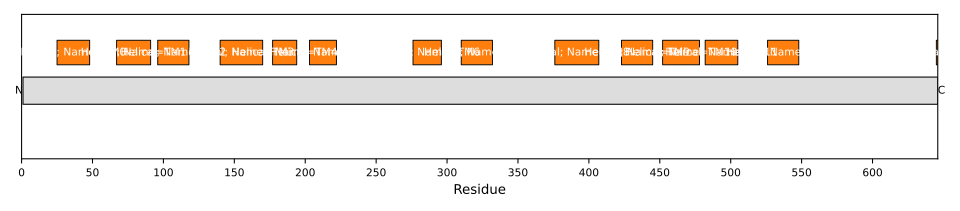
1: Electrogenic Na(+)-coupled sugar symporter that actively transports D-glucose or D-galactose at the plasma membrane, with a Na(+) to sugar coupling ratio of 2:1. Transporter activity is driven by a transmembrane Na(+) electrochemical gradient set by the Na(+)/K(+) pump (PubMed:20980548, PubMed:34880492, PubMed:35077764, PubMed:8563765, PubMed:37217492). Has a primary role in the transport of dietary monosaccharides from enterocytes to blood. Responsible for the absorption of D-glucose or D-galactose across the apical brush-border membrane of enterocytes, whereas basolateral exit is provided by GLUT2. Additionally, functions as a D-glucose sensor in enteroendocrine cells, triggering the secretion of the incretins GCG and GIP that control food intake and energy homeostasis (By similarity) (PubMed:8563765). Together with SGLT2, functions in reabsorption of D-glucose from glomerular filtrate, playing a nonredundant role in the S3 segment of the proximal tubules (By similarity). Transports D-glucose into endometrial epithelial cells, controlling glycogen synthesis and nutritional support for the embryo as well as the decidual transformation of endometrium prior to conception (PubMed:28974690). Acts as a water channel enabling passive water transport across the plasma membrane in response to the osmotic gradient created upon sugar and Na(+) uptake. Has high water conductivity, comparable to aquaporins, and therefore is expected to play an important role in transepithelial water permeability, especially in the small intestine