Pyruvate kinase PKM (EC 2.7.1.40) (Cytosolic thyroid hormone-binding protein) (CTHBP) (Opa-interacting protein 3) (OIP-3) (Pyruvate kinase 2/3) (Pyruvate kinase muscle isozyme) (Threonine-protein kinase PKM2) (EC 2.7.11.1) (Thyroid hormone-binding protein 1) (THBP1) (Tumor M2-PK) (Tyrosine-protein kinase PKM2) (EC 2.7.10.2) (p58)
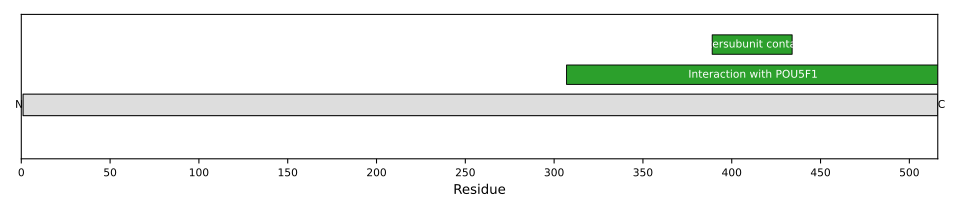
1_MSKPH 6_ SEAGT 11_ AFIQT 16_ QQLHA 21_ AMADT 26_ FLEHM 31_ CRLDI 36_ DSPPI 41_ TARNT 46_ GIICT 51_ IGPAS 56_ RSVET 61_ LKEMI 66_ KSGMN 71_ VARLN 76_ FSHGT 81_ HEYHA 86_ ETIKN 91_ VRTAT 96_ ESFAS 101_ DPILY 106_ RPVAV 111_ ALDTK 116_ GPEIR 121_ TGLIK 126_ GSGTA 131_ EVELK 136_ KGATL 141_ KITLD 146_ NAYME 151_ KCDEN 156_ ILWLD 161_ YKNIC 166_ KVVEV 171_ GSKIY 176_ VDDGL 181_ ISLQV 186_ KQKGA 191_ DFLVT 196_ EVENG 201_ GSLGS 206_ KKGVN 211_ LPGAA 216_ VDLPA 221_ VSEKD 226_ IQDLK 231_ FGVEQ 236_ DVDMV 241_ FASFI 246_ RKASD 251_ VHEVR 256_ KVLGE 261_ KGKNI 266_ KIISK 271_ IENHE 276_ GVRRF 281_ DEILE 286_ ASDGI 291_ MVARG 296_ DLGIE 301_ IPAEK 306_ VFLAQ 311_ KMMIG 316_ RCNRA 321_ GKPVI 326_ CATQM 331_ LESMI 336_ KKPRP 341_ TRAEG 346_ SDVAN 351_ AVLDG 356_ ADCIM 361_ LSGET 366_ AKGDY 371_ PLEAV 376_ RMQHL 381_ IAREA 386_ EAAIY 391_ HLQLF 396_ EELRR 401_ LAPIT 406_ SDPTE 411_ ATAVG 416_ AVEAS 421_ FKCCS 426_ GAIIV 431_ LTKSG 436_ RSAHQ 441_ VARYR 446_ PRAPI 451_ IAVTR 456_ NPQTA 461_ RQAHL 466_ YRGIF 471_ PVLCK 476_ DPVQE 481_ AWAED 486_ VDLRV 491_ NFAMN 496_ VGKAR 501_ GFFKK 506_ GDVVI 511_ VLTGW 516_ RPGSG 521_ FTNTM 526_RVVPV
1: Catalyzes the final rate-limiting step of glycolysis by mediating the transfer of a phosphoryl group from phosphoenolpyruvate (PEP) to ADP, generating ATP (PubMed:15996096, PubMed:1854723, PubMed:20847263). The ratio between the highly active tetrameric form and nearly inactive dimeric form determines whether glucose carbons are channeled to biosynthetic processes or used for glycolytic ATP production (PubMed:15996096, PubMed:1854723, PubMed:20847263). The transition between the 2 forms contributes to the control of glycolysis and is important for tumor cell proliferation and survival (PubMed:15996096, PubMed:1854723, PubMed:20847263)
2: Isoform specifically expressed during embryogenesis that has low pyruvate kinase activity by itself and requires allosteric activation by D-fructose 1,6-bisphosphate (FBP) for pyruvate kinase activity (PubMed:18337823, PubMed:20847263). In addition to its pyruvate kinase activity in the cytoplasm, also acts as a regulator of transcription in the nucleus by acting as a protein kinase (PubMed:18191611, PubMed:21620138, PubMed:22056988, PubMed:22306293, PubMed:22901803, PubMed:24120661). Translocates into the nucleus in response to various signals, such as EGF receptor activation, and homodimerizes, leading to its conversion into a protein threonine- and tyrosine-protein kinase (PubMed:22056988, PubMed:22306293, PubMed:22901803, PubMed:24120661, PubMed:26787900). Catalyzes phosphorylation of STAT3 at 'Tyr-705' and histone H3 at 'Thr-11' (H3T11ph), leading to activate transcription (PubMed:22306293, PubMed:22901803, PubMed:24120661). Its ability to activate transcription plays a role in cancer cells by promoting cell proliferation and promote tumorigenesis (PubMed:18337823, PubMed:22901803, PubMed:26787900). Promotes the expression of the immune checkpoint protein CD274 in BMAL1-deficient macrophages (By similarity). May also act as a translation regulator for a subset of mRNAs, independently of its pyruvate kinase activity: associates with subpools of endoplasmic reticulum-associated ribosomes, binds directly to the mRNAs translated at the endoplasmic reticulum and promotes translation of these endoplasmic reticulum-destined mRNAs (By similarity). Plays a role in caspase independent cell death of tumor cells (PubMed:17308100)
3: Pyruvate kinase isoform expressed in adult tissues, which replaces isoform M2 after birth (PubMed:18337823). In contrast to isoform M2, has high pyruvate kinase activity by itself and does not require allosteric activation by D-fructose 1,6-bisphosphate (FBP) for activity (PubMed:20847263)