D-amino-acid oxidase (DAAO) (DAMOX) (DAO) (EC 1.4.3.3)
1_MRVVV 6_ IGAGV 11_ IGLST 16_ ALCIH 21_ ERYHS 26_ VLQPL 31_ DIKVY 36_ ADRFT 41_ PLTTT 46_ DVAAG 51_ LWQPY 56_ LSDPN 61_ NPQEA 66_ DWSQQ 71_ TFDYL 76_ LSHVH 81_ SPNAE 86_ NLGLF 91_ LISGY 96_ NLFHE 101_ AIPDP 106_ SWKDT 111_ VLGFR 116_ KLTPR 121_ ELDMF 126_ PDYGY 131_ GWFHT 136_ SLILE 141_ GKNYL 146_ QWLTE 151_ RLTER 156_ GVKFF 161_ QRKVE 166_ SFEEV 171_ AREGA 176_ DVIVN 181_ CTGVW 186_ AGALQ 191_ RDPLL 196_ QPGRG 201_ QIMKV 206_ DAPWM 211_ KHFIL 216_ THDPE 221_ RGIYN 226_ SPYII 231_ PGTQT 236_ VTLGG 241_ IFQLG 246_ NWSEL 251_ NNIQD 256_ HNTIW 261_ EGCCR 266_ LEPTL 271_ KNARI 276_ IGERT 281_ GFRPV 286_ RPQIR 291_ LEREQ 296_ LRTGP 301_ SNTEV 306_ IHNYG 311_ HGGYG 316_ LTIHW 321_ GCALE 326_ AAKLF 331_ GRILE 336_ EKKLS 341_RMPPS
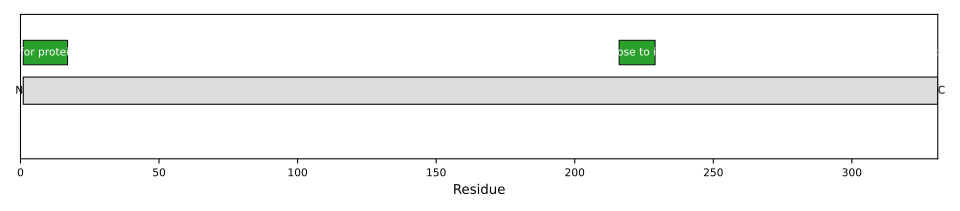
1: Catalyzes the oxidative deamination of D-amino acids with broad substrate specificity (PubMed:16616139, PubMed:17088322, PubMed:17303072, PubMed:18544534, PubMed:20368421, PubMed:20567862, PubMed:20603179, PubMed:22203986, PubMed:23219954, PubMed:23391306, PubMed:25030849, PubMed:25701391, PubMed:29274788, PubMed:29326945, PubMed:30938755, PubMed:31799256, PubMed:32730563, PubMed:33484270, PubMed:34041270, PubMed:37558109, PubMed:38035964). Required to catabolize D-amino acids synthesized endogenously, of gastrointestinal bacterial origin or obtained from the diet, and to use these as nutrients (By similarity). Regulates the level of D-amino acid neurotransmitters in the brain, such as D-serine, a co-agonist of N-methyl D-aspartate (NMDA) receptors, and may modulate synaptic transmission (PubMed:17303072). Catalyzes the first step of the racemization of D-DOPA to L-DOPA, for possible use in an alternative dopamine biosynthesis pathway (PubMed:17303072). Also catalyzes the first step of the chiral inversion of N(gamma)-nitro-D-arginine methyl ester (D-NNA) to its L-enantiomer L-NNA that acts as a nitric oxide synthase inhibitor (By similarity). The hydrogen peroxide produced in the reaction provides protection against microbial infection; it contributes to the oxidative killing activity of phagocytic leukocytes and protects against bacterial colonization of the small intestine (By similarity). Enzyme secreted into the lumen of the intestine may not be catalytically active and could instead be proteolytically cleaved into peptides with antimicrobial activity (By similarity). The hydrogen peroxide produced in the reaction may also play a role in promoting cellular senescence in response to DNA damage (PubMed:30659069). Could act as a detoxifying agent which removes D-amino acids accumulated during aging (PubMed:17303072)