Myogenin (Class C basic helix-loop-helix protein 3) (bHLHc3) (Myogenic factor 4) (Myf-4)
1_MELYE 6_ TSPYF 11_ YQEPR 16_ FYDGE 21_ NYLPV 26_ HLQGF 31_ EPPGY 36_ ERTEL 41_ TLSPE 46_ APGPL 51_ EDKGL 56_ GTPEH 61_ CPGQC 66_ LPWAC 71_ KVCKR 76_ KSVSV 81_ DRRRA 86_ ATLRE 91_ KRRLK 96_ KVNEA 101_ FEALK 106_ RSTLL 111_ NPNQR 116_ LPKVE 121_ ILRSA 126_ IQYIE 131_ RLQAL 136_ LSSLN 141_ QEERD 146_ LRYRG 151_ GGGPQ 156_ PGVPS 161_ ECSSH 166_ SASCS 171_ PEWGS 176_ ALEFS 181_ ANPGD 186_ HLLTA 191_ DPTDA 196_ HNLHS 201_ LTSIV 206_ DSITV 211_ EDVSV 216_AFPDE
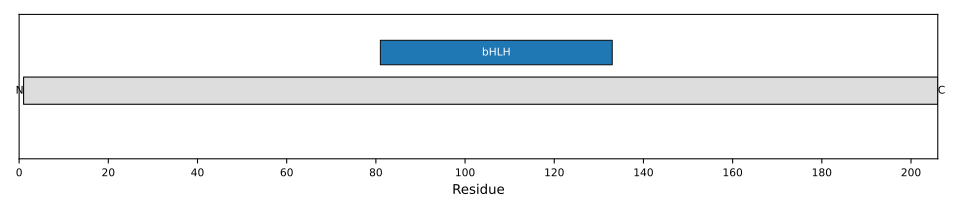
1: Acts as a transcriptional activator that promotes transcription of muscle-specific target genes and plays a role in muscle differentiation, cell cycle exit and muscle atrophy. Essential for the development of functional embryonic skeletal fiber muscle differentiation. However is dispensable for postnatal skeletal muscle growth; phosphorylation by CAMK2G inhibits its transcriptional activity in respons to muscle activity. Required for the recruitment of the FACT complex to muscle-specific promoter regions, thus promoting gene expression initiation. During terminal myoblast differentiation, plays a role as a strong activator of transcription at loci with an open chromatin structure previously initiated by MYOD1. Together with MYF5 and MYOD1, co-occupies muscle-specific gene promoter core regions during myogenesis. Also cooperates with myocyte-specific enhancer factor MEF2D and BRG1-dependent recruitment of SWI/SNF chromatin-remodeling enzymes to alter chromatin structure at myogenic late gene promoters. Facilitates cell cycle exit during terminal muscle differentiation through the up-regulation of miR-20a expression, which in turn represses genes involved in cell cycle progression. Binds to the E-box containing (E1) promoter region of the miR-20a gene. Also plays a role in preventing reversal of muscle cell differentiation. Contributes to the atrophy-related gene expression in adult denervated muscles. Induces fibroblasts to differentiate into myoblasts (By similarity)