Histatin-3 (Basic histidine-rich protein) (Hst) (Histidine-rich protein 3) (PB) [Cleaved into: Histatin-3; His3-(20-44)-peptide (His3 20/44) (His3-(1-25)-peptide) (His3 1/25) (Histatin-3 1/25) (Histatin-6); His3-(20-43)-peptide (His3 20/43) (His3-(1-24)-peptide) (His3 1/24) (Histatin-3 1/24) (Histatin-5); His3-(20-32)-peptide (His3 20/32) (His3-(1-13)-peptide) (His3 1/13) (Histatin-3 1/13); His3-(20-31)-peptide (His3 20/31) (His3-(1-12)-peptide) (His3 1/12) (Histatin-3 1/12); His3-(20-30)-peptide (His3 20/30) (His3-(1-11)-peptide) (His3 1/11) (Histatin-3 1/11); His3-(24-32)-peptide (His3 24/32) (His3-(5-13)-peptide) (His3 5/13) (Histatin-3 5/13); His3-(24-31)-peptide (His3 24/31) (His3-(5-12)-peptide) (His3 5/12) (Histatin-11) (Histatin-3 5/12); His3-(24-30)-peptide (His3 24/30) (His3-(5-11)-peptide) (His3 5/11) (Histatin-12) (Histatin-3 5/11); His3-(25-32)-peptide (His3 25/32) (His3-(6-13)-peptide) (His3 6/13) (Histatin-3 6/13); His3-(25-30)-peptide (His3 25/30) (His3-(6-11)-peptide) (His3 6/11) (Histatin-3 6/11); His3-(26-32)-peptide (His3 26/32) (His3-(7-13)-peptide) (His3 7/13) (Histatin-3 7/13); His3-(26-31)-peptide (His3 26/31) (His3-(7-12)-peptide) (His3 7/12) (Histatin-3 7/12); His3-(26-30)-peptide (His3 26/30) (His3-(7-11)-peptide) (His3 7/11) (Histatin-3 7/11); His3-(31-51)-peptide (His3 31/51) (His3-(12-32)-peptide) (His3 12/32) (Histatin-3 12/32) (Histatin-4); His3-(31-44)-peptide (His3 31/44) (His3-(12-25)-peptide) (His3 12/25) (Histatin-3 12/25) (Histatin-9); His3-(31-43)-peptide (His3 31/43) (His3-(12-24)-peptide) (His3 12/24) (Histatin-3 12/24) (Histatin-7); His3-(32-44)-peptide (His3 32/44) (His3-(13-25)-peptide) (His3 13/25) (Histatin-10) (Histatin-3 13/25); His3-(32-43)-peptide (His3 32-43) (His3-(13-24)-peptide) (His3 13/24) (Histatin-3 13/24) (Histatin-8); His3-(33-44)-peptide (His3 33/44) (His3-(14-25)-peptide) (His3 14/25) (Histatin-3 14/25); His3-(33-43)-peptide (His3 33/43) (His3-(14-24)-peptide) (His3 14/24) (Histatin-3 14/24); His3-(34-44)-peptide (His3 34/44) (His3-(15-25)-peptide) (His3 15/25) (Histatin-3 15/25); His3-(34-43)-peptide (His3 34/43) (His3-(15-24)-peptide) (His3 15/24) (Histatin-3 15/24); His3-(45-51)-peptide (His3 45/51) (His3-(26-32)-peptide) (His3 26/32) (Histatin-3 26/32); His3-(47-51)-peptide (His3 47/51) (His3-(28-32)-peptide) (His3 28/32) (Histatin-3 28/32); His3-(48-51)-peptide (His3 48/51) (His3-(29-32)-peptide) (His3 29/32) (Histatin-3 29/32)]
1_MKFFV 6_ FALIL 11_ ALMLS 16_ MTGAD 21_ SHAKR 26_ HHGYK 31_ RKFHE 36_ KHHSH 41_ RGYRS 46_NYLYD
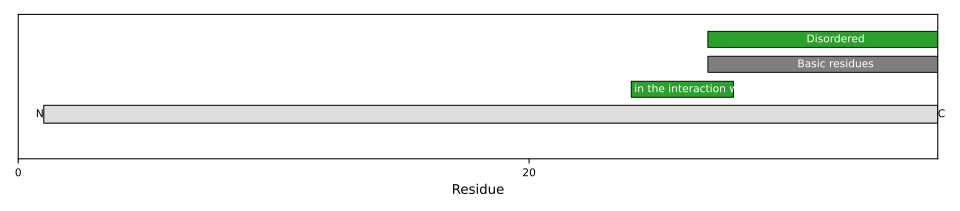
1: Histatins are cationic and histidine-rich peptides mainly found in the saliva of higher primates (PubMed:3286634). They are considered to be major precursors of the protective proteinaceous structure on tooth surfaces (enamel pellicle). Hsts can be divided into two major groups according to their biological functions: antimicrobial Hsts (e.g. Hst 5/HTN3) and cell-activating Hsts (e.g. Hst 1/HTN1, Hst 2/HTN1 and Hst 3/HTN3) (PubMed:32225006)
2: Histatin 3 (Hst 3) is mostly involved in cell migration and wound healing in the oral cavity (PubMed:18650243). Also stimulates cell proliferation after binding to heat shock protein HSC70, which enhances HSC70-CDKN1B complex formation and subsequent ubiquitination during G1/S transition (PubMed:26775844). Also displays antifungal activity against pathogenic yeast Candida albicans, however with less effectiveness than Hst 5 (PubMed:11083804, PubMed:3286634)
3: Histatin 5 (Hst 5), a fragment of Hst 3, is the major histatin exhibiting antifungal and antibacterial activities (PubMed:10066791, PubMed:11083804, PubMed:11179305, PubMed:11717389, PubMed:12939362, PubMed:15485849, PubMed:2372245, PubMed:8945538). It is effective against pathogenic yeast C.albicans, C.neoformans, C.glabrata and S.cerevisiae as well as ESKAPE bacterial pathogens (PubMed:18974864, PubMed:23613860, PubMed:2372245, PubMed:28261570, PubMed:8945538). Secreted Hst 5 mediates a multi-step intracellular mechanism of action against the pathogen. Depending on peptide concentration and pathogen, uptake across the membrane can occur through transporters, direct interaction with plasma membrane and/or receptor-mediated endocytosis (PubMed:18974864, PubMed:20487276, PubMed:28261570). Binds C.albicans cell wall proteins SSA1 and SSA2 and glycans in an energy-independent manner, then is taken up by the cells through fungal polyamine transporters DUR3 and DUR31 in an energy-dependent manner (PubMed:12761219, PubMed:20487276, PubMed:22033918, PubMed:23613860). Internalized Hst5 is then targeted to the energized mitochondrion to induce reactive oxygen species (ROS) formation and subsequent release of intracellular non-lytic ATP which ultimately leads to fungal cell death (PubMed:10066791, PubMed:11083804, PubMed:11717389). In addition, inhibits C.albicans TRK1 potassium-transporter which causes exudation of intracellular K(+), generating an osmotic imbalance leading to delayed membrane lysis and cell death (PubMed:15485849). Also acts as a potent inhibitor of bacterial proteases such as Lys-gingipain and Arg-gingipain (rgpB) from P.gingivalis as well as human metalloproteases MMP2 and MMP9 (PubMed:11179305). The binding of metals such as zinc, copper or nickel with Hst 5 results in the protection of the enamel and antimicrobial activities such as the inhibition of microbial growth by decreasing the metal concentration, the formation of ROS commonly associated with redox-active metals, the induction of membrane disruption mediated by zinc binding (PubMed:19846304, PubMed:28261570, PubMed:28763199, PubMed:32751915). Also involved in coating oral surfaces in the form of a salivary film which reduces colonization by C.albicans on epithelial cell surfaces (PubMed:26379655). Secreted Hst 5 can also internalize mammalian epithelial cells and target the mitochondria although it does not exert cytotoxic effects in these cells (PubMed:32225006). In contrast with Hst 3, not able to promote wound healing in mammalian host cells (PubMed:18650243)