V(D)J recombination-activating protein 1 (RAG-1) (RING finger protein 74) [Includes: Endonuclease RAG1 (EC 3.1.-.-); E3 ubiquitin-protein ligase RAG1 (EC 2.3.2.27) (RING-type E3 ubiquitin transferase RAG1)]
1_MAASF 6_ PPTLG 11_ LSSAP 16_ DEIQH 21_ PHIKF 26_ SEWKF 31_ KLFRV 36_ RSFEK 41_ TPEEA 46_ QKEKK 51_ DSFEG 56_ KPSLE 61_ QSPAV 66_ LDKAD 71_ GQKPV 76_ PTQPL 81_ LKAHP 86_ KFSKK 91_ FHDNE 96_ KARGK 101_ AIHQA 106_ NLRHL 111_ CRICG 116_ NSFRA 121_ DEHNR 126_ RYPVH 131_ GPVDG 136_ KTLGL 141_ LRKKE 146_ KRATS 151_ WPDLI 156_ AKVFR 161_ IDVKA 166_ DVDSI 171_ HPTEF 176_ CHNCW 181_ SIMHR 186_ KFSSA 191_ PCEVY 196_ FPRNV 201_ TMEWH 206_ PHTPS 211_ CDICN 216_ TARRG 221_ LKRKS 226_ LQPNL 231_ QLSKK 236_ LKTVL 241_ DQARQ 246_ ARQHK 251_ RRAQA 256_ RISSK 261_ DVMKK 266_ IANCS 271_ KIHLS 276_ TKLLA 281_ VDFPE 286_ HFVKS 291_ ISCQI 296_ CEHIL 301_ ADPVE 306_ TNCKH 311_ VFCRV 316_ CILRC 321_ LKVMG 326_ SYCPS 331_ CRYPC 336_ FPTDL 341_ ESPVK 346_ SFLSV 351_ LNSLM 356_ VKCPA 361_ KECNE 366_ EVSLE 371_ KYNHH 376_ ISSHK 381_ ESKEI 386_ FVHIN 391_ KGGRP 396_ RQHLL 401_ SLTRR 406_ AQKHR 411_ LRELK 416_ LQVKA 421_ FADKE 426_ EGGDV 431_ KSVCM 436_ TLFLL 441_ ALRAR 446_ NEHRQ 451_ ADELE 456_ AIMQG 461_ KGSGL 466_ QPAVC 471_ LAIRV 476_ NTFLS 481_ CSQYH 486_ KMYRT 491_ VKAIT 496_ GRQIF 501_ QPLHA 506_ LRNAE 511_ KVLLP 516_ GYHHF 521_ EWQPP 526_ LKNVS 531_ SSTDV 536_ GIIDG 541_ LSGLS 546_ SSVDD 551_ YPVDT 556_ IAKRF 561_ RYDSA 566_ LVSAL 571_ MDMEE 576_ DILEG 581_ MRSQD 586_ LDDYL 591_ NGPFT 596_ VVVKE 601_ SCDGM 606_ GDVSE 611_ KHGSG 616_ PVVPE 621_ KAVRF 626_ SFTIM 631_ KITIA 636_ HSSQN 641_ VKVFE 646_ EAKPN 651_ SELCC 656_ KPLCL 661_ MLADE 666_ SDHET 671_ LTAIL 676_ SPLIA 681_ EREAM 686_ KSSEL 691_ MLELG 696_ GILRT 701_ FKFIF 706_ RGTGY 711_ DEKLV 716_ REVEG 721_ LEASG 726_ SVYIC 731_ TLCDA 736_ TRLEA 741_ SQNLV 746_ FHSIT 751_ RSHAE 756_ NLERY 761_ EVWRS 766_ NPYHE 771_ SVEEL 776_ RDRVK 781_ GVSAK 786_ PFIET 791_ VPSID 796_ ALHCD 801_ IGNAA 806_ EFYKI 811_ FQLEI 816_ GEVYK 821_ NPNAS 826_ KEERK 831_ RWQAT 836_ LDKHL 841_ RKKMN 846_ LKPIM 851_ RMNGN 856_ FARKL 861_ MTKET 866_ VDAVC 871_ ELIPS 876_ EERHE 881_ ALREL 886_ MDLYL 891_ KMKPV 896_ WRSSC 901_ PAKEC 906_ PESLC 911_ QYSFN 916_ SQRFA 921_ ELLST 926_ KFKYR 931_ YEGKI 936_ TNYFH 941_ KTLAH 946_ VPEII 951_ ERDGS 956_ IGAWA 961_ SEGNE 966_ SGNKL 971_ FRRFR 976_ KMNAR 981_ QSKCY 986_ EMEDV 991_ LKHHW 996_ LYTSK 1001_ YLQKF 1006_ MNAHN 1011_ ALKTS 1016_ GFTMN 1021_ PQASL 1026_ GDPLG 1031_ IEDSL 1036_ESQDS
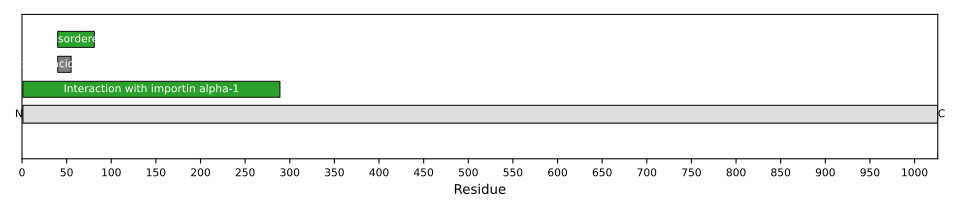
1: Catalytic component of the RAG complex, a multiprotein complex that mediates the DNA cleavage phase during V(D)J recombination. V(D)J recombination assembles a diverse repertoire of immunoglobulin and T-cell receptor genes in developing B and T-lymphocytes through rearrangement of different V (variable), in some cases D (diversity), and J (joining) gene segments. In the RAG complex, RAG1 mediates the DNA-binding to the conserved recombination signal sequences (RSS) and catalyzes the DNA cleavage activities by introducing a double-strand break between the RSS and the adjacent coding segment. RAG2 is not a catalytic component but is required for all known catalytic activities. DNA cleavage occurs in 2 steps: a first nick is introduced in the top strand immediately upstream of the heptamer, generating a 3'-hydroxyl group that can attack the phosphodiester bond on the opposite strand in a direct transesterification reaction, thereby creating 4 DNA ends: 2 hairpin coding ends and 2 blunt, 5'-phosphorylated ends. The chromatin structure plays an essential role in the V(D)J recombination reactions and the presence of histone H3 trimethylated at 'Lys-4' (H3K4me3) stimulates both the nicking and haipinning steps. The RAG complex also plays a role in pre-B cell allelic exclusion, a process leading to expression of a single immunoglobulin heavy chain allele to enforce clonality and monospecific recognition by the B-cell antigen receptor (BCR) expressed on individual B-lymphocytes. The introduction of DNA breaks by the RAG complex on one immunoglobulin allele induces ATM-dependent repositioning of the other allele to pericentromeric heterochromatin, preventing accessibility to the RAG complex and recombination of the second allele. In addition to its endonuclease activity, RAG1 also acts as an E3 ubiquitin-protein ligase that mediates monoubiquitination of histone H3. Histone H3 monoubiquitination is required for the joining step of V(D)J recombination. Mediates polyubiquitination of KPNA1 (By similarity)