Potassium voltage-gated channel subfamily A member 2 (NGK1) (Voltage-gated K(+) channel HuKIV) (Voltage-gated potassium channel HBK5) (Voltage-gated potassium channel subunit Kv1.2)
1_MTVAT 6_ GDPAD 11_ EAAAL 16_ PGHPQ 21_ DTYDP 26_ EADHE 31_ CCERV 36_ VINIS 41_ GLRFE 46_ TQLKT 51_ LAQFP 56_ ETLLG 61_ DPKKR 66_ MRYFD 71_ PLRNE 76_ YFFDR 81_ NRPSF 86_ DAILY 91_ YYQSG 96_ GRLRR 101_ PVNVP 106_ LDIFS 111_ EEIRF 116_ YELGE 121_ EAMEM 126_ FREDE 131_ GYIKE 136_ EERPL 141_ PENEF 146_ QRQVW 151_ LLFEY 156_ PESSG 161_ PARII 166_ AIVSV 171_ MVILI 176_ SIVSF 181_ CLETL 186_ PIFRD 191_ ENEDM 196_ HGSGV 201_ TFHTY 206_ SNSTI 211_ GYQQS 216_ TSFTD 221_ PFFIV 226_ ETLCI 231_ IWFSF 236_ EFLVR 241_ FFACP 246_ SKAGF 251_ FTNIM 256_ NIIDI 261_ VAIIP 266_ YFITL 271_ GTELA 276_ EKPED 281_ AQQGQ 286_ QAMSL 291_ AILRV 296_ IRLVR 301_ VFRIF 306_ KLSRH 311_ SKGLQ 316_ ILGQT 321_ LKASM 326_ RELGL 331_ LIFFL 336_ FIGVI 341_ LFSSA 346_ VYFAE 351_ ADERE 356_ SQFPS 361_ IPDAF 366_ WWAVV 371_ SMTTV 376_ GYGDM 381_ VPTTI 386_ GGKIV 391_ GSLCA 396_ IAGVL 401_ TIALP 406_ VPVIV 411_ SNFNY 416_ FYHRE 421_ TEGEE 426_ QAQYL 431_ QVTSC 436_ PKIPS 441_ SPDLK 446_ KSRSA 451_ STISK 456_ SDYME 461_ IQEGV 466_ NNSNE 471_ DFREE 476_ NLKTA 481_ NCTLA 486_ NTNYV 491_NITKM
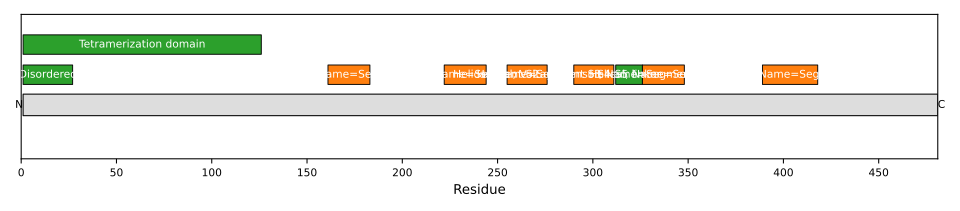
1: Voltage-gated potassium channel that mediates transmembrane potassium transport in excitable membranes, primarily in the brain and the central nervous system, but also in the cardiovascular system. Prevents aberrant action potential firing and regulates neuronal output. Forms tetrameric potassium-selective channels through which potassium ions pass in accordance with their electrochemical gradient. The channel alternates between opened and closed conformations in response to the voltage difference across the membrane (PubMed:11211111, PubMed:19912772, PubMed:23769686, PubMed:8495559). Can form functional homotetrameric channels and heterotetrameric channels that contain variable proportions of KCNA1, KCNA2, KCNA4, KCNA5, KCNA6, KCNA7, and possibly other family members as well; channel properties depend on the type of alpha subunits that are part of the channel (PubMed:20220134, PubMed:8495559). Channel properties are modulated by cytoplasmic beta subunits that regulate the subcellular location of the alpha subunits and promote rapid inactivation of delayed rectifier potassium channels. In vivo, membranes probably contain a mixture of heteromeric potassium channel complexes, making it difficult to assign currents observed in intact tissues to any particular potassium channel family member. Homotetrameric KCNA2 forms a delayed-rectifier potassium channel that opens in response to membrane depolarization, followed by slow spontaneous channel closure (PubMed:19912772, PubMed:23769686). In contrast, a heteromultimer formed by KCNA2 and KCNA4 shows rapid inactivation (PubMed:8495559). Regulates neuronal excitability and plays a role as pacemaker in the regulation of neuronal action potentials (By similarity). KCNA2-containing channels play a presynaptic role and prevent hyperexcitability and aberrant action potential firing (By similarity). Response to toxins that are selective for KCNA2-containing potassium channels suggests that in Purkinje cells, dendritic subthreshold KCNA2-containing potassium channels prevent random spontaneous calcium spikes, suppressing dendritic hyperexcitability without hindering the generation of somatic action potentials, and thereby play an important role in motor coordination (By similarity). Plays a role in the induction of long-term potentiation of neuron excitability in the CA3 layer of the hippocampus (By similarity). May function as down-stream effector for G protein-coupled receptors and inhibit GABAergic inputs to basolateral amygdala neurons (By similarity). May contribute to the regulation of neurotransmitter release, such as gamma-aminobutyric acid (GABA) (By similarity). Contributes to the regulation of the axonal release of the neurotransmitter dopamine (By similarity). Reduced KCNA2 expression plays a role in the perception of neuropathic pain after peripheral nerve injury, but not acute pain (By similarity). Plays a role in the regulation of the time spent in non-rapid eye movement (NREM) sleep (By similarity)