Platelet glycoprotein 4 (Fatty acid translocase) (FAT) (Glycoprotein IIIb) (GPIIIB) (Leukocyte differentiation antigen CD36) (PAS IV) (PAS-4) (Platelet collagen receptor) (Platelet glycoprotein IV) (GPIV) (Thrombospondin receptor) (CD antigen CD36)
1_MGCDR 6_ NCGLI 11_ AGAVI 16_ GAVLA 21_ VFGGI 26_ LMPVG 31_ DLLIQ 36_ KTIKK 41_ QVVLE 46_ EGTIA 51_ FKNWV 56_ KTGTE 61_ VYRQF 66_ WIFDV 71_ QNPQE 76_ VMMNS 81_ SNIQV 86_ KQRGP 91_ YTYRV 96_ RFLAK 101_ ENVTQ 106_ DAEDN 111_ TVSFL 116_ QPNGA 121_ IFEPS 126_ LSVGT 131_ EADNF 136_ TVLNL 141_ AVAAA 146_ SHIYQ 151_ NQFVQ 156_ MILNS 161_ LINKS 166_ KSSMF 171_ QVRTL 176_ RELLW 181_ GYRDP 186_ FLSLV 191_ PYPVT 196_ TTVGL 201_ FYPYN 206_ NTADG 211_ VYKVF 216_ NGKDN 221_ ISKVA 226_ IIDTY 231_ KGKRN 236_ LSYWE 241_ SHCDM 246_ INGTD 251_ AASFP 256_ PFVEK 261_ SQVLQ 266_ FFSSD 271_ ICRSI 276_ YAVFE 281_ SDVNL 286_ KGIPV 291_ YRFVL 296_ PSKAF 301_ ASPVE 306_ NPDNY 311_ CFCTE 316_ KIISK 321_ NCTSY 326_ GVLDI 331_ SKCKE 336_ GRPVY 341_ ISLPH 346_ FLYAS 351_ PDVSE 356_ PIDGL 361_ NPNEE 366_ EHRTY 371_ LDIEP 376_ ITGFT 381_ LQFAK 386_ RLQVN 391_ LLVKP 396_ SEKIQ 401_ VLKNL 406_ KRNYI 411_ VPILW 416_ LNETG 421_ TIGDE 426_ KANMF 431_ RSQVT 436_ GKINL 441_ LGLIE 446_ MILLS 451_ VGVVM 456_ FVAFM 461_ ISYCA 466_CRSKT
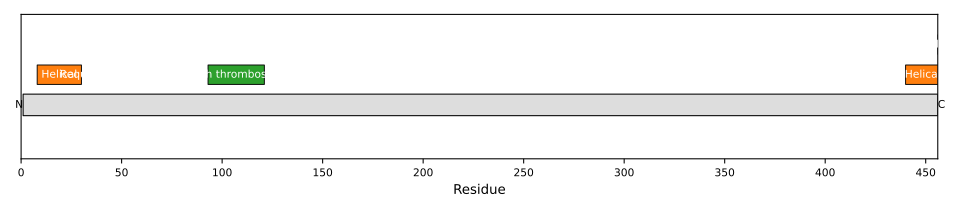
1: Multifunctional glycoprotein that acts as a receptor for a broad range of ligands. Ligands can be of proteinaceous nature like thrombospondin, fibronectin, collagen or amyloid-beta as well as of lipidic nature such as oxidized low-density lipoprotein (oxLDL), anionic phospholipids, long-chain fatty acids and bacterial diacylated lipopeptides. They are generally multivalent and can therefore engage multiple receptors simultaneously, the resulting formation of CD36 clusters initiates signal transduction and internalization of receptor-ligand complexes. The dependency on coreceptor signaling is strongly ligand specific. Cellular responses to these ligands are involved in angiogenesis, inflammatory response, fatty acid metabolism, taste and dietary fat processing in the intestine (Probable). Binds long-chain fatty acids and facilitates their transport into cells, thus participating in muscle lipid utilization, adipose energy storage, and gut fat absorption (By similarity) (PubMed:18353783, PubMed:21610069). Mechanistically, binding of fatty acids activates downstream kinase LYN, which phosphorylates the palmitoyltransferase ZDHHC5 and inactivates it, resulting in the subsequent depalmitoylation of CD36 and caveolar endocytosis (PubMed:32958780). In the small intestine, plays a role in proximal absorption of dietary fatty acid and cholesterol for optimal chylomicron formation, possibly through the activation of MAPK1/3 (ERK1/2) signaling pathway (By similarity) (PubMed:18753675). Involved in oral fat perception and preferences (PubMed:22240721, PubMed:25822988). Detection into the tongue of long-chain fatty acids leads to a rapid and sustained rise in flux and protein content of pancreatobiliary secretions (By similarity). In taste receptor cells, mediates the induction of an increase in intracellular calcium levels by long-chain fatty acids, leading to the activation of the gustatory neurons in the nucleus of the solitary tract (By similarity). Important factor in both ventromedial hypothalamus neuronal sensing of long-chain fatty acid and the regulation of energy and glucose homeostasis (By similarity). Receptor for thrombospondins, THBS1 and THBS2, mediating their antiangiogenic effects (By similarity). Involved in inducing apoptosis in podocytes in response to elevated free fatty acids, acting together with THBS1 (By similarity). As a coreceptor for TLR4:TLR6 heterodimer, promotes inflammation in monocytes/macrophages. Upon ligand binding, such as oxLDL or amyloid-beta 42, interacts with the heterodimer TLR4:TLR6, the complex is internalized and triggers inflammatory response, leading to NF-kappa-B-dependent production of CXCL1, CXCL2 and CCL9 cytokines, via MYD88 signaling pathway, and CCL5 cytokine, via TICAM1 signaling pathway, as well as IL1B secretion, through the priming and activation of the NLRP3 inflammasome (By similarity) (PubMed:20037584). Selective and nonredundant sensor of microbial diacylated lipopeptide that signal via TLR2:TLR6 heterodimer, this cluster triggers signaling from the cell surface, leading to the NF-kappa-B-dependent production of TNF, via MYD88 signaling pathway and subsequently is targeted to the Golgi in a lipid-raft dependent pathway (By similarity) (PubMed:16880211)
2: (Microbial infection) Directly mediates cytoadherence of Plasmodium falciparum parasitized erythrocytes and the internalization of particles independently of TLR signaling