Protein kinase C alpha type (PKC-A) (PKC-alpha) (EC 2.7.11.13)
1_MADVF 6_ PGNDS 11_ TASQD 16_ VANRF 21_ ARKGA 26_ LRQKN 31_ VHEVK 36_ DHKFI 41_ ARFFK 46_ QPTFC 51_ SHCTD 56_ FIWGF 61_ GKQGF 66_ QCQVC 71_ CFVVH 76_ KRCHE 81_ FVTFS 86_ CPGAD 91_ KGPDT 96_ DDPRS 101_ KHKFK 106_ IHTYG 111_ SPTFC 116_ DHCGS 121_ LLYGL 126_ IHQGM 131_ KCDTC 136_ DMNVH 141_ KQCVI 146_ NVPSL 151_ CGMDH 156_ TEKRG 161_ RIYLK 166_ AEVAD 171_ EKLHV 176_ TVRDA 181_ KNLIP 186_ MDPNG 191_ LSDPY 196_ VKLKL 201_ IPDPK 206_ NESKQ 211_ KTKTI 216_ RSTLN 221_ PQWNE 226_ SFTFK 231_ LKPSD 236_ KDRRL 241_ SVEIW 246_ DWDRT 251_ TRNDF 256_ MGSLS 261_ FGVSE 266_ LMKMP 271_ ASGWY 276_ KLLNQ 281_ EEGEY 286_ YNVPI 291_ PEGDE 296_ EGNME 301_ LRQKF 306_ EKAKL 311_ GPAGN 316_ KVISP 321_ SEDRK 326_ QPSNN 331_ LDRVK 336_ LTDFN 341_ FLMVL 346_ GKGSF 351_ GKVML 356_ ADRKG 361_ TEELY 366_ AIKIL 371_ KKDVV 376_ IQDDD 381_ VECTM 386_ VEKRV 391_ LALLD 396_ KPPFL 401_ TQLHS 406_ CFQTV 411_ DRLYF 416_ VMEYV 421_ NGGDL 426_ MYHIQ 431_ QVGKF 436_ KEPQA 441_ VFYAA 446_ EISIG 451_ LFFLH 456_ KRGII 461_ YRDLK 466_ LDNVM 471_ LDSEG 476_ HIKIA 481_ DFGMC 486_ KEHMM 491_ DGVTT 496_ RTFCG 501_ TPDYI 506_ APEII 511_ AYQPY 516_ GKSVD 521_ WWAYG 526_ VLLYE 531_ MLAGQ 536_ PPFDG 541_ EDEDE 546_ LFQSI 551_ MEHNV 556_ SYPKS 561_ LSKEA 566_ VSVCK 571_ GLMTK 576_ HPAKR 581_ LGCGP 586_ EGERD 591_ VREHA 596_ FFRRI 601_ DWEKL 606_ ENREI 611_ QPPFK 616_ PKVCG 621_ KGAEN 626_ FDKFF 631_ TRGQP 636_ VLTPP 641_ DQLVI 646_ ANIDQ 651_ SDFEG 656_ FSYVN 661_ PQFVH 666_PILQS
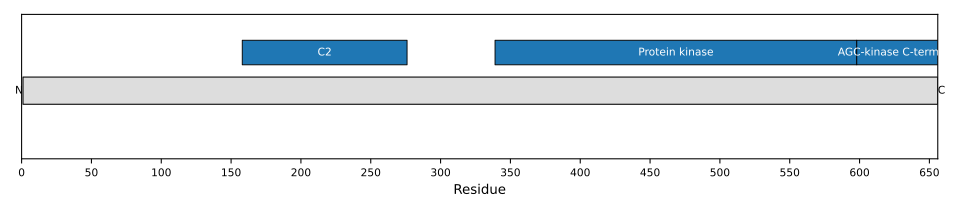
1: Calcium-activated, phospholipid- and diacylglycerol (DAG)-dependent serine/threonine-protein kinase that is involved in positive and negative regulation of cell proliferation, apoptosis, differentiation, migration and adhesion, tumorigenesis, cardiac hypertrophy, angiogenesis, platelet function and inflammation, by directly phosphorylating targets such as RAF1, BCL2, CSPG4, TNNT2/CTNT, or activating signaling cascade involving MAPK1/3 (ERK1/2) and RAP1GAP. Involved in cell proliferation and cell growth arrest by positive and negative regulation of the cell cycle. Can promote cell growth by phosphorylating and activating RAF1, which mediates the activation of the MAPK/ERK signaling cascade, and/or by up-regulating CDKN1A, which facilitates active cyclin-dependent kinase (CDK) complex formation in glioma cells. In intestinal cells stimulated by the phorbol ester PMA, can trigger a cell cycle arrest program which is associated with the accumulation of the hyper-phosphorylated growth-suppressive form of RB1 and induction of the CDK inhibitors CDKN1A and CDKN1B. Exhibits anti-apoptotic function in glioma cells and protects them from apoptosis by suppressing the p53/TP53-mediated activation of IGFBP3, and in leukemia cells mediates anti-apoptotic action by phosphorylating BCL2. During macrophage differentiation induced by macrophage colony-stimulating factor (CSF1), is translocated to the nucleus and is associated with macrophage development. After wounding, translocates from focal contacts to lamellipodia and participates in the modulation of desmosomal adhesion. Plays a role in cell motility by phosphorylating CSPG4, which induces association of CSPG4 with extensive lamellipodia at the cell periphery and polarization of the cell accompanied by increases in cell motility. During chemokine-induced CD4(+) T cell migration, phosphorylates CDC42-guanine exchange factor DOCK8 resulting in its dissociation from LRCH1 and the activation of GTPase CDC42 (PubMed:28028151). Is highly expressed in a number of cancer cells where it can act as a tumor promoter and is implicated in malignant phenotypes of several tumors such as gliomas and breast cancers. Negatively regulates myocardial contractility and positively regulates angiogenesis, platelet aggregation and thrombus formation in arteries. Mediates hypertrophic growth of neonatal cardiomyocytes, in part through a MAPK1/3 (ERK1/2)-dependent signaling pathway, and upon PMA treatment, is required to induce cardiomyocyte hypertrophy up to heart failure and death, by increasing protein synthesis, protein-DNA ratio and cell surface area. Regulates cardiomyocyte function by phosphorylating cardiac troponin T (TNNT2/CTNT), which induces significant reduction in actomyosin ATPase activity, myofilament calcium sensitivity and myocardial contractility. In angiogenesis, is required for full endothelial cell migration, adhesion to vitronectin (VTN), and vascular endothelial growth factor A (VEGFA)-dependent regulation of kinase activation and vascular tube formation. Involved in the stabilization of VEGFA mRNA at post-transcriptional level and mediates VEGFA-induced cell proliferation. In the regulation of calcium-induced platelet aggregation, mediates signals from the CD36/GP4 receptor for granule release, and activates the integrin heterodimer ITGA2B-ITGB3 through the RAP1GAP pathway for adhesion. During response to lipopolysaccharides (LPS), may regulate selective LPS-induced macrophage functions involved in host defense and inflammation. But in some inflammatory responses, may negatively regulate NF-kappa-B-induced genes, through IL1A-dependent induction of NF-kappa-B inhibitor alpha (NFKBIA/IKBA). Upon stimulation with 12-O-tetradecanoylphorbol-13-acetate (TPA), phosphorylates EIF4G1, which modulates EIF4G1 binding to MKNK1 and may be involved in the regulation of EIF4E phosphorylation. Phosphorylates KIT, leading to inhibition of KIT activity. Phosphorylates ATF2 which promotes cooperation between ATF2 and JUN, activating transcription. Phosphorylates SOCS2 at 'Ser-52' facilitating its ubiquitination and proteasomal degradation (By similarity). Phosphorylates KLHL3 in response to angiotensin II signaling, decreasing the interaction between KLHL3 and WNK4 (PubMed:25313067). Phosphorylates and activates LRRK1, which phosphorylates RAB proteins involved in intracellular trafficking (PubMed:36040231)