Sphingomyelin phosphodiesterase (EC 3.1.4.12) (EC 3.1.4.3) (Acid sphingomyelinase) (aSMase)
1_MPRYG 6_ ASLRQ 11_ SCPRS 16_ GREQG 21_ QDGTA 26_ GAPGL 31_ LWMGL 36_ VLALA 41_ LALAL 46_ ALALS 51_ DSRVL 56_ WAPAE 61_ AHPLS 66_ PQGHP 71_ ARLHR 76_ IVPRL 81_ RDVFG 86_ WGNLT 91_ CPICK 96_ GLFTA 101_ INLGL 106_ KKEPN 111_ VARVG 116_ SVAIK 121_ LCNLL 126_ KIAPP 131_ AVCQS 136_ IVHLF 141_ EDDMV 146_ EVWRR 151_ SVLSP 156_ SEACG 161_ LLLGS 166_ TCGHW 171_ DIFSS 176_ WNISL 181_ PTVPK 186_ PPPKP 191_ PSPPA 196_ PGAPV 201_ SRILF 206_ LTDLH 211_ WDHDY 216_ LEGTD 221_ PDCAD 226_ PLCCR 231_ RGSGL 236_ PPASR 241_ PGAGY 246_ WGEYS 251_ KCDLP 256_ LRTLE 261_ SLLSG 266_ LGPAG 271_ PFDMV 276_ YWTGD 281_ IPAHD 286_ VWHQT 291_ RQDQL 296_ RALTT 301_ VTALV 306_ RKFLG 311_ PVPVY 316_ PAVGN 321_ HESTP 326_ VNSFP 331_ PPFIE 336_ GNHSS 341_ RWLYE 346_ AMAKA 351_ WEPWL 356_ PAEAL 361_ RTLRI 366_ GGFYA 371_ LSPYP 376_ GLRLI 381_ SLNMN 386_ FCSRE 391_ NFWLL 396_ INSTD 401_ PAGQL 406_ QWLVG 411_ ELQAA 416_ EDRGD 421_ KVHII 426_ GHIPP 431_ GHCLK 436_ SWSWN 441_ YYRIV 446_ ARYEN 451_ TLAAQ 456_ FFGHT 461_ HVDEF 466_ EVFYD 471_ EETLS 476_ RPLAV 481_ AFLAP 486_ SATTY 491_ IGLNP 496_ GYRVY 501_ QIDGN 506_ YSGSS 511_ HVVLD 516_ HETYI 521_ LNLTQ 526_ ANIPG 531_ AIPHW 536_ QLLYR 541_ ARETY 546_ GLPNT 551_ LPTAW 556_ HNLVY 561_ RMRGD 566_ MQLFQ 571_ TFWFL 576_ YHKGH 581_ PPSEP 586_ CGTPC 591_ RLATL 596_ CAQLS 601_ ARADS 606_ PALCR 611_ HLMPD 616_ GSLPE 621_ AQSLW 626_PRPLF
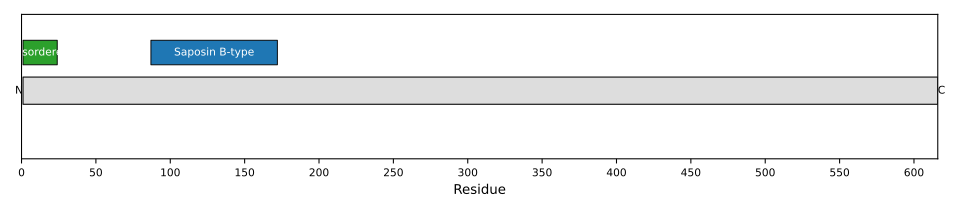
1: Converts sphingomyelin to ceramide (PubMed:12563314, PubMed:1840600, PubMed:18815062, PubMed:25339683, PubMed:25920558, PubMed:27659707, PubMed:33163980). Exists as two enzymatic forms that arise from alternative trafficking of a single protein precursor, one that is targeted to the endolysosomal compartment, whereas the other is released extracellularly (PubMed:20807762, PubMed:21098024, PubMed:9660788). However, in response to various forms of stress, lysosomal exocytosis may represent a major source of the secretory form (PubMed:12563314, PubMed:20530211, PubMed:20807762, PubMed:22573858, PubMed:9393854)
2: In the lysosomes, converts sphingomyelin to ceramide (PubMed:20807762, PubMed:21098024). Plays an important role in the export of cholesterol from the intraendolysosomal membranes (PubMed:25339683). Also has phospholipase C activities toward 1,2-diacylglycerolphosphocholine and 1,2-diacylglycerolphosphoglycerol (PubMed:25339683). Modulates stress-induced apoptosis through the production of ceramide (PubMed:8706124)
3: When secreted, modulates cell signaling with its ability to reorganize the plasma membrane by converting sphingomyelin to ceramide (PubMed:12563314, PubMed:17303575, PubMed:20807762). Secreted form is increased in response to stress and inflammatory mediators such as IL1B, IFNG or TNF as well as upon infection with bacteria and viruses (PubMed:12563314, PubMed:20807762, PubMed:9393854). Produces the release of ceramide in the outer leaflet of the plasma membrane playing a central role in host defense (PubMed:12563314, PubMed:20807762, PubMed:9393854). Ceramide reorganizes these rafts into larger signaling platforms that are required to internalize P.aeruginosa, induce apoptosis and regulate the cytokine response in infected cells (PubMed:12563314). In wounded cells, the lysosomal form is released extracellularly in the presence of Ca(2+) and promotes endocytosis and plasma membrane repair (PubMed:20530211)
4: This form is generated following cleavage by CASP7 in the extracellular milieu in response to bacterial infection (PubMed:21157428). It shows increased ability to convert sphingomyelin to ceramide and promotes plasma membrane repair (By similarity). Plasma membrane repair by ceramide counteracts the action of gasdermin-D (GSDMD) perforin (PRF1) pores that are formed in response to bacterial infection (By similarity)
5: (Microbial infection) Secretion is activated by bacteria such as P.aeruginosa, N.gonorrhoeae and others, this activation results in the release of ceramide in the outer leaflet of the plasma membrane which facilitates the infection
6: (Microbial infection) Secretion is activated by human coronaviruses SARS-CoV and SARS-CoV-2 as well as Zaire ebolavirus, this activation results in the release of ceramide in the outer leaflet of the plasma membrane which facilitates the infection
7: Lacks residues that bind the cofactor Zn(2+) and has no enzyme activity
8: Lacks residues that bind the cofactor Zn(2+) and has no enzyme activity