HLA class I histocompatibility antigen, alpha chain G (HLA G antigen) (MHC class I antigen G) [Cleaved into: Soluble HLA class I histocompatibility antigen, alpha chain G (sHLA-G)]
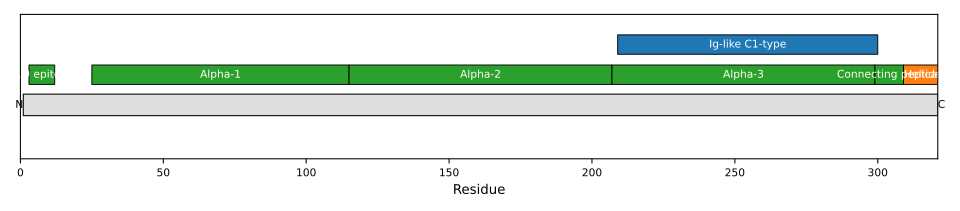
1_MVVMA 6_ PRTLF 11_ LLLSG 16_ ALTLT 21_ ETWAG 26_ SHSMR 31_ YFSAA 36_ VSRPG 41_ RGEPR 46_ FIAMG 51_ YVDDT 56_ QFVRF 61_ DSDSA 66_ CPRME 71_ PRAPW 76_ VEQEG 81_ PEYWE 86_ EETRN 91_ TKAHA 96_ QTDRM 101_ NLQTL 106_ RGYYN 111_ QSEAS 116_ SHTLQ 121_ WMIGC 126_ DLGSD 131_ GRLLR 136_ GYEQY 141_ AYDGK 146_ DYLAL 151_ NEDLR 156_ SWTAA 161_ DTAAQ 166_ ISKRK 171_ CEAAN 176_ VAEQR 181_ RAYLE 186_ GTCVE 191_ WLHRY 196_ LENGK 201_ EMLQR 206_ ADPPK 211_ THVTH 216_ HPVFD 221_ YEATL 226_ RCWAL 231_ GFYPA 236_ EIILT 241_ WQRDG 246_ EDQTQ 251_ DVELV 256_ ETRPA 261_ GDGTF 266_ QKWAA 271_ VVVPS 276_ GEEQR 281_ YTCHV 286_ QHEGL 291_ PEPLM 296_ LRWKQ 301_ SSLPT 306_ IPIMG 311_ IVAGL 316_ VVLAA 321_ VVTGA 326_ AVAAV 331_LWRKK
1: Non-classical major histocompatibility class Ib molecule involved in immune regulatory processes at the maternal-fetal interface (PubMed:19304799, PubMed:23184984, PubMed:29262349). In complex with B2M/beta-2 microglobulin binds a limited repertoire of nonamer self-peptides derived from intracellular proteins including histones and ribosomal proteins (PubMed:7584149, PubMed:8805247). Peptide-bound HLA-G-B2M complex acts as a ligand for inhibitory/activating KIR2DL4, LILRB1 and LILRB2 receptors on uterine immune cells to promote fetal development while maintaining maternal-fetal tolerance (PubMed:16366734, PubMed:19304799, PubMed:20448110, PubMed:23184984, PubMed:27859042, PubMed:29262349). Upon interaction with KIR2DL4 and LILRB1 receptors on decidual NK cells, it triggers NK cell senescence-associated secretory phenotype as a molecular switch to promote vascular remodeling and fetal growth in early pregnancy (PubMed:16366734, PubMed:19304799, PubMed:23184984, PubMed:29262349). Through interaction with KIR2DL4 receptor on decidual macrophages induces pro-inflammatory cytokine production mainly associated with tissue remodeling (PubMed:19304799). Through interaction with LILRB2 receptor triggers differentiation of type 1 regulatory T cells and myeloid-derived suppressor cells, both of which actively maintain maternal-fetal tolerance (PubMed:20448110, PubMed:27859042). May play a role in balancing tolerance and antiviral-immunity at maternal-fetal interface by keeping in check the effector functions of NK, CD8+ T cells and B cells (PubMed:10190900, PubMed:11290782, PubMed:24453251). Reprograms B cells toward an immune suppressive phenotype via LILRB1 (PubMed:24453251). May induce immune activation/suppression via intercellular membrane transfer (trogocytosis), likely enabling interaction with KIR2DL4, which resides mostly in endosomes (PubMed:20179272, PubMed:26460007). Through interaction with the inhibitory receptor CD160 on endothelial cells may control angiogenesis in immune privileged sites (PubMed:16809620)
2: Likely does not bind B2M and presents peptides. Negatively regulates NK cell- and CD8+ T cell-mediated cytotoxicity (PubMed:11290782)
3: Likely does not bind B2M and presents peptides. Negatively regulates NK cell- and CD8+ T cell-mediated cytotoxicity (PubMed:11290782)
4: Likely does not bind B2M and presents peptides. Negatively regulates NK cell- and CD8+ T cell-mediated cytotoxicity (PubMed:11290782)
5: Non-classical major histocompatibility class Ib molecule involved in immune regulatory processes at the maternal-fetal interface (PubMed:19304799, PubMed:23184984, PubMed:29262349). In complex with B2M/beta-2 microglobulin binds a limited repertoire of nonamer self-peptides derived from intracellular proteins including histones and ribosomal proteins (PubMed:7584149, PubMed:8805247). Peptide-bound HLA-G-B2M complex acts as a ligand for inhibitory/activating KIR2DL4, LILRB1 and LILRB2 receptors on uterine immune cells to promote fetal development while maintaining maternal-fetal tolerance (PubMed:16366734, PubMed:19304799, PubMed:20448110, PubMed:23184984, PubMed:29262349). Upon interaction with KIR2DL4 and LILRB1 receptors on decidual NK cells, it triggers NK cell senescence-associated secretory phenotype as a molecular switch to promote vascular remodeling and fetal growth in early pregnancy (PubMed:16366734, PubMed:19304799, PubMed:23184984, PubMed:29262349). Through interaction with KIR2DL4 receptor on decidual macrophages induces pro-inflammatory cytokine production mainly associated with tissue remodeling (PubMed:19304799). Through interaction with LILRB2 receptor triggers differentiation of type 1 regulatory T cells and myeloid-derived suppressor cells, both of which actively maintain maternal-fetal tolerance (PubMed:20448110). Reprograms B cells toward an immune suppressive phenotype via LILRB1 (PubMed:24453251)
6: Likely does not bind B2M and presents peptides
7: Likely does not bind B2M and presents peptides